
Yes - hydrogen peroxide will kill fungus through oxidation, destroying fungal cell membranes, spore structures, and hyphae on contact. At 3% concentration, it is effective on bathroom grout and tile mold, kitchen surface fungus, powdery mildew on plant leaves, soil fungal pathogens, and seed tray damping off. Nature's Freedom 35% H2O2 and 12% H2O2 are both NSF/ANSI/CAN 60 and NSF/ANSI/CAN 50 certified and stabilizer-free - dilute either to 3% for antifungal use. It is not effective on deep-rooted fungal growth inside porous materials such as drywall or unsealed wood.
Will Hydrogen Peroxide Kill Fungus - How Does It Work?
Hydrogen peroxide kills fungus through an oxidative mechanism - it destroys the fungal organism rather than simply bleaching its visible color. According to PubChem (National Institutes of Health), H2O2 has well-documented antimicrobial activity against fungi, bacteria, and viruses. The reactive oxygen it releases attacks the lipid bilayers in fungal cell membranes, disrupts the proteins that regulate cellular function, and breaks down the structural components of fungal spores.
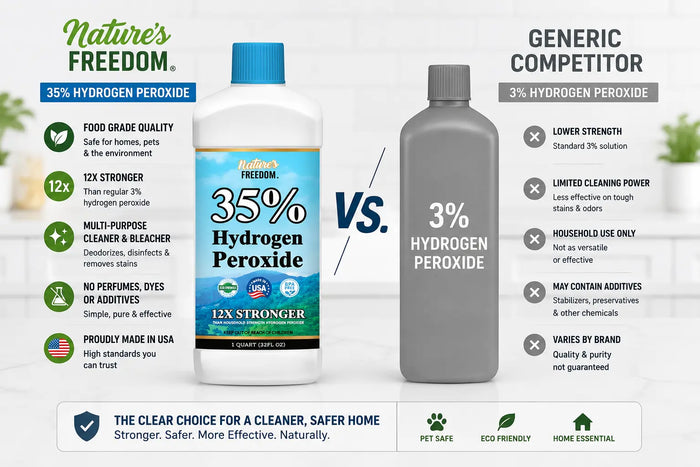
Chlorine bleach primarily bleaches the pigmented compounds that make mold visible - it does not reliably destroy the fungal organism itself, particularly on porous surfaces where the mycelium continues to grow beneath the bleached surface. Hydrogen peroxide oxidizes the fungal structure itself. For food-contact surfaces, it is clearly preferable because it decomposes entirely into water and oxygen with no surface residue. For full dilution ratios from both 35% and 12% H2O2, see the hydrogen peroxide dilution guide.
Does Hydrogen Peroxide Kill Fungus on Household Surfaces?
Yes, at 3% concentration with adequate contact time. The key rule: do not wipe the surface immediately. Allow the minimum contact time for the full oxidation reaction to complete.
Bathroom Tile and Grout
Apply 3% H2O2 directly to affected grout lines, allow 5 to 10 minutes, scrub with a stiff brush, then rinse. For heavy buildup, two treatment sessions 24 hours apart produce better results than a single longer application. For prevention, a weekly spray of 3% H2O2 on shower grout after cleaning - allowed to dry without rinsing - significantly reduces mold recurrence.
Kitchen Surfaces
Spray 3% H2O2 on countertops, backsplash tile, and around sink areas. Allow 30 seconds to 1 minute of contact time and wipe clean. Hydrogen peroxide is ideal for kitchen use because it leaves no chemical residue on food preparation surfaces after decomposition.
Basement Wall Surface Mold
Apply 3% H2O2 spray, allow 10 minutes, scrub with a stiff brush, and allow to dry fully without rinsing. This removes surface fungal growth effectively. Recurring basement mold driven by persistent moisture requires correction of the underlying moisture source for lasting control.
Nature's Freedom 35% H2O2 diluted to 3% produces more than ten spray bottles of antifungal solution from a single 32 fl oz bottle.
Will Hydrogen Peroxide Kill Fungus on Plants and in Soil?
Yes - for fungal diseases affecting plant surfaces and root zones, hydrogen peroxide is one of the most effective chemical-free options. See the full hydrogen peroxide for plants guide for complete application methods including root rot treatment and seed soak protocols. For an overview of concentration safety, see does hydrogen peroxide kill plants. Learn other hydrogen peroxide uses.
Powdery Mildew
Spray 3% H2O2 onto affected leaves in the early morning before direct sun exposure. Sunlight accelerates H2O2 decomposition - morning application allows the solution to remain in contact with the fungal surface longer before it breaks down. Repeat every three days until mildew clears, then weekly as a preventive measure.
Soil Surface Mold and Root Pathogens
Apply 3% H2O2 as a soil drench to the affected root zone, allowing the solution to penetrate to root depth. Repeat every three days for two weeks during active treatment. For ongoing prevention, a weekly 1% maintenance drench keeps the root zone oxygenated and inhospitable to anaerobic pathogens. The EPA Safer Choice program recognizes hydrogen peroxide as an approved active ingredient for cleaning and disinfecting formulations. For soil applications in edible gardens, stabilizer-free NSF-certified H2O2 is the correct choice - conventional peroxide stabilizers accumulate in soil over repeated applications.
Seed Tray Damping Off
Drench the seed tray with a 1% to 3% H2O2 solution before sowing to kill fungal spores in the growing medium. For seedlings already showing early damping off, a 3% drench applied to the soil around the base of affected seedlings can stop spread to neighboring plants.
How Long Does Hydrogen Peroxide Take to Kill Fungus?
|
Application |
Conc. |
Contact Time |
Method |
Effectiveness |
|
Bathroom tile and grout mold |
3% |
5-10 min |
Spray, scrub, rinse |
Excellent |
|
Shower caulk mildew |
3% |
10 min |
Apply with brush, rinse |
Good |
|
Kitchen surface mold |
3% |
30 sec-1 min |
Spray and wipe |
Excellent |
|
Basement wall surface mold |
3% |
10 min |
Spray, scrub, dry |
Good (surface only) |
|
Powdery mildew on plants |
3% |
5 min |
Morning foliar spray |
Good |
|
Root zone fungal pathogens |
3% |
Soil drench |
Water through root zone |
Good |
|
Seed tray damping off |
1-3% |
Pre-treatment |
Drench soil before sowing |
Good |
|
Deep porous material mold |
3% |
Multiple |
Not fully effective |
Limited |
Where Does Hydrogen Peroxide Not Work on Fungus?
Deep porous materials: Drywall, unfinished wood, ceiling tiles, carpet, and insulation with fungal growth that has penetrated below the surface are not suitable candidates. H2O2 is a contact agent - it destroys what it physically reaches. Material replacement or professional remediation is the appropriate response.
Large-scale or structural infestations: For mold covering more than approximately 10 square feet, or any situation involving structural building materials, professional remediation is required.
Fungal infections inside plant tissue: When fungal disease has moved inside leaves or into vascular tissue, surface H2O2 application cannot reach the organisms. Remove and dispose of affected plant material to prevent spread.
For descaling and deodorizing where mineral deposits accompany fungal growth, Nature's Freedom 45% concentrated vinegar handles the mineral and organic buildup that hydrogen peroxide cannot dissolve. See is 45% vinegar safe for guidance on concentrated vinegar around household surfaces.
Why Is NSF-Certified H2O2 the Most Reliable Antifungal Option?
Antifungal effectiveness depends on accurate concentration. Drugstore 3% H2O2 degrades over time after opening - a partially degraded bottle that is actually 1.5% produces weaker results with no visible indication the concentration has dropped. It also contains stabilizers that interfere with the oxidation reaction at low concentrations. The CDC NIOSH Pocket Guide recognizes hydrogen peroxide as a broad-spectrum antimicrobial effective against fungi, bacteria, and viruses. NSF certification provides independent verification that it performs as labeled.
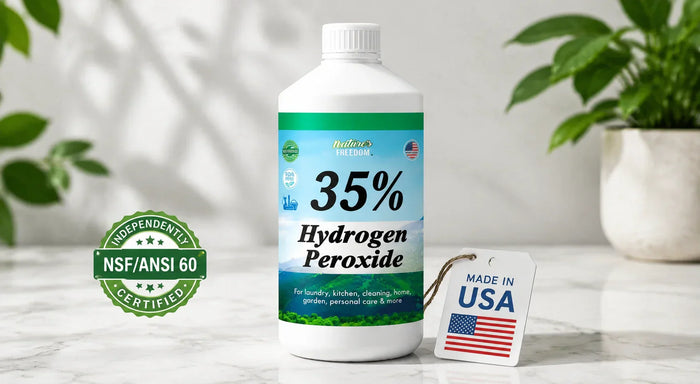
Nature's Freedom 35% H2O2 and 12% H2O2 are both NSF/ANSI/CAN 60 and NSF/ANSI/CAN 50 certified - independently verified concentration, no stabilizers, no residue on treated surfaces after decomposition. The 12% option simplifies the math: mix 1 part 12% H2O2 with 3 parts water to reach 3%, versus 10.7 parts water for 35%. Learn more about why Nature's Freedom holds these certifications. See also what is food grade hydrogen peroxide for a full breakdown of grades and stabilizer differences.
- No stabilizer residue on treated surfaces - clean decomposition into water and oxygen only
- Independently verified 35% and 12% concentration - dilution to 3% produces full-strength antifungal solution every time
- Manufactured in the USA under NSF-audited conditions
Nature's Freedom 35% hydrogen peroxide is NSF Certified to NSF/ANSI/CAN 60 for drinking water treatment chemicals and NSF/ANSI/CAN 50 for pool, spa, hot tub, and other recreational water treatment chemical use.
Kill Fungus. Leave Nothing Behind.
Nature's Freedom 35% H2O2 is NSF/ANSI/CAN 60 and NSF/ANSI/CAN 50 certified, stabilizer-free, and made in the USA. It kills fungus on every accessible surface and decomposes into water and oxygen with no residue.
Shop concentrated hydrogen peroxide | Browse the full collection | Contact Nature's Freedom
Frequently Asked Questions
1. Will hydrogen peroxide kill fungus?
Yes. At 3% concentration, hydrogen peroxide kills fungus through oxidation - destroying fungal cell membranes and spores on contact. It is effective on bathroom grout mold, kitchen surface fungus, powdery mildew, soil fungal pathogens, and seed tray damping off. It is not effective on deep-seated fungal growth inside porous materials.
2. How long does hydrogen peroxide take to kill fungus?
Bathroom tile and grout require 5 to 10 minutes minimum. Kitchen surfaces require 30 seconds to 1 minute. Plant leaf powdery mildew needs 5 minutes of undisturbed contact. Soil fungal pathogens require a full drench repeated every 3 days. The critical rule: do not wipe the surface immediately - allow the minimum contact time for the full oxidation reaction to complete.
3. Does hydrogen peroxide kill fungus better than bleach?
For most non-porous surfaces, hydrogen peroxide produces comparable or better kill rates and leaves no chemical residue after decomposition. Bleach bleaches fungal discoloration without necessarily killing the organism at root depth, particularly on grout. Hydrogen peroxide oxidizes the fungal structure itself - for kitchen and food-contact surfaces, it is clearly preferable.
4. Will hydrogen peroxide kill fungus in soil?
Yes. A 3% H2O2 soil drench kills soil-dwelling fungal organisms including Pythium and Phytophthora species that cause root rot and damping off. Repeat every three days for two weeks during active treatment. The oxygen released by H2O2 decomposition also improves root zone aeration, making the soil less hospitable to anaerobic pathogens long after the active H2O2 has decomposed.
5. Why is NSF-certified hydrogen peroxide better for antifungal use?
NSF certification independently verifies the product meets its stated concentration and contains no stabilizers. Drugstore 3% H2O2 degrades over time and contains stabilizers that can interfere with the oxidation reaction. Starting from Nature's Freedom NSF-certified 35% H2O2 or 12% H2O2 ensures your diluted 3% solution performs at full labeled strength, with no residue on treated surfaces after decomposition.
Key Takeaways
- Hydrogen peroxide kills fungus through oxidation - it destroys fungal cell membranes and spores on contact rather than simply bleaching their color.
- 3% concentration is effective for bathroom grout mold, kitchen surface fungus, powdery mildew, soil pathogens, and seed tray damping off. Allow 5 to 10 minutes minimum contact time before wiping or rinsing.
- Hydrogen peroxide is not effective on deep-seated fungal growth inside porous materials such as drywall, unfinished wood, or carpet - material removal or professional remediation is needed.
- For plant fungal applications, spray 3% H2O2 in the early morning to maximize contact time before sunlight accelerates decomposition.
- Unlike bleach, hydrogen peroxide kills the fungal organism itself and decomposes into water and oxygen with no surface residue.
- Nature's Freedom 35% H2O2 and 12% H2O2 are both NSF Certified to NSF/ANSI/CAN 60 and NSF/ANSI/CAN 50 - stabilizer-free. One 32 fl oz bottle of 35% dilutes into more than ten spray bottles of 3% antifungal solution at independently verified full-strength concentration.