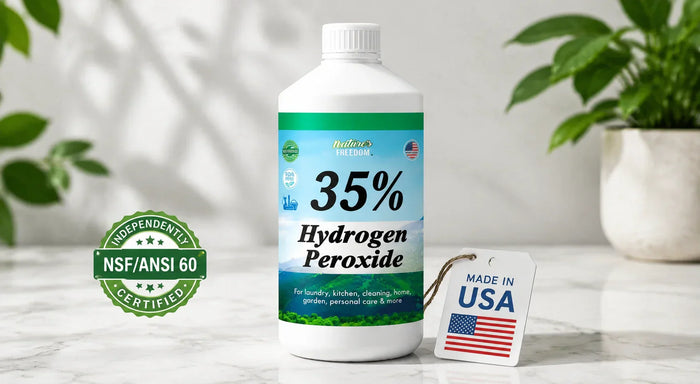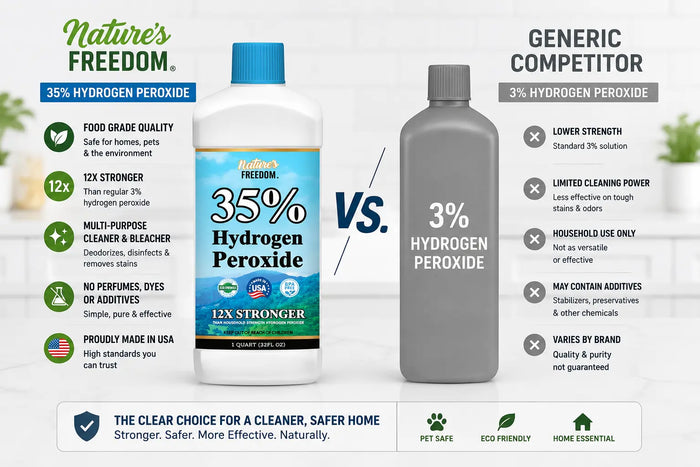

Hydrogen peroxide for plants is safe and effective at concentrations between 0.5% and 3%. It treats root rot, oxygenates compacted soil, controls fungal pathogens, improves seed germination, and disinfects garden tools without leaving chemical residue in the growing medium. Nature's Freedom offers NSF-certified 35% H2O2 and 12% H2O2 - both stabilizer-free, both NSF/ANSI/CAN 60 and NSF/ANSI/CAN 50 certified, and both safe for edible plants and produce gardens when diluted correctly. Use 0.5%-1% for routine watering and root-zone oxygenation, and 3% for root rot treatment, soil sterilization, and fungal control.
What Does Hydrogen Peroxide for Plants Do?
Hydrogen peroxide benefits plants through four mechanisms. According to PubChem (National Institutes of Health), H2O2 has well-documented antimicrobial activity against bacteria, viruses, and fungi - and decomposes into water and oxygen with no chemical residue. See what is food grade hydrogen peroxide for a full breakdown of grades and why stabilizer-free H2O2 matters for edible plants.
- Oxygen delivery to the root zone: Overwatered or compacted soil becomes oxygen-depleted, stressing roots and inviting pathogens. H2O2 releases reactive oxygen directly into the root zone, restoring aerobic conditions.
- Pathogen elimination: At low concentrations, H2O2 targets anaerobic pathogens responsible for root rot - primarily Pythium and Phytophthora - without harming beneficial aerobic soil organisms.
- Pre-plant soil sterilization: A 3% drench applied 24 hours before sowing kills fungal spores, harmful bacteria, and pest eggs without leaving residue. The soil is ready for planting after the decomposition period.
- Clean decomposition: After the oxidation reaction is complete, only water and oxygen remain - no chemical accumulation in soil over repeated applications.
How Do You Treat Root Rot with Hydrogen Peroxide?
Hydrogen peroxide treats root rot by killing anaerobic pathogens and re-oxygenating the depleted root zone simultaneously. The CDC NIOSH Pocket Guide confirms H2O2's broad-spectrum antimicrobial effectiveness - the same mechanism that works in the laundry room works at the root zone.
Diagnosing Root Rot
- Wilting despite moist soil - roots cannot absorb water even when available
- Yellowing lower leaves with no other clear cause
- Black, brown, or mushy roots when the plant is removed from its container
- Foul or sour smell from the soil
Root Rot Treatment Protocol (HowTo)
1. Remove the plant from its container and gently rinse the roots with clean water.
2. Trim all visibly rotted roots - black, brown, or mushy sections - with sterilized scissors. Cut back to firm, white root tissue.
3. Prepare a 3% solution: mix 1 part 35% H2O2 with 10.7 parts water. From 12% H2O2, mix 1 part with 3 parts water to reach 3%.
4. Soak the trimmed roots in the 3% solution for 10 to 15 minutes.
5. Allow roots to air dry for 20 to 30 minutes before repotting into fresh, well-draining soil.
6. Water the repotted plant with a 3% H2O2 solution as the first watering, then transition to 1% for weekly watering over the following two weeks.
7. Ensure the new container provides adequate drainage to prevent recurrence.
For in-ground plants or raised beds showing signs of root rot, apply a 3% H2O2 soil drench directly to the affected area. Water until the solution reaches the root zone and repeat every three days for two weeks. Learn other hydrogen peroxide uses.
How Do You Water Plants with Hydrogen Peroxide?
Adding hydrogen peroxide to watering water is one of the most effective ongoing plant care practices for container plants, seedlings, and hydroponic systems. Full dilution ratios for every concentration are available in the dilution guide.
Standard Watering Solution
Dilute to 1%: mix 1 part 35% H2O2 with 34 parts water, or 1 part 12% H2O2 with 11 parts water. Use as your normal watering solution once per week. For sensitive plants or seedlings, reduce to 0.5% (1 part 35% H2O2 to 69 parts water) until established.
Hydroponic Systems
In hydroponic reservoirs, a 1% H2O2 solution maintains dissolved oxygen levels and prevents bacterial biofilm buildup that clogs reservoir walls and root systems. Add H2O2 weekly and replace the full reservoir solution every two weeks. Monitor dissolved oxygen with a standard DO meter.
Does Hydrogen Peroxide Improve Seed Germination?
Yes. Soaking seeds in a dilute hydrogen peroxide solution before planting improves germination rates by softening the seed coat, killing surface pathogens that cause seed rot, and delivering extra oxygen to the embryo during the critical first hours of germination.
Seed Soak Method (HowTo)
1. Prepare a 1% solution: mix 1 part 35% H2O2 with 34 parts water.
2. Place seeds in a small container and pour enough solution to fully submerge them.
3. Soak for 30 minutes. Do not exceed 60 minutes - extended soaking begins to affect seed viability on some species.
4. Remove seeds and rinse thoroughly with clean water.
5. Plant immediately or allow seeds to surface-dry for 10 to 15 minutes before sowing.
This method is particularly effective for seeds with hard or thick coats - tomatoes, peppers, cucumbers, and brassicas - where the softening effect measurably reduces germination time.
What Concentrations of Hydrogen Peroxide Are Safe for Plants?
Concentration is the most important factor in hydrogen peroxide plant applications. Too low produces no benefit. Too high causes oxidative stress to plant tissue.
|
Concentration |
Dilution from 35% |
Plant Application |
Frequency |
|
0.5% |
1 part + 69 parts water |
Seedling watering, sensitive roots |
Once per week max |
|
1% |
1 part + 34 parts water |
Regular watering, root oxygenation |
Once per week |
|
3% |
1 part + 10.7 parts water |
Root rot, soil drench, fungus control |
Every 3-4 days (treatment) |
|
6% |
1 part + 4.8 parts water |
Severe root rot, tool disinfecting |
Treatment only |
From 12% H2O2: to reach 1%, mix 1 part 12% H2O2 with 11 parts water. To reach 3%, mix 1 part with 3 parts water. Both Nature's Freedom 35% and 12% H2O2 are NSF/ANSI/CAN 60 and NSF/ANSI/CAN 50 certified - no stabilizers, no residue accumulation in soil.
|
Application |
Conc. |
Method |
Notes |
|
Root rot treatment |
3% |
Soil drench until runoff |
Repeat every 3 days, 2 weeks |
|
Regular watering boost |
1% |
Use as normal watering solution |
Once per week maximum |
|
Seed germination soak |
1% |
Soak seeds 30 min before planting |
Rinse seeds after soaking |
|
Foliar fungus spray |
3% |
Spray leaves in early morning |
Avoid midday sun |
|
Soil sterilization |
3% |
Drench soil before planting |
Allow 24 hrs before sowing |
|
Garden tool disinfecting |
3%-6% |
Wipe or soak tool surfaces |
Rinse and dry after treatment |
|
Hydroponic reservoir |
1% |
Add to reservoir water weekly |
Replace reservoir every 2 weeks |
Never apply undiluted or partially diluted 35% H2O2 to plants, soil, or roots. At full concentration, it causes immediate chemical burns on plant tissue. Always dilute to the target concentration before any plant contact.
How Do You Use Hydrogen Peroxide for Plants Outdoors?
Garden Beds and Raised Beds
For established garden beds showing signs of fungal disease or soil compaction, apply a 3% H2O2 solution as a targeted drench to affected areas. Use 1% for ongoing maintenance around established plantings, not more than once per week.
Garden Tool Disinfecting
Wipe tool surfaces with 3% H2O2 between uses when working with plants showing disease symptoms. For heavily contaminated tools, soak in a 6% H2O2 solution for 10 minutes, then rinse and dry.
Weed Control
For weed control in pathways and non-planting areas, Nature's Freedom 45% concentrated vinegar is more effective than hydrogen peroxide as a contact herbicide. See the vinegar weed killer recipe for application ratios. H2O2 is a soil and root health tool, not a reliable weed killer - use each product for what it does best.
For outdoor pet areas adjacent to garden beds where dog urine is damaging grass and soil, see how to get rid of dog urine smell in the backyard - or browse Nature's Freedom Outdoor Pet Odor Eliminator for large outdoor surface applications.
Why Is NSF-Certified H2O2 the Safest Option for Plants?
For edible plants, produce gardens, and any growing system where the harvest is consumed, stabilizer-free hydrogen peroxide is not optional - it is the correct choice. Drugstore 3% hydrogen peroxide contains stabilizers including acetanilide and phenol. Applied to soil repeatedly, those stabilizers accumulate in the growing medium and can be taken up through roots into plant tissue. The EPA Safer Choice program recognizes hydrogen peroxide as an approved active ingredient for safer cleaning formulations, citing its clean decomposition profile.
Nature's Freedom 35% H2O2 and 12% H2O2 are both NSF/ANSI/CAN 60 and NSF/ANSI/CAN 50 certified, verified to contain no stabilizers and to meet their stated concentrations. Applied to soil or plant roots, only H2O2 and water enter the system. After decomposition, only oxygen and water remain. Learn more about why Nature's Freedom holds these certifications.
- No stabilizer residue accumulating in soil or taken up by plant roots over repeated applications
- Independently verified concentration - dilution ratios produce accurate results every time
- Safe for food contact surface sanitation at correct dilution - safe for produce and edible plants
- Manufactured in the USA under NSF-audited conditions
Nature's Freedom 35% hydrogen peroxide is NSF Certified to NSF/ANSI/CAN 60 for drinking water treatment chemicals and NSF/ANSI/CAN 50 for pool, spa, hot tub, and other recreational water treatment chemical use.
Healthier Roots Start with the Right Source
Nature's Freedom 35% H2O2 is NSF/ANSI/CAN 60 and NSF/ANSI/CAN 50 certified, stabilizer-free, and made in the USA - safe for edible plants, produce gardens, and hydroponic systems. One bottle covers root rot treatment, ongoing soil health, seed germination, and more.
Shop concentrated hydrogen peroxide | Browse the full collection | Contact Nature's Freedom
Frequently Asked Questions
1. Is hydrogen peroxide safe for plants?
Yes, at the correct concentration. At 0.5% to 1%, it is safe for most plants as a regular watering additive and root zone oxygenator. At 3%, it is safe for targeted root rot treatment and soil fungal control when used as directed. Never apply undiluted 35% or 12% H2O2 to plants.
2. How much hydrogen peroxide do you add to plant water?
For regular watering, use 1%: mix 1 part 35% H2O2 with 34 parts water, or 1 part 12% H2O2 with 11 parts water. Apply once per week maximum. For root rot treatment, use 3% and apply every three days during the treatment period.
3. Can hydrogen peroxide kill root rot?
Yes. It kills the anaerobic pathogens responsible - primarily Pythium and Phytophthora - and re-oxygenates the depleted root zone simultaneously. Trim rotted roots, soak in 3% H2O2 for 15 minutes, repot in fresh well-draining soil, and water with 3% solution every three days for two weeks. Results are visible within 7 to 14 days for plants caught before extensive damage.
4. Will hydrogen peroxide hurt plants if used too much?
Yes. Concentrations above 3% applied to soil or leaves can cause oxidative stress and chemical burn on plant tissue. Using 1% or 3% more than once every three days does not improve outcomes and can affect beneficial soil microorganisms. When in doubt, use a lower concentration - 0.5% still provides meaningful benefit with essentially zero risk of over-application.
5. Why is NSF-certified hydrogen peroxide important for edible plants?
Drugstore 3% contains stabilizers that accumulate in soil over repeated applications and can be absorbed through plant roots into edible tissue. For vegetables, herbs, fruits, and any plant whose harvest is consumed, stabilizer-free hydrogen peroxide is the correct choice. Nature's Freedom NSF-certified 35% H2O2 and 12% H2O2 contain only H2O2 and water - no stabilizers, no residue in soil or plant tissue.
6. Can you use hydrogen peroxide in hydroponics?
Yes. A 1% hydrogen peroxide solution in the hydroponic reservoir maintains dissolved oxygen levels, prevents bacterial biofilm buildup, and inhibits algae growth. Add H2O2 weekly and replace the full reservoir solution every two weeks. Monitor dissolved oxygen levels with a DO meter throughout the growing cycle.
Key Takeaways
- Use 0.5% to 1% hydrogen peroxide for regular plant watering and root zone oxygenation, once per week maximum. Use 3% for root rot treatment, soil fungal control, and pre-plant sterilization.
- Root rot treatment: trim rotted roots, soak in 3% H2O2 for 15 minutes, repot in fresh well-draining soil, and water with 3% solution every three days for two weeks.
- Seed germination improves with a 30-minute soak in 1% H2O2 before planting - softens the seed coat and kills surface pathogens without affecting viability.
- Never apply undiluted 35% or 12% H2O2 directly to plant tissue or roots - concentrations above 3% cause oxidative stress and chemical burn.
- For edible plants and produce gardens, use stabilizer-free NSF-certified H2O2 only - drugstore peroxide contains stabilizers that accumulate in soil and can be absorbed by plants.
- Nature's Freedom 35% H2O2 and 12% H2O2 are both NSF Certified to NSF/ANSI/CAN 60 and NSF/ANSI/CAN 50 - stabilizer-free. One 32 fl oz bottle of 35% provides enough concentrate for dozens of plant treatment sessions.