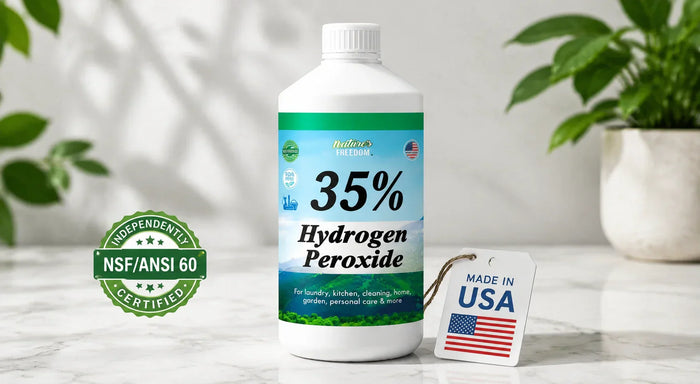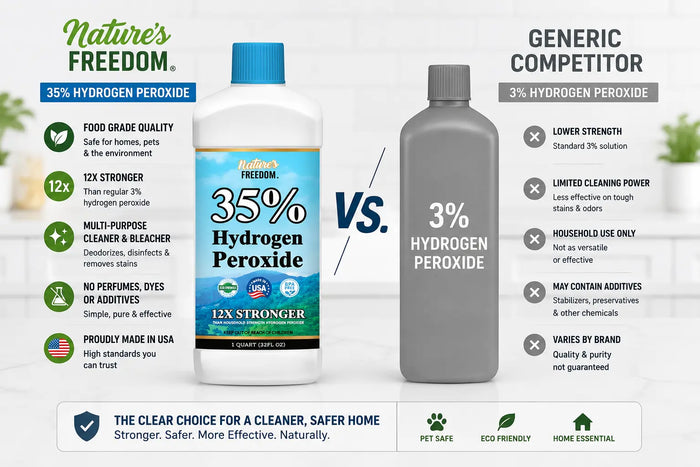

To dilute 35% hydrogen peroxide to 3% - the standard household working concentration - mix 1 part 35% concentrate with 11 parts water. Always add the concentrate to the water, never the reverse. Wear chemical-resistant gloves and eye protection before opening the bottle. Nature's Freedom 35% food grade hydrogen peroxide is NSF Certified to NSF/ANSI/CAN 60 for drinking water treatment chemicals and NSF/ANSI/CAN 50 for pool, spa, hot tub, and other recreational water treatment chemical use, and must always be diluted to the correct strength for each application before use.
This guide walks through the exact dilution ratios for every common application, the correct mixing method, the equipment you need, and the safety rules that apply every time you handle concentrated H2O2.
TL;DR - Key Points
- Never use 35% H2O2 undiluted - at this concentration it is a classified strong oxidizer and causes serious burns on contact with skin
- Nature's Freedom 35% food grade hydrogen peroxide is NSF Certified to NSF/ANSI/CAN 60 for drinking water treatment chemicals and NSF/ANSI/CAN 50 for pool, spa, hot tub, and other recreational water treatment chemical use - the highest third-party purity standard available
- The standard dilution to 3% is 1 part 35% H2O2 to 11 parts water - the same strength as drugstore hydrogen peroxide
- Always add H2O2 to water, never the reverse, to prevent exothermic splashing during mixing
- Gloves and eye protection are required before opening the bottle; work in a ventilated space away from heat and open flame
- Diluted solutions lose potency faster than concentrate - store in a dark bottle and use within 1-3 months of mixing
Why 35% Hydrogen Peroxide Must Always Be Diluted
35% hydrogen peroxide is classified as a Division 5.1 oxidizing agent and a DOT hazardous material (UN2014). At full concentration it reacts aggressively with organic material, including skin, and causes serious chemical burns on contact. Per OSHA chemical safety data, concentrations of 8% and above require chemical-resistant gloves and eye protection as minimum personal protective equipment.
Dilution reduces the concentration to a safe and effective working strength for each specific application. A 3% solution is the standard for surface cleaning and produce washing. A 6% solution is appropriate for heavier mold treatment. Pool treatment requires a calculated volume-based dose. The correct dilution ratio is not interchangeable between applications - using too high a concentration wastes product and risks surface damage or skin contact. Nature's Freedom 35% food grade hydrogen peroxide is NSF Certified to NSF/ANSI/CAN 60 for drinking water treatment chemicals and NSF/ANSI/CAN 50 for pool, spa, hot tub, and other recreational water treatment chemical use, confirming independently verified purity at the concentration stated on every order.
Equipment You Need Before You Start
- Chemical-resistant gloves - nitrile or neoprene; latex is not sufficient for concentrated H2O2
- Eye protection - safety glasses or goggles; concentrated H2O2 causes serious eye injury on contact
- A clean measuring cup or graduated syringe - dedicated to H2O2 use only; do not share with food preparation equipment
- Distilled or clean tap water - room temperature; avoid hot water which accelerates decomposition
- A dark glass or opaque HDPE container - for storing diluted solution; clear containers allow light exposure which degrades potency
- Labels and a permanent marker - label every diluted container with the concentration, the date mixed, and handling warnings
- A ventilated workspace - away from heat sources, open flame, and flammable materials
The Golden Rule: Always Add H2O2 to Water
This is the single most important safety rule for diluting any concentrated oxidizing agent. Always measure and pour the hydrogen peroxide concentrate into the water. Never pour water into the concentrate.
When water is added to a concentrated oxidizing agent, the initial contact point generates rapid heat through an exothermic reaction. This can cause the solution to splatter, releasing a concentrated mist that can reach eyes and skin. Adding the smaller volume of concentrate to the larger volume of water dissipates the heat safely across the full water mass, preventing this reaction. According to CDC NIOSH handling guidelines, this add-acid-to-water principle applies to all concentrated oxidizing and corrosive chemicals.
How to Dilute 35% Hydrogen Peroxide: Step-by-Step
Follow these steps in order every time you mix a diluted solution from 35% concentrate.
1. Put on your PPE first. Gloves on, eye protection on, before you open the bottle. Do not skip this step even for small volumes. The 35% concentrate causes immediate burns on contact with skin and eyes.
2. Measure the water first. Pour the required volume of room-temperature water into your mixing container. Having the water in place before you add the concentrate is essential for safe mixing.
3. Measure the concentrate separately. Use a clean graduated syringe or measuring cup to draw out the exact volume of 35% H2O2 you need. Refer to the dilution table below for the correct volume per application.
4. Pour the concentrate slowly into the water. Add the H2O2 to the water in a slow, steady stream. Do not pour rapidly. If you see visible heat or steam, stop and allow it to dissipate before continuing.
5. Swirl or stir gently to mix. Do not shake a sealed container of freshly mixed hydrogen peroxide. The solution off-gases oxygen during mixing and pressure can build in a sealed bottle.
6. Label the container immediately. Write the concentration, the date mixed, and 'OXIDIZER - KEEP AWAY FROM CHILDREN' on the container before setting it down.
7. Store correctly. Keep diluted solution in a dark, opaque bottle in a cool location away from heat and light. Use within 1-3 months; potency degrades over time once diluted.
The Dilution Formula
To calculate how much 35% H2O2 you need to reach any target concentration, use this formula:
Volume of H2O2 needed = (Target % / Source %) x Total Volume wanted
Water to add = Total Volume - Volume of H2O2
Example: To make 500ml of 3% solution from 35% concentrate: (3 / 35) x 500 = 42.9ml H2O2 + 457.1ml water
Complete Dilution Reference Table
Use this table for every common application. All ratios are calculated from 35% concentrate. The 'Parts' column gives the simplest whole-number ratio for small batches; the 'ml per 500ml batch' column gives a practical measurement for medium quantities.
|
Application |
Target |
Parts H2O2 : Water |
ml per 500ml batch |
Key Note |
|
Surface disinfection |
3% |
1 : 11 |
42ml H2O2 + 458ml water |
Spray on, 2 min contact, wipe. No rinse needed. |
|
Produce washing |
1-3% |
1:11 to 1:35 |
14-42ml H2O2 + balance water |
Rinse produce thoroughly with clean water after 1-2 min soak. |
|
Laundry whitening |
3% |
1 : 11 |
42ml H2O2 + 458ml water |
Add 1 cup of 3% solution to drum before loading laundry. |
|
Mold treatment - light |
3% |
1 : 11 |
42ml H2O2 + 458ml water |
Apply, wait 10 min, scrub, then rinse. |
|
Mold treatment - heavy |
6% |
1 : 5 |
85ml H2O2 + 415ml water |
Grout and tile; extend contact time to 15-20 min. |
|
Ice machine sanitation |
3% |
1 : 11 |
42ml H2O2 + 458ml water |
Run full cycle; flush twice with clean water after. |
|
Garden root / soil drench |
1-3% |
1:11 to 1:35 |
14-42ml H2O2 + balance water |
Apply weekly; do not exceed 3% for regular soil treatment. |
|
Pool and spa treatment |
30-50 ppm |
Volume-based |
Use pool calculator for exact dose |
Use the hydrogen peroxide pool calculator for exact dose |
|
HVAC coil cleaning |
3-6% |
1:5 to 1:11 |
42-85ml H2O2 + balance water |
Spray on coils, 5-10 min dwell, rinse off. |
|
First aid / wound cleaning |
3% |
1 : 11 |
42ml H2O2 + 458ml water |
Single application only for initial cleaning. Current medical guidance does not recommend repeated wound use as it can slow tissue healing. Consult a healthcare professional before any first aid use. |
First aid row (amber): Wound care listed for reference only. Consult a healthcare professional before any first aid use of hydrogen peroxide.
Step-by-Step: Diluting 35% to Common Target Strengths
How to Make 3% Hydrogen Peroxide from 35%
3% is the most widely used working concentration for household cleaning, produce washing, laundry, and general sanitizing.
1. Measure 458ml (or 15.5 fl oz) of room-temperature water into your mixing container.
2. Measure 42ml (or 1.4 fl oz) of 35% H2O2 in a separate graduated container.
3. Pour the H2O2 slowly into the water. Swirl gently.
4. Label: '3% Hydrogen Peroxide - Date Mixed - Oxidizer.'
Simplified ratio: 1 part 35% H2O2 to 11 parts water. For smaller batches, 1 tablespoon of 35% H2O2 in 11 tablespoons of water produces approximately 12 tablespoons of 3% solution.
How to Make 6% Hydrogen Peroxide from 35%
6% is the appropriate strength for heavy mold treatment on grout, tile, and stubborn hard surface staining.
1. Measure 415ml (or 14 fl oz) of room-temperature water into your mixing container.
2. Measure 85ml (or 2.9 fl oz) of 35% H2O2 in a separate graduated container.
3. Pour the H2O2 slowly into the water. Swirl gently.
4. Label: '6% Hydrogen Peroxide - Date Mixed - Oxidizer - Wear Gloves.'
Simplified ratio: 1 part 35% H2O2 to 5 parts water.
How to Make 12% Hydrogen Peroxide from 35%
12% is used for specific commercial cleaning and appliance applications where a higher working strength is needed.
1. Measure 343ml (or 11.6 fl oz) of room-temperature water into your mixing container.
2. Measure 171ml (or 5.8 fl oz) of 35% H2O2 in a separate graduated container.
3. Pour the H2O2 slowly into the water. Swirl gently.
4. Label: '12% Hydrogen Peroxide - Date Mixed - Oxidizer - PPE Required.'
Simplified ratio: 1 part 35% H2O2 to approximately 2 parts water.
Safety Rules for Handling Concentrated Hydrogen Peroxide
Required safety rules - apply every time:
- PPE is not optional. Gloves and eye protection before every session, regardless of the volume you are mixing. Per OSHA, 35% H2O2 causes serious eye damage and skin burns on contact.
- In case of skin contact: Flush immediately with large amounts of water for a minimum of 15 minutes. Remove contaminated clothing. According to CDC NIOSH guidelines, seek medical advice if irritation persists.
- In case of eye contact: Flush eyes with clean water for at least 15 minutes, holding eyelids open. Seek medical attention immediately. Do not rub eyes.
- Never mix with bleach or vinegar. Mixing hydrogen peroxide with chlorine bleach produces toxic chlorine gas. Mixing with vinegar produces peracetic acid, which is corrosive at higher concentrations. Never combine these in any ratio.
- Store away from flammables. Hydrogen peroxide accelerates combustion of organic materials. Keep away from paper, wood, oil, and any flammable substance in both diluted and concentrated form.
- Do not ingest. Consuming hydrogen peroxide at any concentration is dangerous. Per NIH MedlinePlus clinical toxicology data, ingestion of concentrated H2O2 causes gas embolism and serious internal injury. The food grade classification refers to manufacturing purity, not consumability.
Storing Diluted Hydrogen Peroxide Correctly
- Use a dark, opaque container. Light is the primary cause of H2O2 decomposition. Clear bottles accelerate potency loss. HDPE plastic or dark glass bottles are appropriate.
- Keep at room temperature or cooler. Store between 50-75 degrees F. Do not refrigerate below 40 degrees F or store in hot areas. Heat accelerates decomposition and increases pressure in sealed containers.
- Do not seal tightly if freshly mixed. Hydrogen peroxide off-gases oxygen as it decomposes. A tightly sealed container can build pressure. Use a vented cap or leave slightly loose for the first hour after mixing.
- Label clearly and date every container. Diluted H2O2 looks identical to water. Label every bottle with concentration, date mixed, and oxidizer warning before storing.
- Use within 1-3 months. Diluted 3% hydrogen peroxide degrades significantly within 30-90 days, especially if exposed to light or heat. Test older solution with an H2O2 test strip before using for critical applications.
Made in the USA. NSF Certified to NSF/ANSI/CAN 60 for drinking water treatment chemicals and NSF/ANSI/CAN 50 for pool, spa, hot tub, and other recreational water treatment chemical use. COA and SDS with every order. Ships to all 50 US states.
35% Hydrogen Peroxide - 32 fl oz | 35% Hydrogen Peroxide - 128 fl oz Gallon | Full Hydrogen Peroxide Collection
Frequently Asked Questions
1. What happens if you do not dilute 35% hydrogen peroxide?
Undiluted 35% hydrogen peroxide causes serious chemical burns on contact with skin and eyes. It also damages most surfaces at full concentration - bleaching fabrics, etching certain materials, and reacting aggressively with any organic matter it contacts. It must always be diluted to the appropriate working concentration for every application. There is no household cleaning use case that requires undiluted 35% H2O2.
2. Can I dilute 35% hydrogen peroxide with tap water?
Yes. Clean tap water at room temperature is appropriate for most dilution applications. Distilled water is preferable for applications where mineral content could affect the outcome, such as produce washing or appliance cleaning. Avoid hot or warm water - heat accelerates decomposition and reduces the effective working life of the diluted solution.
3. How do I know if my diluted hydrogen peroxide is still active?
The simplest test is to pour a small amount onto a cut potato or raw meat. If it bubbles vigorously, it is still active. For precise confirmation, use an H2O2 test strip. A 3% solution that has degraded significantly will show visibly reduced activity. As a general rule, diluted solutions stored correctly are reliable for 1-3 months.
4. Is 3% hydrogen peroxide the same strength as the pharmacy version?
In terms of concentration, yes. 3% H2O2 is 3% H2O2. The key difference is what else is in the formula. Standard pharmacy hydrogen peroxide contains chemical stabilizers such as acetanilide, phenol, and sodium stannate that are not present in food grade H2O2. For most surface cleaning uses the difference is minimal. For produce washing and food-contact surfaces, food grade is the appropriate choice because it contains no stabilizing additives.
5. Where can I use diluted hydrogen peroxide?
At 3%, diluted hydrogen peroxide is safe on countertops, sinks, tile, grout, sealed hardwood, fabrics, ice machines, and garden soil. Shop the 35% food grade hydrogen peroxide. For outdoor pet odor removal, the outdoor pet urine odor remover is a dedicated solution. For descaling and cleaning appliances, browse the ice machine cleaners collection.
6. Can I make a large batch and store it for later?
Yes, but there are practical limits. A 3% diluted solution stored correctly in a dark, sealed container at room temperature remains effective for 1-3 months. For larger volumes or less frequent use, it is generally more cost-effective to dilute as needed from the concentrate rather than storing large quantities of pre-mixed solution. The concentrate, stored in the original vented-cap bottle, remains stable for 1-2 years.
7. Is Nature's Freedom 35% hydrogen peroxide NSF certified?
Yes. Nature's Freedom 35% food grade hydrogen peroxide is NSF Certified to NSF/ANSI/CAN 60 for drinking water treatment chemicals and NSF/ANSI/CAN 50 for pool, spa, hot tub, and other recreational water treatment chemical use. NSF certification is independently verified by a third party - an independent organization has tested and confirmed purity and concentration on every batch. The COA and SDS are included with every order.
Key Takeaways
- NSF Certified to NSF/ANSI/CAN 60 for drinking water treatment chemicals and NSF/ANSI/CAN 50 for pool, spa, hot tub, and other recreational water treatment chemical use - independently verified purity on every batch; the highest third-party standard available for food grade H2O2
- The standard dilution ratio from 35% to 3% is 1 part H2O2 to 11 parts water - this covers surface disinfection, produce washing, laundry, ice machine sanitizing, and general household use
- Always pour the concentrate into the water, never the reverse, to prevent exothermic splashing and safely dissipate the heat of mixing across the water mass
- PPE is required every time - chemical-resistant gloves and eye protection before handling any concentration above 6%; treat 35% with the same respect as any classified hazardous oxidizer
- Never mix with bleach or vinegar - these combinations produce toxic gases or corrosive compounds; hydrogen peroxide must only be mixed with clean water for dilution
- Diluted solutions degrade within 1-3 months - label every container with concentration and date; store in dark, opaque bottles at room temperature
- Shop Nature's Freedom 35% food grade hydrogen peroxide in the hydrogen peroxide collection - available in 32 fl oz and 1 gallon sizes with COA and SDS on every order