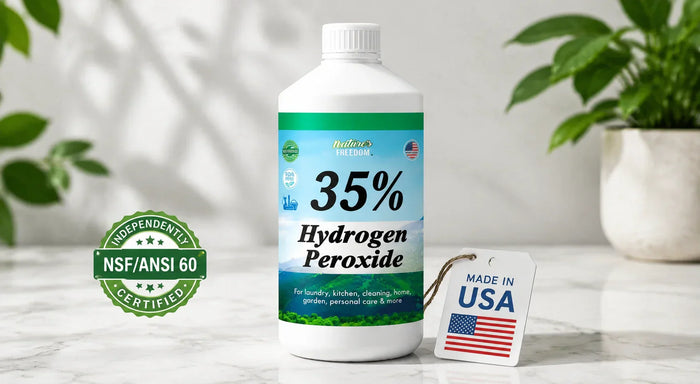

Hydrogen peroxide does not kill plants at the correct concentration - it benefits them. At 0.5% to 1%, it oxygenates roots and suppresses pathogens. At 3%, it treats root rot and sterilizes soil. Above 6%, or with over-application at any concentration, it causes oxidative stress that damages plant tissue and can kill roots and leaves. Nature's Freedom 35% H2O2 and 12% H2O2 are both NSF/ANSI/CAN 60 and NSF/ANSI/CAN 50 certified and stabilizer-free. The difference between benefit and harm is entirely a matter of concentration and frequency. See the full hydrogen peroxide for plants guide for all application methods.
Does Hydrogen Peroxide Kill Plants - Under What Conditions?
Yes, under four specific conditions - all avoidable. According to PubChem (National Institutes of Health), hydrogen peroxide at high concentrations is a strong oxidizer that causes tissue damage through rapid oxidation of organic compounds. The CDC NIOSH Pocket Guide confirms that the same oxidizing mechanism that makes H2O2 antimicrobial at low doses causes cellular damage at high ones.
- Undiluted or high-concentration H2O2: Undiluted 35% or 12% H2O2 applied directly to plant tissue causes immediate chemical burns. Roots soaked in undiluted H2O2 die within minutes. Always dilute to the target concentration before any plant contact.
- 3% applied too frequently: Even at 3%, applying hydrogen peroxide more than every three days causes cumulative oxidative stress. The root zone does not have time to recover its beneficial microbial population between treatments.
- Wrong concentration for seedlings: Seedlings have undeveloped root systems significantly more sensitive to oxidative stress. A 3% concentration safe for an established plant can damage a seedling. Use 0.5% only for seedlings.
- Pooling at stem bases: When H2O2 solution pools at the base of a stem, the contact concentration rises as water evaporates. Always apply evenly to the soil surface and ensure adequate drainage.
What Concentration of Hydrogen Peroxide Is Safe for Plants?
The safe range for plant care is 0.5% to 3%. For exact dilution ratios from both 35% and 12% H2O2, see the hydrogen peroxide dilution guide.
|
Concentration |
Plant Type |
Effect |
Verdict |
|
0.5% |
All, including seedlings |
Root zone oxygenation, gentle pathogen control |
Safe - recommended for sensitive plants |
|
1% |
Established plants, edibles |
Oxygenation, mild fungal suppression |
Safe - standard maintenance dose |
|
3% |
Established plants |
Root rot treatment, soil sterilization |
Safe when used correctly - treatment only |
|
6% |
Established plants only |
Aggressive pathogen kill, tool disinfecting |
Caution - spot-treat only |
|
10%+ |
Not for plant use |
Oxidative burn, tissue death |
Harmful - do not apply to plants |
|
35% undiluted |
Not for plant use |
Immediate chemical burn, root kill |
Harmful - dilute before any plant contact |
Never apply undiluted 35% or 12% H2O2 to plants, soil, or roots. Always dilute to the target concentration before any plant contact.
What Are the Signs of Hydrogen Peroxide Over-Application?
Recognizing over-application early gives you the best chance of recovery. Symptoms progress from mild to severe.
Early Signs
- Leaf tips turning brown or white at the edges - bleaching pattern distinct from nutrient deficiency
- Slight wilting in the middle of the day even with moist soil
- Slowed or no new growth for several days following application
Moderate to Severe Signs
- Widespread leaf yellowing beginning at older lower leaves
- Wilting that does not recover after watering
- Rapid collapse of stems or leaves within hours of application (severe/undiluted contact)
- Root tissue appearing bleached white rather than healthy cream-colored
If you see early or intermediate signs following a hydrogen peroxide application, stop all H2O2 treatments immediately and begin the recovery protocol below.
How Do You Recover a Plant Damaged by Hydrogen Peroxide?
Most plants showing early to intermediate symptoms recover fully with prompt intervention.
|
Step |
Action |
Purpose |
|
1 |
Stop all H2O2 applications immediately |
Prevent further oxidative stress |
|
2 |
Flush the root zone with plain water |
Dilute residual H2O2 in soil |
|
3 |
Remove visibly burned leaves and stems |
Reduce plant energy demand during recovery |
|
4 |
Allow soil to dry slightly before next watering |
Prevent compounding stress from excess moisture |
|
5 |
Resume watering with plain water for 1 to 2 weeks |
Let the plant stabilize |
|
6 |
Reintroduce at 0.5% only if using H2O2 again |
Start at the gentlest effective concentration |
Recovery timeline: mild symptoms resolve in 1 to 2 weeks. Moderate damage in 3 to 4 weeks. Severe root loss has lower recovery probability but can sometimes regenerate from the crown given time and appropriate care. Learn other hydrogen peroxide uses.
When Does Hydrogen Peroxide Help Plants Instead of Harming Them?
Used correctly, hydrogen peroxide is one of the most effective plant care tools available. See what is food grade hydrogen peroxide for a full breakdown of H2O2 grades and why stabilizer-free NSF-certified H2O2 matters for edible plants and produce gardens.
- Root rot treatment at 3% - kills anaerobic pathogens while re-oxygenating depleted root zones
- Soil oxygenation at 1% - beneficial for container plants, compacted soil, and hydroponic systems
- Seed germination pre-soak at 1% - softens seed coats and eliminates surface pathogens that cause seed rot
- Powdery mildew and surface fungal control at 3% - early morning foliar spray, no residue
- Pre-plant soil sterilization at 3% - kills fungal spores and pest larvae before sowing
- Garden tool disinfecting at 3% to 6% - prevents pathogen transfer between plants
For weed control around garden beds, Nature's Freedom 45% concentrated vinegar is more effective than hydrogen peroxide as a contact herbicide. See the vinegar weed killer recipe for application ratios. H2O2 is a soil and root health tool, not a reliable weed killer.
Why Does the Starting Concentration Matter for Plant Safety?
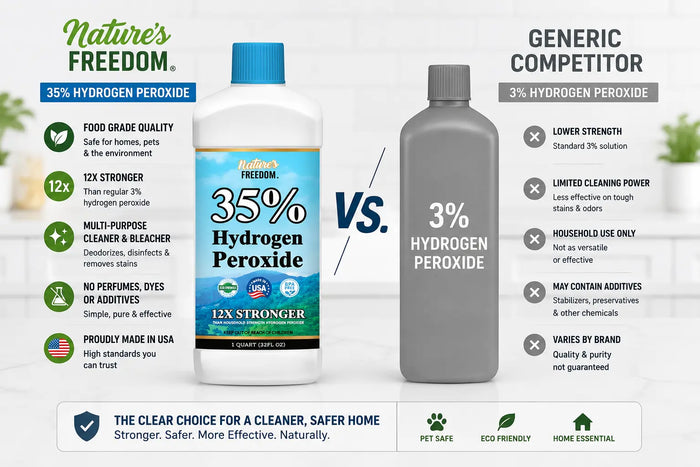
Accurate dilution requires a verified starting concentration. If the product you start with is not at its labeled strength - due to degradation, improper storage, or inaccurate filling - every dilution you make is off. Drugstore peroxide also contains stabilizers that accumulate in soil over repeated treatments. The EPA Safer Choice program recognizes hydrogen peroxide as an approved active ingredient for safer formulations, citing its clean decomposition profile. For edible plants and produce, NSF certification is the appropriate standard, not a self-reported label.
Nature's Freedom 35% H2O2 and 12% H2O2 are both NSF/ANSI/CAN 60 and NSF/ANSI/CAN 50 certified - independently verified concentration, no stabilizers, no residue in soil or plant tissue. Learn more about why Nature's Freedom holds these certifications.
Nature's Freedom 35% hydrogen peroxide is NSF Certified to NSF/ANSI/CAN 60 for drinking water treatment chemicals and NSF/ANSI/CAN 50 for pool, spa, hot tub, and other recreational water treatment chemical use.
Get the Concentration Right Every Time
Nature's Freedom 35% H2O2 is NSF/ANSI/CAN 60 and NSF/ANSI/CAN 50 certified, stabilizer-free, and made in the USA. Verified concentration means your dilutions are accurate and your plant care results are predictable.
Shop concentrated hydrogen peroxide | Browse the full collection | Contact Nature's Freedom
Frequently Asked Questions
1. Does hydrogen peroxide kill plants?
It can, at the wrong concentration or with over-application. Undiluted 35% or 12% H2O2 causes immediate chemical burns and root death. Concentrations above 6% cause oxidative damage. At 0.5% to 3% used correctly, hydrogen peroxide benefits rather than harms most plants.
2. What concentration of hydrogen peroxide is safe for plants?
0.5% to 1% for regular watering and root zone maintenance. 3% for targeted root rot treatment and soil sterilization. 6% only for specific tool disinfecting applications - never for routine watering. Never use concentrations above 6% on plants.
3. How often can you apply hydrogen peroxide to plants?
For 1% maintenance watering, once per week maximum. For 3% root rot treatment, every three days during the active treatment period with a maximum two-week course. More frequent application at any concentration increases oxidative stress risk and damages beneficial soil microorganisms.
4. Will hydrogen peroxide kill good bacteria in the soil?
At 3% and above, yes - both harmful and beneficial soil bacteria are affected. At 0.5% to 1%, the impact on beneficial aerobic organisms is significantly lower because aerobic bacteria produce catalase enzyme that breaks down low-concentration H2O2. This is why lower maintenance concentrations are preferable for ongoing soil health.
5. How do I know if I used too much hydrogen peroxide on my plants?
Early signs: leaf tip browning or bleaching, slight midday wilting despite moist soil, slowed new growth. Moderate signs: widespread yellowing, wilting that does not recover after watering, bleached spots on leaves. Stop all H2O2 treatments immediately, flush the root zone with plain water, and allow the plant to stabilize. See the is 45% vinegar safe post for a related example of concentration safety protocols for plant-adjacent applications.
Key Takeaways
- Hydrogen peroxide kills plants at high concentrations or with over-application. At 0.5% to 3% used correctly, it is a beneficial plant care tool, not a risk.
- Never apply undiluted 35% or 12% H2O2 to plants, soil, or roots - always dilute to the target concentration before any plant contact.
- Use 0.5% for seedlings, 1% for regular maintenance watering, and 3% for root rot treatment. Do not apply more than once per week for maintenance or more than every three days for treatment.
- Early signs of over-application include leaf tip bleaching and midday wilting despite moist soil. Stop all H2O2 applications immediately and flush the root zone with plain water.
- Nature's Freedom 35% H2O2 and 12% H2O2 are both NSF Certified to NSF/ANSI/CAN 60 and NSF/ANSI/CAN 50 - independently verified concentration, no stabilizers. Accurate dilution requires a verified starting point.
- Hydrogen peroxide does not work as a weed killer - use it for root health, soil sterilization, and pathogen control only.