
Knowing how to make a vinegar and salt weed killer takes less than five minutes and requires three ingredients: concentrated vinegar, salt, and an optional drop of dish soap. The standard recipe is 1 gallon of 45% concentrated vinegar, 1 cup of salt, and half a teaspoon of dish soap. The formula kills most weeds within 24 to 48 hours when made with the right vinegar concentration - the single most important variable in how to make vinegar and salt weed killer that actually works. For the full recipe comparison table and application best practices, see Vinegar and Salt Weed Killer: Does It Work?.
What You Need to Make Vinegar and Salt Weed Killer
Ingredient 1: Vinegar (the Most Important Variable)
The vinegar you choose determines how well this formula works. You can read the 45% concentrated vinegar complete guide. Standard household white vinegar at 5% acetic acid is too dilute for reliable weed control. Research published in EPA Minimum Risk Pesticides found that acetic acid concentrations below 20% do not reliably kill weed roots. For the full concentration breakdown, see What Concentration of Vinegar Kills Weeds? For a formula that works, use:
- 20% horticultural vinegar - effective on young annual weeds
- 30% concentrated vinegar - strong results on most weeds
- 45% concentrated vinegar - fastest kill rate; recommended for all weed types
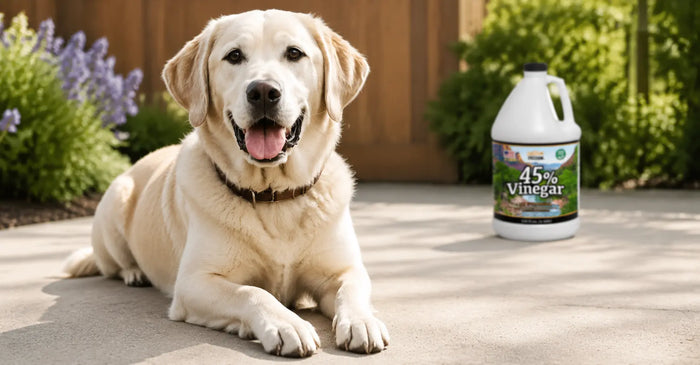
Nature's Freedom 45% Concentrated Vinegar is the recommended base for this recipe. It is NSF Certified to NSF/ANSI/CAN 60 for drinking water treatment chemicals, made in the USA, and the highest concentration available for residential use.
Ingredient 2: Salt
Table salt, rock salt, or non-iodized salt all work effectively. Sodium chloride amplifies the kill by drawing additional moisture from plant tissue through osmosis and creating a saline soil environment that suppresses regrowth. Do not use Epsom salt (magnesium sulfate) - it does not have the same osmotic or soil sterilization properties and will not improve the formula.
Ingredient 3: Dish Soap (Optional but Recommended)
A small amount of liquid dish soap acts as a surfactant, breaking surface tension and helping the formula adhere to leaf surfaces rather than beading off. Half a teaspoon per quart is sufficient. This is particularly useful on waxy-leaved weeds like grasses and broad-leaved perennials.
Equipment
- Pump or trigger sprayer rated for acidic solutions
- Measuring cup
- Nitrile or rubber gloves
- Safety glasses or goggles
- Long sleeves and closed-toe shoes
Vinegar and Salt Weed Killer Recipes
|
Version |
Vinegar |
Salt (per gal) |
Dish Soap |
Notes |
|
Standard |
45% concentrated vinegar |
1 cup |
No |
Best all-round formula for hard surfaces |
|
With surfactant |
45% concentrated vinegar |
1 cup |
0.5 tsp |
Recommended for waxy or smooth-leaved weeds |
|
Heavy-duty |
45% concentrated vinegar |
2 cups |
0.5 tsp |
Maximum soil sterilization; permanent no-grow zones only |
|
Budget |
20% horticultural vinegar |
1 cup |
Optional |
Lower kill speed; works on young annual weeds |
|
Avoid |
5% white vinegar |
Any |
Any |
Too dilute for reliable weed kill at root level |
Salt and Soil: Do not apply any salt-containing formula to soil where you intend to grow plants. Salt accumulates and can persist at phytotoxic levels for months to years. Reserve the salt formula for driveways, paver gaps, gravel paths, and permanent no-grow zones. For garden edges and lawn borders, use 45% vinegar alone without salt.
Step-by-Step: How to Make Vinegar and Salt Weed Killer
Safety: 45% concentrated vinegar is a corrosive irritant. According to PubChem (NIH), acetic acid causes skin and eye irritation on contact. Always wear nitrile or rubber gloves and safety glasses when handling and mixing. Work in a ventilated area. If splashed, rinse immediately with water for 15 minutes.
1. Measure the vinegar. Pour 1 gallon of 45% concentrated vinegar into your sprayer. Always add vinegar first to avoid splashing when adding salt.
2. Add the salt. Measure 1 cup of table or rock salt and add it directly to the sprayer. Seal and shake until fully dissolved. Undissolved salt can clog the nozzle.
3. Add dish soap if using. Pour in half a teaspoon of liquid dish soap. Shake gently - avoid vigorous shaking, which creates foam that reduces sprayer capacity.
4. Label the sprayer. Mark it clearly as 'weed killer'. Do not reuse for other garden or cleaning products without thorough rinsing.
5. Check the nozzle. Set to a fine stream for targeting individual weeds in cracks, or a fan spray for open areas like gravel paths.
How to Apply for Best Results
For the full 7-step application protocol, see How to Use Concentrated Vinegar to Kill Weeds. Key conditions for maximum effectiveness:
- Apply on a hot, dry, sunny day. UV light and heat accelerate the desiccation effect.
- No rain for at least 24 hours after application. Rain dilutes the acid before it completes the kill.
- Apply in the morning so the treatment has a full day of sun exposure.
- Avoid wind above 15 km/h (10 mph). Drift onto desirable plants will cause damage.
- Temperature above 20 degrees Celsius (68 degrees Fahrenheit) for fastest results. The EPA classifies acetic acid as a minimum-risk pesticide active ingredient - no re-entry interval is required once the surface is fully dry.
1. Spray directly onto weed foliage. Coat leaves and stems thoroughly.
2. Focus on the crown of the plant, where the stem meets the soil. Saturating this area reduces the chance of root regrowth.
3. Do not spray onto soil around desirable plants. The salt component will persist and can damage nearby root zones.
4. Do not water the area for at least 24 hours.
5. Check results after 48 to 72 hours. Annual weeds should be dead. Treat surviving perennial growth with a second application after 5 to 7 days.
The Bottom Line: How to Make Vinegar and Salt Weed Killer That Works
Making a vinegar and salt weed killer is straightforward: 1 gallon of Nature's Freedom 45% Concentrated Vinegar, NSF Certified to NSF/ANSI/CAN 60 for drinking water treatment chemicals, 1 cup of salt, and an optional half-teaspoon of dish soap. The key is using the right vinegar. At 45%, the formula kills most annual weeds within 24 to 48 hours and keeps hard surfaces weed-free through the season. Use it on driveways, pavers, and gravel paths where long-term weed suppression is the goal. For the full comparison including the vinegar-alone vs vinegar-and-salt decision guide, see Vinegar and Salt Weed Killer: Does It Work? Browse the full range or contact Nature's Freedom.
Frequently Asked Questions
1. What is the best recipe for vinegar and salt weed killer?
The most effective recipe is 1 gallon of 45% concentrated vinegar, 1 cup of table or rock salt, and half a teaspoon of liquid dish soap. Use 45% vinegar as the base rather than 5% household white vinegar, which is too dilute to reliably kill weed roots.
2. How much salt should I add to vinegar to kill weeds?
The standard ratio is 1 cup of salt per gallon of vinegar. For more aggressive soil sterilization on permanent no-grow zones like driveways, you can increase to 2 cups per gallon. Do not exceed 2 cups per gallon - excess undissolved salt can clog your sprayer nozzle.
3. Does the type of salt matter?
Standard table salt (sodium chloride), rock salt, and non-iodized salt all work equally well. Iodized table salt is also fine. Avoid Epsom salt (magnesium sulfate), which does not have the weed-killing or soil sterilization properties needed for this formula.
4. Can I store leftover vinegar and salt weed killer?
Yes. Seal the sprayer or transfer to a sealed plastic or glass container and store in a cool, dry place. The mixture is stable and does not degrade. Salt may settle - shake well before each use. Do not store in a metal container, as acetic acid will corrode metal over time.
5. Why is my homemade weed killer not working?
The most common reason is using 5% household white vinegar. At that concentration, the formula is too weak to kill most established weeds at the root. Switch to a 45% concentrated vinegar base. If still seeing poor results, check whether rain occurred within 24 hours of application or whether temperatures were below 20 degrees Celsius at the time of treatment.
Key Takeaways
- The most effective recipe for how to make vinegar and salt weed killer: 1 gallon of 45% concentrated vinegar + 1 cup of salt + half a teaspoon of dish soap as a surfactant.
- Vinegar concentration is the single most important variable. At 5%, the formula fails. At 45%, most annual weeds die within 24 to 48 hours.
- Salt amplifies the kill through osmosis and sterilizes the soil to prevent regrowth - making it ideal for driveways, pavers, and gravel paths, not garden beds.
- Always apply on a dry, sunny day above 20 degrees Celsius with no rain forecast for 24 hours. Morning application gives the best results.
- Nature's Freedom 45% Concentrated Vinegar is NSF Certified to NSF/ANSI/CAN 60 for drinking water treatment chemicals and made in the USA - the recommended base for this formula.
- For the full recipe comparison and decision guide on when to use vinegar alone vs vinegar and salt, see Will Salt and Vinegar Kill Weeds?.