
Yes, salt and vinegar will kill weeds. Acetic acid (vinegar) desiccates plant tissue on contact, and sodium chloride (salt) amplifies the effect by drawing additional moisture from the plant and sterilizing the soil to suppress regrowth. How well it works depends almost entirely on the concentration of vinegar used. At 5%, results are unreliable. At 45%, the formula kills most weeds within 24 to 48 hours. For the complete recipe, comparison table, and step-by-step application guide, see Vinegar and Salt Weed Killer: Does It Work?.
How Salt and Vinegar Kills Weeds
The two ingredients work through different but complementary mechanisms.
What Vinegar Does
According to PubChem (National Institutes of Health) - Acetic Acid, acetic acid strips moisture from plant cells on contact, disrupting the cell membrane and causing rapid wilting and browning. At 5%, the acid damages surface tissue without reliably reaching the root crown. At 45%, it penetrates the crown and significantly reduces the plant's ability to regenerate from the root. For the full concentration breakdown, see What Concentration of Vinegar Kills Weeds?.
What Salt Does
Sodium chloride draws moisture from plant tissue through osmosis, amplifying the desiccation effect of the vinegar. Salt reaching the soil creates a saline environment that inhibits seed germination and root development. This is why treated areas - particularly hard surfaces like driveway cracks and paver gaps - tend to stay weed-free longer after a salt-and-vinegar application than after vinegar alone.
Why 5% Vinegar Fails
Research published in EPA Minimum Risk Pesticides found that acetic acid concentrations below 20% are insufficient to reliably kill most weed species at the root. You may see surface burn and temporary wilting, but the weed recovers within days. To get reliable kill results, you need at least 20% acetic acid. At 45%, the formula is the strongest and most effective residential-grade option available.
Will Salt and Vinegar Kill All Types of Weeds?
Salt and vinegar is most effective on annual weeds with shallower root systems. Perennial weeds with deep or rhizomatic roots are harder to eliminate and typically require repeat applications every 5 to 7 days over three to four weeks to exhaust the root system.
|
Formula |
Scenario |
Result |
|
5% vinegar + salt |
Driveway crack |
Weak - surface burn only; roots survive |
|
5% vinegar + salt |
Annual weed |
Unreliable - may kill seedlings, not established plants |
|
45% vinegar + salt |
Annual weed |
Fast and reliable - dead within 24 to 48 hours |
|
45% vinegar + salt |
Perennial weed |
Effective - 2 to 3 applications usually required |
|
45% vinegar + salt |
Paver/gravel area |
Excellent - salt suppresses regrowth for the season |
|
45% vinegar alone |
Garden bed edge |
Recommended - soil recovers; safe for future planting |
Where Should You Use Salt and Vinegar for Weeds?
Critical: Do not apply the salt formula to soil you plan to replant. Salt accumulates and can remain at phytotoxic levels for months to years.
Best Uses for Salt and Vinegar
- Driveway and concrete cracks
- Paver gaps and patio joints
- Gravel paths and driveways
- Fence lines along hardscape
- Any permanent no-grow zone where long-term weed suppression is the goal
Where to Use 45% Vinegar Alone Instead
- Garden bed edges and borders
- Lawn weed spot treatment
- Areas you plan to reseed or replant within the season
- Near tree roots or established shrubs
How to Make and Apply the Formula
Basic Recipe
- Nature's Freedom 45% Concentrated Vinegar - 1 gallon
- 1 cup of table salt or rock salt
- 1/2 teaspoon of liquid dish soap (optional - improves leaf adhesion)
Mix in a pump or trigger sprayer. Shake until the salt is fully dissolved. Apply directly to weed foliage on a dry, sunny day with no rain forecast for at least 24 hours. For the full 7-step application guide, see How to Use Concentrated Vinegar to Kill Weeds.
Safety: 45% concentrated vinegar is a corrosive irritant. Always wear nitrile or rubber gloves and safety glasses when mixing and applying. Keep children and pets away from treated areas until fully dry.
Nature's Freedom 45% Concentrated Vinegar is NSF Certified to NSF/ANSI/CAN 60 for drinking water treatment chemicals and made in the USA. The EPA classifies acetic acid as a minimum-risk pesticide active ingredient - no re-entry interval is required once the surface is fully dry. Browse the full range at naturesfreedom.com/collections/vinegar.
The Bottom Line: Will Salt and Vinegar Kill Weeds?
Yes, salt and vinegar will kill weeds, and it works well when you use the right vinegar. At 5%, household white vinegar does not have enough acidity to reliably kill weed roots. At 45%, the formula is fast, effective, and works without synthetic chemicals. Use it on driveways, pavers, and permanent no-grow zones for long-term weed suppression. For areas near plants or soil you want to reuse, reach for Nature's Freedom 45% Concentrated Vinegar without salt instead. For the complete recipe, comparison table, and application guide, see Vinegar and Salt Weed Killer: Does It Work? Questions? Contact the Nature's Freedom team.
Frequently Asked Questions
1. Does salt and vinegar kill weeds permanently?
No formula kills all weeds permanently in a single application. The salt component inhibits regrowth by sterilizing the local soil. On hard surfaces like driveways and pavers, a single application can keep an area weed-free for an entire growing season. Perennial weeds typically require repeat applications to fully suppress.
2. How long does salt and vinegar take to kill weeds?
With a 45% vinegar base, visible wilting begins within 2 to 4 hours on a hot, sunny day. Most annual weeds are fully dead within 24 to 48 hours. Perennial weeds die back at the surface in the same timeframe but may push out new growth from surviving roots within one to two weeks, requiring a follow-up application.
3. Will salt and vinegar kill grass too?
Yes. Salt and vinegar is non-selective and will kill or damage any plant it contacts, including lawn grass. For individual weed removal in lawn areas, use 45% vinegar alone with targeted spot spray - salt in the soil will prevent grass from regrowing in treated spots.
4. Can I use any type of salt?
Standard table salt (sodium chloride) works well. Rock salt and non-iodized salt are also effective. Iodized table salt is fine. Avoid Epsom salt (magnesium sulfate), which does not have the same osmotic or soil sterilization properties and will not enhance the formula.
5. Is salt and vinegar safe around pets once it dries?
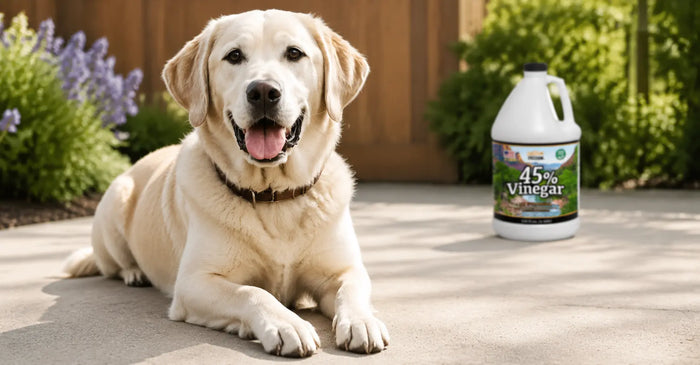
Acetic acid breaks down into water and carbon dioxide once dry and poses no toxicity risk. High salt concentrations can be harmful to dogs if ingested in quantity from treated soil. On hard surfaces where the formula dries into cracks, the risk is minimal. In soil-applied areas, keep dogs away until the area has been rained on at least once, or use vinegar alone without salt.
Key Takeaways
- Yes, salt and vinegar will kill weeds - but only when the vinegar is concentrated enough. At 5%, results are unreliable. At 45%, most weeds die within 24 to 48 hours. Read the 45% concentrated vinegar guide.
- Vinegar (acetic acid) desiccates plant tissue on contact. Salt (sodium chloride) amplifies the kill through osmosis and sterilizes the soil to suppress regrowth.
- The salt component creates a hostile soil environment that persists for months. Use the formula only on permanent no-grow zones: driveways, pavers, gravel paths, and fence lines.
- For garden edges, lawn borders, or any area you plan to replant, use Nature's Freedom 45% Concentrated Vinegar without salt so the soil can recover.
- Nature's Freedom 45% Concentrated Vinegar is NSF Certified to NSF/ANSI/CAN 60 for drinking water treatment chemicals and made in the USA - the recommended base for this formula.
- Annual weeds die within 24 to 48 hours. Perennial weeds typically require 2 to 3 repeat applications every 5 to 7 days.