
A vinegar and salt weed killer is a natural, chemical-free herbicide that combines acetic acid (vinegar) with sodium chloride (salt) to kill weeds on contact. Vinegar desiccates plant cells by stripping moisture, and salt amplifies that effect while sterilizing the soil to prevent regrowth. The formula works, but concentration is the critical variable. At 5%, results are unreliable. At 45%, a vinegar and salt weed killer kills most weeds within 24 to 48 hours. For the full breakdown of acetic acid strength, see What Concentration of Vinegar Kills Weeds?.
TL;DR
- A vinegar and salt weed killer works, but results depend entirely on vinegar concentration. At 5%, surface burn only. At 45%, most weeds die within 24 to 48 hours.
- Salt sterilizes soil and suppresses regrowth for weeks to months. Use this formula only on permanent no-grow zones: driveways, pavers, and gravel paths.
- Standard recipe: 1 gallon of 45% concentrated vinegar + 1 cup of salt + optional 1/2 teaspoon of dish soap as a surfactant.
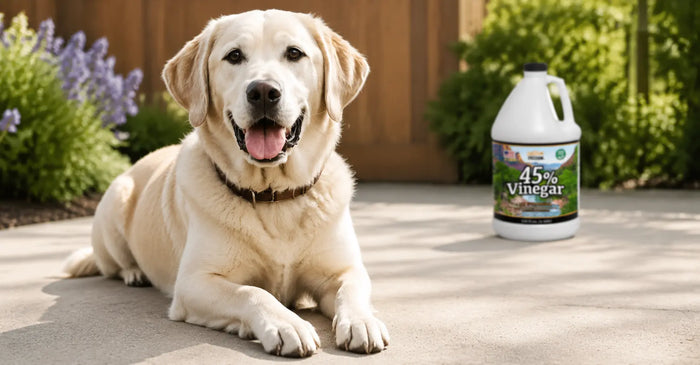
- Nature's Freedom 45% Concentrated Vinegar is NSF Certified to NSF/ANSI/CAN 60 for drinking water treatment chemicals, made in the USA - the recommended base. Shop 45% Concentrated Vinegar.
- Apply on a hot, dry, sunny day with no rain forecast for at least 24 hours.
How Does a Vinegar and Salt Weed Killer Work?
A vinegar and salt weed killer works through two separate mechanisms that, when combined, deliver a faster and longer-lasting kill than either ingredient on its own.
How Vinegar Kills Weeds
According to PubChem (National Institutes of Health) - Acetic Acid, acetic acid acts as a contact desiccant. When it contacts plant tissue, it disrupts the cell membrane and strips moisture rapidly. The plant wilts, turns brown, and dies from dehydration. At higher concentrations - particularly at 45% - acetic acid penetrates the plant crown and reduces the root system's ability to push out new growth.
What Salt Adds to the Formula
Sodium chloride draws moisture from plant tissue through osmosis, amplifying the desiccation effect of the vinegar. Critically, salt reaching the soil creates a saline environment hostile to germination and root development. A vinegar and salt formula applied to a driveway crack stays weed-free longer than vinegar alone because salt inhibits regrowth for weeks to months, depending on rainfall.
Why Concentration Is the Critical Variable
Research published in EPA found that acetic acid concentrations below 20% are insufficient to reliably kill most weed species at the root. Standard 5% household white vinegar causes surface burn but does not kill the plant. For a vinegar and salt weed killer to be effective, the vinegar base should be at least 20%, with 45% delivering the fastest and most reliable results.
The Standard Vinegar and Salt Weed Killer Recipe
The most effective recipe uses Nature's Freedom 45% Concentrated Vinegar as the base. Read the complete 45% concentrated vinegar guide.
Ingredients
- 1 gallon of Nature's Freedom 45% Concentrated Vinegar
- 1 cup of table salt, rock salt, or non-iodized salt
- 1/2 teaspoon of liquid dish soap (optional surfactant)
Mixing Instructions
1. Pour the vinegar into a clean pump or trigger sprayer.
2. Add the salt directly to the sprayer. Shake or stir until fully dissolved.
3. Add dish soap if using. Shake gently to avoid excess foam.
4. Label the sprayer clearly. Do not reuse the same sprayer for other garden products.
Nature's Freedom 45% Concentrated Vinegar is NSF Certified to NSF/ANSI/CAN 60 for drinking water treatment chemicals and made in the USA. Browse the full range of collections.
|
Version |
Vinegar Base |
Salt (per 1 gal) |
Notes |
|
Basic (DIY) |
5% white vinegar |
1 cup |
Surface burn only on young weeds |
|
Standard |
20% horticultural vinegar |
1 cup |
Effective on annual weeds |
|
Recommended |
45% concentrated vinegar |
1 cup |
Fastest kill; best for perennials and tough weeds |
|
With surfactant |
45% concentrated vinegar |
1 cup + 1/2 tsp dish soap |
Best adherence on waxy leaves |
How to Apply Vinegar and Salt Weed Killer Safely
Important: 45% concentrated vinegar is a corrosive irritant. Wear nitrile or rubber gloves and safety glasses when mixing and applying. Keep children and pets away from the treated area until fully dry. For species-specific drying time guidance, see Is 45% Vinegar Safe for Pets?.
Before You Apply
- Choose a dry, sunny day with no rain forecast for at least 24 to 48 hours.
- Avoid wind above 15 km/h (10 mph) to prevent drift onto desirable plants.
- Apply in the morning for maximum sun exposure during the treatment window.
- Identify and protect any nearby desirable plants. This formula is non-selective.
Application Steps
For the full 7-step application protocol, see How to Use Concentrated Vinegar to Kill Weeds.
1. Fill your sprayer with the mixed solution.
2. Apply directly to weed foliage. Coat leaves and stems thoroughly, with focus on the crown at soil level.
3. For hard surfaces, apply more liberally to reach weed roots in cracks.
4. Do not water the area for at least 24 hours. The EPA classifies acetic acid as a minimum-risk pesticide active ingredient - no re-entry interval is required once the surface is dry.
5. Assess after 48 to 72 hours. Annual weeds should be dead. Repeat on surviving perennial growth after 5 to 7 days.
Salt Is Permanent in Soil: Do not apply the salt formula to soil where you intend to grow plants in the future. Salt accumulates and can remain phytotoxic for months to years. Use only on permanent no-grow zones.
Vinegar Alone vs Vinegar and Salt: Which Should You Use?
The choice comes down to what you plan to do with the treated area afterward. For the full weed killer overview, see Vinegar Weed Killer: How It Works and Best Results.
|
Factor |
Vinegar Alone (45%) |
Vinegar + Salt |
|
Kill speed |
24 to 72 hours |
24 to 48 hours (faster) |
|
Effectiveness on annuals |
High |
High |
|
Effectiveness on perennials |
Moderate (repeat apps) |
Moderate (repeat apps) |
|
Soil impact |
Temporary pH drop |
Long-term sodium buildup |
|
Safe near desirable plants |
With care |
No - salt persists |
|
Safe on hard surfaces |
Yes |
Yes |
|
Reversible soil effect |
Yes (weeks) |
No - salt accumulates |
|
Best use case |
Garden edges, lawn borders |
Driveways, paths, permanent zones |
|
NSF Certified (Nature's Freedom 45%) |
Yes - NSF/ANSI/CAN 60 |
Yes - NSF/ANSI/CAN 60 |
|
Calyptus / Belle Chemical / Natural Armor |
No NSF cert |
No NSF cert |
Use vinegar alone at 45% when treating weeds near garden beds, lawn edges, or any area where you want the soil to recover and support plant growth afterward.
Use vinegar and salt on driveways, patio cracks, gravel paths, stone pavers, fence lines, and any permanent no-grow zone where long-term weed suppression is the goal.
Where Vinegar and Salt Weed Killer Works Best
Because salt sterilizes soil and prevents regrowth, the vinegar and salt formula delivers the best results in areas where you actively want nothing to grow.
Ideal Applications
- Driveway and sidewalk cracks
- Gravel paths, driveways, and crushed rock areas
- Pavers, patios, and stepping stone gaps
- Fence lines and border edges along hardscape
- Between railway sleepers and retaining wall gaps
- Paths through woodland or utility areas
Where Not to Use It
- Vegetable gardens or raised beds
- Lawn areas or turf you want to keep
- Near tree roots or established shrubs
- Any soil you plan to replant within the next season
Is Vinegar and Salt Safe Around Pets and Children?
Once fully dry, acetic acid breaks down into water and carbon dioxide and poses no toxicity risk. Keep pets and children off the treated area until dry - typically one to two hours on a warm, sunny day. See Is 45% Vinegar Safe for Pets? for species-specific guidance.
High salt concentrations can harm dogs if ingested directly from treated soil. If your dog regularly licks outdoor surfaces, vinegar alone without salt may be the more appropriate option. For pet-safe outdoor odor and weed control on grass, Nature's Freedom Outdoor Pet Odor Eliminator is enzyme-based, contains no acetic acid, and is safe for use on lawns without restriction.
The Most Effective Natural Weed Control. NSF Verified.
Nature's Freedom 45% Concentrated Vinegar is NSF Certified to NSF/ANSI/CAN 60 for drinking water treatment chemicals and made in the USA. Browse the full range or contact Nature’s Freedom.
Frequently Asked Questions
1. Does vinegar and salt kill weeds permanently?
No single application will permanently eliminate all weeds. The salt component inhibits regrowth by creating a hostile soil environment. On hard surfaces like driveways and pavers, one application can keep an area weed-free for a full growing season. Perennial weeds with deep root systems typically need two to three applications over two to three weeks.
2. What is the best ratio of vinegar to salt for killing weeds?
The most commonly used ratio is 1 gallon of vinegar to 1 cup of salt (approximately 230 grams). Some formulas use up to 2 cups of salt per gallon for more aggressive soil sterilization on permanent no-grow zones. Adding 1/2 teaspoon of dish soap per quart improves adherence to leaf surfaces and accelerates kill on waxy or smooth-leaved weeds.
3. Will vinegar and salt kill grass?
Yes. Vinegar and salt is non-selective and will damage or kill any plant it contacts, including lawn grass. On grass areas, consider using vinegar alone without salt so the soil can recover and reseed after treatment. Salt-treated soil will not support grass regrowth for an extended period.
4. How long does it take for vinegar and salt to kill weeds?
With a 45% vinegar base, most annual weeds show visible wilting within 2 to 4 hours on a warm, sunny day and are fully dead within 24 to 48 hours. Perennial weeds die back at the surface in the same timeframe but may push out new growth from surviving roots, requiring repeat applications.
5. Is vinegar and salt better than Roundup?
They work differently. Roundup (glyphosate) is a systemic herbicide absorbed by the plant to kill roots from a single application. Vinegar and salt is a contact herbicide that kills what it touches and relies on salt to suppress regrowth. For permanent weed-free zones like driveways and paths, vinegar and salt is a practical and effective alternative where synthetic chemical residue is a concern.
6. Can I use table salt or does it need to be a specific type?
Standard table salt (sodium chloride) works well. Non-iodized salt or rock salt are also effective. Iodized table salt is fine for weed killing. Avoid Epsom salt (magnesium sulfate), which does not have the same soil sterilization effect and is not suitable for this formula.
Key Takeaways: Vinegar and Salt Weed Killer
- A vinegar and salt weed killer combines acetic acid (contact desiccant) with sodium chloride (osmotic desiccant and soil sterilizer) for faster kill and longer weed suppression than vinegar alone.
- Concentration is the most important variable. Use 45% for reliable results. Standard 5% household vinegar is not effective for weed control.
- The salt component creates a hostile soil environment that prevents regrowth. Ideal for driveways, pavers, and permanent no-grow zones - not for soil you plan to replant.
- Apply on a dry, sunny day with no rain forecast for at least 24 hours.
- Nature's Freedom 45% Concentrated Vinegar is NSF Certified to NSF/ANSI/CAN 60 for drinking water treatment chemicals and made in the USA - the recommended vinegar base for this formula.
- Annual weeds die within 24 to 48 hours. Perennial weeds typically require 2 to 3 repeat applications.