
You need a minimum of 20% acetic acid for any meaningful weed control. Household white vinegar at 5% causes surface burn on leaves but leaves root systems intact. Research backed by PubChem (National Institutes of Health) - Acetic Acid confirms that acetic acid's cell-disrupting mechanism scales directly with concentration - at 20% and above, the acid penetrates plant tissue deeply enough to kill annual weeds in a single application. For established perennials, 30% to 45% delivers the most reliable results. For the complete application guide, see How to Kill Weeds With Vinegar.
TL;DR 5% household vinegar does not kill weeds reliably. You need at least 20% acetic acid, with 30% to 45% being the most effective range. 45% delivers the fastest kill on tough weeds and perennials. Nature's Freedom 45% Concentrated Vinegar is NSF Certified to NSF/ANSI/CAN 60 for drinking water treatment chemicals, made in the USA, and the strongest residential-grade option available. Always apply on a dry, sunny day with no rain forecast for at least 24 hours.
Vinegar Concentration vs Weed-Killing Effectiveness
Concentration is the single most important variable. The table below shows the full range from grocery-store vinegar to the strongest residential-grade option available.
|
Concentration |
Product Type |
Kills Weeds? |
Notes |
|
5% |
Standard household white vinegar |
No |
Surface burn only; roots survive; regrowth within days |
|
10% |
Cleaning vinegar (some retailers) |
No |
Minimal kill on very young seedlings only |
|
20% |
Horticultural-grade |
Partial |
Effective on young annual weeds; limited on perennials |
|
30% |
Industrial-grade |
Yes |
Strong kill rate on most weeds; roots may regrow on perennials |
|
45% (Best) |
Nature's Freedom - NSF/ANSI/CAN 60 |
Yes |
Fastest kill rate; most effective on tough weeds and perennials |
The pattern is clear: below 20%, vinegar functions as a temporary burn agent, not a true herbicide. Above 30%, you have a legitimate weed control tool that competes with synthetic contact herbicides for surface-level applications.
Why Does Concentration Matter So Much?
Acetic acid kills plants by stripping moisture from plant cells and disrupting the cell membrane on contact. According to PubChem (National Institutes of Health) - Acetic Acid, acetic acid lowers the pH of any surface it contacts sharply, disrupting cell membranes and causing rapid moisture loss. At 5%, the acid concentration is too low to penetrate deeply into the root collar or travel down to the root system of established plants. The above-ground foliage dies, but the plant regenerates from the root.
At 20% to 45%, the acetic acid is concentrated enough to penetrate deeper into the crown of the plant, kill a wider surface area of tissue on contact, and reduce the chance of the root system pushing out new growth. On shallow-rooted annual weeds, a single 45% application is usually sufficient. On deep-rooted perennials such as dandelion, bindweed, or thistle, multiple applications spaced several days apart are typically required.
The EPA minimum-risk pesticide program under 40 CFR Part 152 recognizes acetic acid as an approved herbicide active ingredient across concentrations, validating its use as a contact weed killer. For the complete breakdown of how different weed types respond to vinegar treatment, see the Vinegar Weed Killer: How It Works and Best Results.
Does vinegar kill weed roots permanently? Not always. Vinegar is a contact herbicide - it kills what it touches and does not move systemically through the plant the way glyphosate-based herbicides do. For persistent perennial weeds, repeat application is part of the process.
How to Use 45% Concentrated Vinegar as a Weed Killer
What you need: Nature's Freedom 45% Concentrated Vinegar (undiluted for weed control), a pump or trigger sprayer rated for acidic solutions, nitrile or rubber gloves, and safety glasses or goggles.
1. Check the weather. Apply on a dry, sunny day. UV light accelerates desiccation. Avoid application if rain is forecast within 24 hours - water will dilute the acid before it can act.
2. Apply undiluted. For weed killing, do not dilute the 45% solution. Fill your sprayer directly from the jug.
3. Spray directly onto plant foliage. Coat the leaves and stem thoroughly. Do not spray on soil around desirable plants, as concentrated vinegar will lower soil pH and can damage nearby root zones.
4. Avoid windy conditions. Drift onto nearby lawn grass or garden plants will cause damage.
5. Reapply as needed. Annual weeds typically show visible wilt within 24 hours and die within 2 to 3 days. Perennial weeds may require 2 to 3 applications spaced 5 to 7 days apart.
Safety Note: Concentrated vinegar at 30% to 45% is a corrosive irritant. Always wear nitrile or rubber gloves and eye protection when applying. Keep children and pets away from the treated area until the solution is fully dry. See Is 45% Vinegar Safe for Pets? for the pet-specific timing guide. For human handling safety, see Is 45% Vinegar Dangerous? Safety Facts Explained.
Vinegar vs Synthetic Weed Killers: What Is the Difference?
The most common synthetic weed killer comparison is glyphosate, the active ingredient in Roundup. Glyphosate is a systemic herbicide - it is absorbed by the plant and transported to the root, killing the entire plant including the root system from a single application. Acetic acid is a contact herbicide, meaning it kills only what it directly contacts and does not travel through the plant.
Concentrated vinegar at 45% is the better choice when you want chemical-free weed control on hard surfaces, driveways, patio cracks, gravel paths, or areas where synthetic herbicide residue is a concern around children and pets. It breaks down in the environment rapidly and does not persist in soil the way glyphosate does.
Glyphosate is more effective for eliminating deep-rooted perennial weeds in a single treatment. For persistent perennial infestations, a combination approach - using 45% vinegar for surface clearing and manual removal for roots - tends to produce better long-term results than either method alone.
Will Concentrated Vinegar Damage My Soil or Lawn?
Acetic acid lowers soil pH temporarily. At 45% concentration, applying directly to soil can drop the local pH enough to inhibit plant growth in that area for a short period. For weed control on driveways, pavers, gravel, and hard surfaces, this is not a concern.
For use near lawn edges or garden beds, direct the spray carefully to avoid overspray onto desirable plants. The pH impact is temporary, typically reversing within a few weeks as rain and microbial activity neutralize the acid in the soil. Avoid repeated concentrated application to the same soil area if you intend to grow plants there.
Browse the full concentrated vinegar collection at naturesfreedom.com.
The Bottom Line
To answer what concentration of vinegar kills weeds: you need at least 20% acetic acid, and 45% is the most effective concentration available for residential use. Standard grocery-store vinegar at 5% will not get the job done on established weeds. Read our complete guide to 45% concentrated vinegar. Nature's Freedom 45% Concentrated Vinegar is NSF Certified to NSF/ANSI/CAN 60 for drinking water treatment chemicals, made in the USA, and delivers the fastest, most effective acetic acid weed control available without synthetic chemicals. Order the 45% Concentrated Vinegar - 1 Gallon. Browse the full concentrated vinegar collection, or contact the Nature's Freedom team with questions.
Frequently Asked Questions: What Concentration of Vinegar Kills Weeds?
1. Does regular white vinegar (5%) kill weeds?
Regular white vinegar at 5% acetic acid causes surface burn on leaves and wilts foliage, but it does not kill most weeds at the root. The plant typically regrows within a few days. For reliable weed control, you need at least 20% concentration, with 45% being the most effective residential-grade option.
2. How fast does concentrated vinegar kill weeds?
At 45% concentration applied undiluted on a sunny day, most annual weeds show visible wilting within a few hours and are dead within 24 to 48 hours. Perennial weeds with established root systems may take 2 to 3 applications over the course of one to two weeks to fully suppress.
3. Is vinegar a safe weed killer around pets and children?
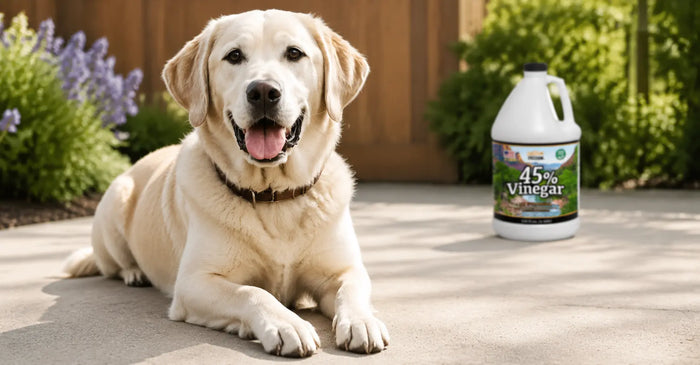
Once dry, acetic acid breaks down into water and carbon dioxide and poses no toxicity risk to pets or children. During application, keep people and animals away from the treated area. Do not let pets walk through wet 45% solution, as concentrated acetic acid is a skin and eye irritant before it dries. See Is 45% Vinegar Safe for Pets? for specific drying times and precautions.
4. How much concentrated vinegar do I need to kill weeds?
Apply undiluted 45% vinegar directly to weed foliage until the leaves are thoroughly coated. For spot treatment of individual weeds, a trigger sprayer is sufficient. For larger areas such as a driveway or gravel path, a pump sprayer with a fan nozzle covers ground more efficiently. One gallon will treat a substantial area when applied as a targeted spray rather than a broadcast application.
5. Will vinegar kill grass as well as weeds?
Yes. Concentrated vinegar is a non-selective contact herbicide, meaning it will kill or damage any plant tissue it contacts, including grass. Apply with care near lawn edges and avoid overspray onto turf you want to keep. This is why it is best suited for hard surfaces, driveways, walkways, and fully contained areas rather than lawn weed spot treatment.
Key Takeaways
• What concentration of vinegar kills weeds? A minimum of 20% acetic acid is needed for meaningful weed control. 45% is the most effective residential-grade concentration available.
• 5% household white vinegar causes surface burn only - roots survive and the plant regrows within days. It is not a reliable weed killer on established plants.
• Vinegar is a contact herbicide that kills what it touches but does not travel to roots the way glyphosate does. Repeat applications are needed for perennial weeds with deep root systems.
• Apply undiluted on a warm, sunny day with no rain forecast for 24 hours. Gloves and eye protection are required.
• Nature's Freedom 45% Concentrated Vinegar is NSF Certified to NSF/ANSI/CAN 60 for drinking water treatment chemicals and made in the USA - the only independently verified 45% option in this category.