
Learning how to use concentrated vinegar to kill weeds comes down to two essentials: the right product and the right conditions. Concentrated vinegar at 45% acetic acid is one of the most effective natural weed killers available without synthetic chemicals. The EPA minimum-risk pesticide program under 40 CFR Part 152 classifies acetic acid as an approved weed control active ingredient. Unlike regular white vinegar at 5%, 45% concentrated vinegar desiccates plant tissue on contact fast enough to kill annual weeds in a single application. For the full concentration breakdown, see What Concentration of Vinegar Kills Weeds?.
TL;DR Apply 45% concentrated vinegar undiluted directly to weed foliage on a dry, sunny day. No dilution needed for weed control. Annual weeds die within 24 to 48 hours. Perennial weeds need 2 to 3 repeat applications. Always wear gloves and eye protection when handling undiluted 45% vinegar.
What You Need Before You Start
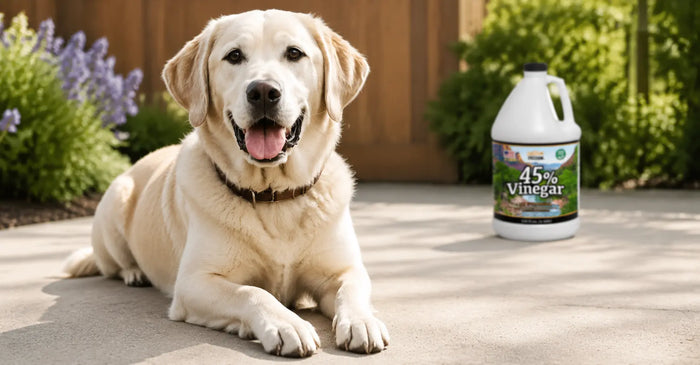
Product: Nature's Freedom 45% Concentrated Vinegar - used undiluted for weed killing. Do not substitute grocery-store vinegar at 5%. The concentration is too low to reliably kill root systems.
Equipment: Pump or trigger sprayer rated for acidic solutions, nitrile or rubber gloves, safety glasses or goggles, long sleeves and closed-toe shoes.
Safety before you apply: 45% concentrated vinegar is a corrosive irritant - not the same as kitchen vinegar. Always wear nitrile gloves and safety glasses when handling or applying undiluted solution. Keep children and pets away from treated areas until completely dry. See Is 45% Vinegar Dangerous? Safety Facts Explained and Is 45% Vinegar Safe for Pets? for species-specific drying time guidance.
How to Use Concentrated Vinegar to Kill Weeds: Step by Step
1. Check the weather first. This is the single most important preparation step. Apply on a dry, sunny day with no rain forecast for at least 24 hours. Rain will wash the solution off the plant before the acid can act. Full sun accelerates the desiccation process significantly.
2. Fill your sprayer undiluted. Pour the 45% concentrated vinegar directly into your sprayer without adding water. For weed killing, dilution reduces effectiveness. Apply in the morning. According to PubChem (National Institutes of Health) - Acetic Acid, acetic acid's contact action is accelerated by heat and UV exposure. Morning application gives the vinegar a full day of sunlight to work.
3. Spray directly onto weed foliage. Coat the leaves and stem of each weed thoroughly - solution should be dripping off the leaves. Focus the spray on the crown of the plant, where the stem meets the soil, as this is where the most tissue damage will prevent regrowth.
4. Avoid drift onto desirable plants. Vinegar is non-selective. It will damage or kill any plant tissue it contacts, including lawn grass, garden plants, and ornamentals. Use a targeted spray pattern and cover nearby plants with cardboard if needed.
5. Do not water the area for at least 24 hours. Watering dilutes the acid before it can complete the kill. Keep the treated area dry for at least 24 hours.
6. Assess and repeat if needed. Check results after 48 to 72 hours. Annual weeds such as chickweed, crabgrass, and thistle seedlings should be brown and dead. Perennial weeds may show top kill but push out new growth - reapply to new growth every 5 to 7 days for up to three treatments.
Where Concentrated Vinegar Works Best for Weed Control
Concentrated vinegar performs best on hard surfaces and contained areas where non-selective kill is not a problem. For the complete cluster of weed-type guides, see Vinegar Weed Killer: How It Works and Best Results.
|
Application Area |
Dilution |
Notes |
|
Driveway and pavement cracks |
Undiluted |
Non-selective; safe around concrete |
|
Gravel paths and patios |
Undiluted |
Broadcast or spot spray |
|
Fence line and border edges |
Undiluted |
Keep away from lawn grass |
|
Annual weed seedlings |
Undiluted |
One application usually sufficient |
|
Perennial weeds (established) |
Undiluted |
Repeat 2 to 3 times over 1 to 2 weeks |
|
Near lawn grass edges |
Careful spot spray |
Non-selective - will kill grass with overspray |
What to Expect After Application
Annual weeds (crabgrass seedlings, hairy bittercress, lamb's quarters, purslane): expect visible wilting within 2 to 4 hours on a warm, sunny day. Full brown-out typically occurs within 24 to 48 hours. One application is usually sufficient for weeds without a deep root system.
Perennial weeds (dandelion, dock, bindweed, ground elder): the top growth dies back, but established roots survive and push out new shoots within one to two weeks. Repeat applications to each flush of new growth, spaced 5 to 7 days apart, will progressively weaken the root system. Three to four treatments over the course of a month is usually sufficient to fully suppress most perennial weeds.
What vinegar does not do: Concentrated vinegar does not move systemically through the plant. It kills what it touches and does not travel down to root tips the way glyphosate-based herbicides do. For deep-rooted perennials in areas you want to plant afterward, manual root removal combined with vinegar surface application is the most effective approach.
Tips for Better Results
• Apply on the hottest, sunniest part of the day for maximum desiccation effect.
• Add a small amount of dish soap - roughly half a teaspoon per quart of vinegar - to act as a surfactant and help the solution adhere to waxy leaves. Particularly useful on grasses and plants with smooth leaf surfaces.
• For large areas like a gravel driveway, a pump sprayer with a fan nozzle covers ground more efficiently than a trigger sprayer.
• Do not apply when temperatures are below 10 degrees Celsius (50 degrees Fahrenheit). Cold slows the desiccation process and reduces kill effectiveness.
• Avoid applying in wind above 15 km/h (10 mph) to prevent drift onto nearby plants.
The Bottom Line
Using concentrated vinegar to kill weeds is straightforward when you start with the right product and the right conditions. Read the complete 45% concentrated vinegar guide. Apply Nature's Freedom 45% Concentrated Vinegar, NSF Certified to NSF/ANSI/CAN 60 for drinking water treatment chemicals, undiluted on a dry, sunny day. Coat the weed foliage thoroughly and give it 24 to 48 hours to work. Repeat on perennial weeds as needed. No synthetic chemicals, no soil residue, and no waiting period before children and pets can return to the area once it dries. Order the 45% Concentrated Vinegar - 1 Gallon. Browse the full concentrated vinegar collection, or contact the Nature's Freedom team with questions.
Frequently Asked Questions: How to Use Concentrated Vinegar to Kill Weeds
1. Do I need to dilute concentrated vinegar before using it on weeds?
No. For weed killing, use 45% concentrated vinegar undiluted straight from the jug. Diluting it reduces the acetic acid concentration and slows or prevents the kill. Dilution ratios are relevant for indoor cleaning tasks, not outdoor weed control.
2. How long does it take for concentrated vinegar to kill weeds?
On annual weeds, visible wilting typically starts within 2 to 4 hours on a warm, sunny day. Full kill occurs within 24 to 48 hours. Perennial weeds take longer, with top growth dying back over the same period, but roots surviving and requiring repeat applications.
3. Will concentrated vinegar kill weed seeds in the soil?
Concentrated vinegar applied as a foliar spray does not penetrate deeply enough into the soil to kill weed seeds at germination depth. It treats existing above-ground weeds but does not act as a pre-emergent herbicide. Regular applications to new growth is the most effective strategy for ongoing weed pressure.
4. Is concentrated vinegar safe to use near a vegetable garden?
Use with care. Concentrated vinegar is non-selective and will damage vegetable plants on contact. Apply targeted sprays only, use a shield to protect nearby crops, and avoid broadcast application near vegetable beds. Once dry, acetic acid breaks down and does not persist in soil in a way that affects food safety.
5. How many applications will it take to clear a driveway full of weeds?
For a driveway with a mix of annual weeds and established perennials, expect two to three applications over two to three weeks. The first application kills surface growth. Subsequent applications target regrowth from surviving roots. After three rounds, the majority of weed pressure on a hard surface like concrete or pavers will be eliminated.
Key Takeaways
• How to use concentrated vinegar to kill weeds: apply 45% undiluted directly to weed foliage on a dry, sunny day. No dilution needed. One application kills annual weeds within 24 to 48 hours.
• Perennial weeds with deep root systems require 2 to 3 repeat applications spaced 5 to 7 days apart. The strategy is to exhaust root energy reserves by killing each flush of new growth.
• Vinegar is non-selective - it kills any green plant tissue it contacts. Keep applications precise and avoid overspray onto lawn grass, garden plants, or ornamentals.
• Apply on the hottest, sunniest part of the day and avoid rain for at least 24 hours after treatment. Adding a small amount of dish soap improves adhesion on waxy leaves.
• Nature's Freedom 45% Concentrated Vinegar is NSF Certified to NSF/ANSI/CAN 60 for drinking water treatment chemicals and made in the USA - the only independently verified 45% option in this category.