
Yes, hydrogen peroxide can be used as a pesticide. The EPA minimum-risk pesticide program lists hydrogen peroxide as an approved active ingredient exempt from standard federal registration requirements. At 3% concentration, it is effective against fungus gnats, spider mites, aphids, mealybugs, and whiteflies.
Can Hydrogen Peroxide Be Used as a Pesticide - How Does It Work?
Hydrogen peroxide kills soft-bodied pests through direct oxidative contact - destroying cell membranes without systemic toxicity. According to PubChem (National Institutes of Health), H2O2 is a strong oxidizing agent that destroys organic compounds through reactive oxygen release. For soft-bodied insects and larvae, this disrupts the lipid membranes of the insect's body and interferes with the respiratory function of larvae that breathe through cuticular surfaces. The CDC NIOSH Pocket Guide confirms hydrogen peroxide's strong oxidizing properties - the same mechanism that makes it antimicrobial applies to soft-bodied pest organisms at the cellular level.
Unlike conventional pesticides that persist on plant surfaces for days to weeks, hydrogen peroxide decomposes immediately after the oxidation reaction completes - no residue, no waiting period before harvest. The tradeoff: repeat applications are required because there is no residual protective effect once the H2O2 has decomposed. See the full hydrogen peroxide for plants guide for concentration guidelines and application frequencies across all plant care uses.
How Do You Treat Fungus Gnats with Hydrogen Peroxide?
Fungus gnats are one of the best use cases for hydrogen peroxide as a pesticide. Adult flies cause minimal damage - the larvae living in moist potting soil and feeding on fine root hairs are the damaging stage. For full dilution ratios from both 35% and 12% H2O2, see the hydrogen peroxide dilution guide.
Fungus Gnat Treatment Protocol (HowTo)
1. Allow the top inch of soil to dry completely before treatment - dry conditions reduce larval survival and prevent adults from laying new eggs.
2. Prepare a 3% solution: mix 1 part 35% H2O2 with 10.7 parts water, or 1 part 12% H2O2 with 3 parts water.
3. Water the plant thoroughly with the 3% solution until it drains freely from the bottom. H2O2 contacts larvae in the soil profile as it moves through the root zone.
4. Repeat every three to four days for two weeks. The treatment cycle must outlast the fungus gnat life cycle (approximately 17 days) to break the infestation.
5. Use yellow sticky traps above the soil to capture adult fungus gnats simultaneously, reducing the adult population laying new eggs.
The fizzing visible in the soil when 3% H2O2 is applied is the oxidation reaction killing larvae on contact and oxygenating the root zone as a secondary benefit. Learn other hydrogen peroxide uses.
How Do You Treat Spider Mites and Other Soft-Bodied Pests?
Spider Mites (HowTo)
1. Prepare a 3% H2O2 solution.
2. Spray all leaf surfaces thoroughly, with emphasis on undersides where mite populations concentrate. Use a fine-mist spray bottle to maximize coverage.
3. Allow to dry naturally - do not rinse. The contact period as the solution dries is when oxidative action against mite soft tissue occurs.
4. Repeat every three days for two weeks. Spider mite eggs are not eliminated in a single treatment - repeat applications break the reproductive cycle.
5. Raise humidity around affected plants. Spider mites thrive in dry air; increased humidity reduces rapid recolonization.
Apply in the early morning to avoid rapid H2O2 decomposition from direct midday sunlight.
Aphids
Apply a direct spray of 3% H2O2 onto the aphid colony, allow 5 minutes, then rinse with clean water. Repeat every three days until the colony is eliminated. Aphids reproduce rapidly - consistent repeat applications matter more than any single high-concentration treatment.
Mealybugs and Whiteflies
For mealybugs, apply 3% H2O2 directly to clusters with a small brush or cotton swab to ensure contact beneath the waxy coating. Allow 5 to 10 minutes, wipe away. For whiteflies, spray leaf undersides three times per week in early morning when movement is reduced. Combine with yellow sticky traps to reduce the adult population between treatments.
Pest Reference Table
|
Pest |
Conc. |
Method |
Frequency |
Effectiveness |
|
Fungus gnats (larvae) |
3% |
Soil drench to root zone |
Every 3-4 days |
Excellent |
|
Spider mites |
3% |
Foliar spray, leaf undersides |
Every 3 days |
Good |
|
Aphids |
3% |
Direct spray on colony |
Every 3 days |
Good |
|
Mealybugs |
3% |
Cotton swab or spray |
Weekly |
Good |
|
Whitefly |
3% |
Foliar spray, morning |
3x weekly |
Moderate |
|
Soil-dwelling larvae |
3% |
Soil drench |
Every 3 days |
Good |
|
Hard-bodied beetles |
N/A |
Not effective |
N/A |
Not recommended |
The EPA Safer Choice program recognizes hydrogen peroxide as an approved active ingredient for safer cleaning and pest control formulations, citing its clean decomposition profile and absence of persistent environmental residue.
Where Does Hydrogen Peroxide Fall Short as a Pesticide?
Hard-bodied insects: Beetles, caterpillars, and grasshoppers are not affected - their cuticle prevents the oxidative action from reaching soft tissue beneath.
Systemic infestations: H2O2 only works where it physically contacts the pest. Leaf miners and pests embedded inside plant tissue are not reachable by surface application.
Large-scale outdoor pressure: The repeat application frequency required is impractical at garden scale. Combine with physical barriers, companion planting, and beneficial insects.
For garden weed control, Nature's Freedom 45% concentrated vinegar is a more effective contact herbicide - see the vinegar weed killer recipe for application ratios. H2O2 has no meaningful herbicidal effect. For concentration safety with plant-adjacent applications, see does hydrogen peroxide kill plants.
Why Is NSF-Certified H2O2 the Right Starting Point for Pest Control?
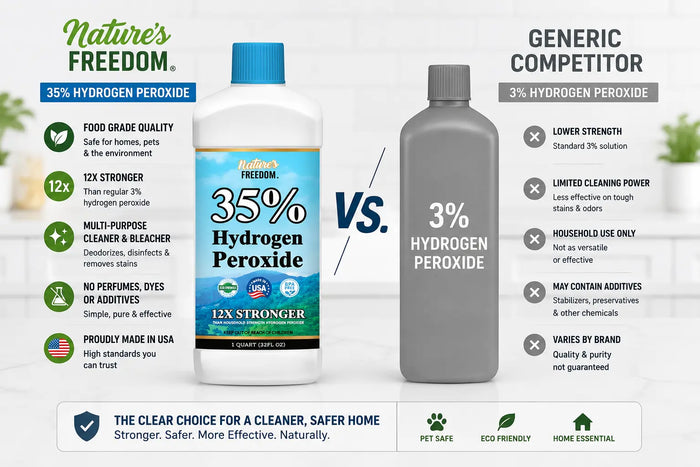
For pest control on edible plants where residue matters most, starting product quality is critical. Drugstore 3% hydrogen peroxide contains stabilizers that do not fully decompose in soil or on plant surfaces - on edible plants treated repeatedly, those stabilizers accumulate in the growing environment. See what is food grade hydrogen peroxide for a full breakdown of stabilizer differences between certified and non-certified H2O2.
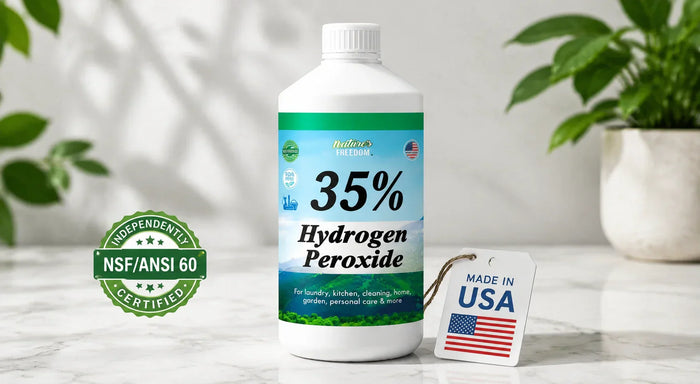
Nature's Freedom 35% H2O2 and 12% H2O2 are both NSF/ANSI/CAN 60 and NSF/ANSI/CAN 50 certified - independently verified concentration, no stabilizers. Diluted to 3%, only H2O2 and water contact the plant and soil. After the oxidation reaction completes, only water and oxygen remain. Accurate concentration from an NSF-verified starting point also means your dilution calculations are correct - critical when treating plants already stressed by pest damage. Learn more about why Nature's Freedom holds these certifications.
- No stabilizer residue on treated plants or in soil after pest control applications
- NSF-verified 35% and 12% concentration - dilution to 3% produces full-strength pest control solution every time
- Safe for edible plants at correct dilution - no waiting period before harvest
- Manufactured in the USA under NSF-audited conditions
Nature's Freedom 35% hydrogen peroxide is NSF Certified to NSF/ANSI/CAN 60 for drinking water treatment chemicals and NSF/ANSI/CAN 50 for pool, spa, hot tub, and other recreational water treatment chemical use.
Control Pests. Leave No Residue.
Nature's Freedom 35% H2O2 is NSF/ANSI/CAN 60 and NSF/ANSI/CAN 50 certified, stabilizer-free, and made in the USA. One bottle provides a full pest treatment course for fungus gnats, spider mites, aphids, and more - no toxic residue on plants or in soil.
Shop concentrated hydrogen peroxide | Browse the full collection | Contact Nature's Freedom
Frequently Asked Questions
1. Can hydrogen peroxide be used as a pesticide?
Yes. The EPA recognizes hydrogen peroxide as an approved active ingredient for minimum-risk pesticide formulations, exempt from standard federal registration requirements. It is effective against fungus gnats, spider mites, aphids, mealybugs, and whiteflies at 3%. It is not effective against hard-bodied insects such as beetles and caterpillars.
2. Does hydrogen peroxide kill fungus gnats?
Yes, particularly the larvae in moist potting soil. A 3% H2O2 soil drench applied every three to four days for two weeks kills larvae on contact and oxygenates the soil to reduce future infestations. Combine with yellow sticky traps to capture adults. See the hydrogen peroxide for plants guide for the full protocol.
3. Will hydrogen peroxide kill spider mites?
Yes. Apply 3% H2O2 as a fine mist to all leaf surfaces - emphasis on undersides. Allow to dry without rinsing. Repeat every three days for two weeks to break the reproductive cycle. Apply in the early morning to maximize contact time. See will hydrogen peroxide kill fungus for context on H2O2's broader antifungal and antimicrobial action on plant surfaces.
4. Is hydrogen peroxide safe as a pesticide on edible plants?
Yes, when using NSF-certified stabilizer-free H2O2. Hydrogen peroxide decomposes entirely into water and oxygen after the oxidation reaction - no pesticide residue remains on plants or in soil, and there is no pre-harvest waiting period. Drugstore 3% contains stabilizers that do not fully decompose; for edible plants, stabilizer-free NSF-certified H2O2 is the correct choice.
5. How often should you apply hydrogen peroxide for pest control?
Every three days for active infestations, consistently for a minimum of two weeks. Most pest life cycles run 14 to 21 days - treatment must continue through the full cycle to prevent reinfestation from eggs that hatch after initial applications. Once resolved, a weekly 1% preventive soil drench reduces conditions favorable to soil-dwelling pest larvae.
Key Takeaways
- Hydrogen peroxide is an EPA-recognized minimum-risk pesticide ingredient effective against fungus gnats, spider mites, aphids, mealybugs, and whiteflies at 3% concentration.
- It works through direct oxidative contact with soft-bodied insects and larvae. It is not effective on hard-bodied pests such as beetles, caterpillars, or grasshoppers.
- Apply every three days for a minimum of two weeks to break the full pest life cycle - single applications do not eliminate eggs or second-generation larvae.
- Hydrogen peroxide leaves no pesticide residue after decomposition - safe for edible plants with no pre-harvest waiting period when using stabilizer-free H2O2.
- For fungus gnats, combine 3% soil drenches with yellow sticky traps - the drench kills larvae, the traps reduce the egg-laying adult population simultaneously.
- Nature's Freedom 35% H2O2 and 12% H2O2 are both NSF Certified to NSF/ANSI/CAN 60 and NSF/ANSI/CAN 50 - stabilizer-free, no residue in soil or on edible plant surfaces after pest control treatment.