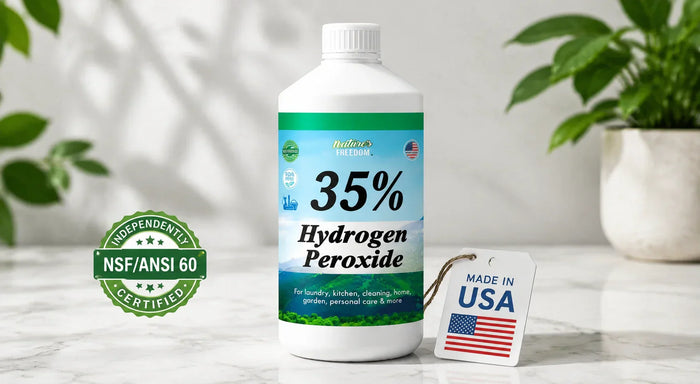

Apply 3% H2O2 directly to the mold-affected surface, allow 5 to 10 minutes of undisturbed contact time, scrub, then rinse or wipe dry. For heavy mold on grout, use 6% and allow the full 10 minutes. The two variables that determine whether treatment works: the right concentration and the full contact time. Nature's Freedom 35% H2O2 is NSF Certified to NSF/ANSI/CAN 60 for drinking water treatment chemicals and NSF/ANSI/CAN 50 for pool, spa, hot tub, and other recreational water treatment chemical use - stabilizer-free, verified concentration, made in the USA.
This guide is for homeowners who need to clean mold with hydrogen peroxide on tile, grout, walls, caulk, and kitchen surfaces. It covers the correct concentration, contact time, tools, and a step-by-step protocol for every common household surface.
What You Need Before You Start
Four things determine the outcome before you apply the first drop: materials, dilution, the right tool for the surface, and ventilation.
Materials
• Nature's Freedom 35% food grade hydrogen peroxide
• Measuring cup and HDPE spray bottle for dilution
• Nitrile gloves for diluting the 35% concentrate
• Stiff grout brush for tile and grout surfaces
• Soft sponge or cloth for walls and smooth surfaces
• Old toothbrush or detail brush for caulk and tight spaces
Dilution
3% working solution: mix 1 part 35% H2O2 with 10.7 parts water
6% working solution: mix 1 part 35% H2O2 with 4.8 parts water
Always add H2O2 to water, not water to H2O2. Wear nitrile gloves during dilution and keep the area ventilated.
How to Clean Mold with Hydrogen Peroxide: Step-by-Step
1. Ventilate. Open windows and run exhaust fans before applying any product. For black mold or a large affected area, wear an N95 mask and safety goggles.
2. Put on nitrile gloves.
3. Prepare your working solution. Dilute to 3% for most surfaces or 6% for heavy grout mold. Pour into an HDPE spray bottle.
4. Apply the solution. Spray directly onto the mold-affected surface and the surrounding 6-inch area, saturating fully.
5. Allow the full contact time. Do not wipe, scrub, or disturb the surface during the contact period. The oxidation reaction requires dwell time to penetrate below the visible surface layer and reach the mold hyphae beneath.
6. Scrub the surface. Use a stiff grout brush for grout lines, an old toothbrush for caulk, and a soft sponge for walls and smooth surfaces.
7. Rinse or wipe. Rinse with clean water for tile, grout, and window frames. Wipe dry without rinsing for painted walls and sealed wood.
8. Inspect. If mold discoloration remains, repeat the treatment. Heavy infestations typically require two to three sessions.
9. Dry the surface thoroughly. Mold requires moisture. After cleaning, dry as completely as possible and improve ventilation to reduce ongoing humidity.
According to PubChem (National Institutes of Health), hydrogen peroxide is a broad-spectrum antimicrobial agent effective against fungi and bacteria. The oxidation mechanism begins immediately on contact and completes over the contact time period. Shortening contact time significantly reduces treatment effectiveness.
Surface-Specific Guide
|
Surface |
Concentration |
Contact Time |
Tool |
Post-Treatment |
|
Bathroom tile |
3% |
5 min |
Spray bottle |
Rinse with water |
|
Grout (light mold) |
3% |
10 min |
Stiff grout brush |
Rinse and dry |
|
Grout (heavy mold) |
6% |
10 min |
Stiff grout brush |
Rinse and dry |
|
Shower caulk |
3% |
10 min |
Toothbrush or detail brush |
Rinse thoroughly |
|
Painted walls |
3% |
5 to 10 min |
Soft sponge |
Wipe dry, do not rinse |
|
Window sills/frames |
3% |
5 min |
Cloth or sponge |
Wipe dry |
|
Kitchen surfaces |
3% |
1 to 3 min |
Cloth or spray |
Air dry |
|
Sealed wood |
3% |
5 to 10 min |
Soft brush |
Wipe dry immediately |
For bathroom mold on grout, caulk, and tile: grout is the most frequent mold location in homes. For heavy black mold that has penetrated grout, step up to 6% and allow the full 10 minutes. For mold on caulk where penetration is visible below the surface, replacement is more effective than surface treatment.
For kitchen surfaces: hydrogen peroxide is the preferred disinfectant over bleach for food-contact areas because it decomposes entirely into water and oxygen. The EPA Safer Choice program recognizes hydrogen peroxide as an approved active ingredient for safer cleaning formulations, including food-adjacent surface applications.
The EPA mold cleanup guidelines recommend professional assessment for mold covering more than 10 square feet. See also the does hydrogen peroxide kill black mold guide for YMYL safety guidance on larger or structural mold situations.
How to Prevent Mold from Coming Back
• Run the bathroom exhaust fan during every shower and for 15 minutes after.
• Fix any leaks in plumbing, roof, or windows immediately.
• Keep indoor humidity below 60%.
• Apply 3% H2O2 to grout and caulk weekly as a maintenance spray and allow to dry without rinsing. For hard water deposits alongside mold, Nature's Freedom 45% concentrated vinegar dissolves mineral deposits H2O2 cannot address. Use separately - never mixed. See the can you mix vinegar and hydrogen peroxide guide for the sequential protocol.
Why NSF-Certified 35% H2O2 Is the Right Product
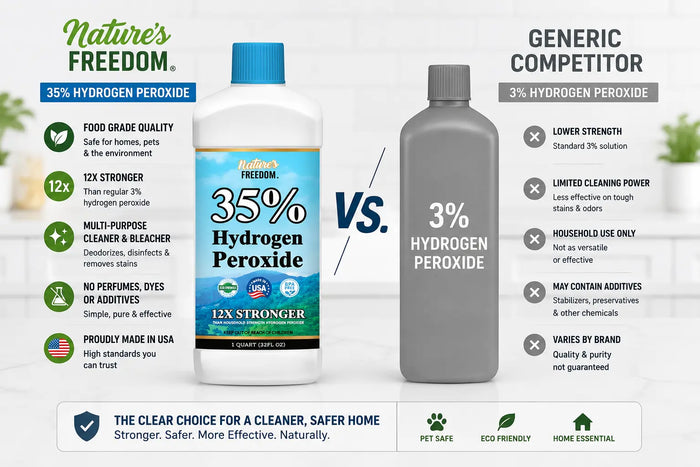
For mold cleaning on food contact surfaces and in areas where surface residue is a concern, the stabilizer content of the hydrogen peroxide matters. Stabilizers in non-certified H2O2 leave residue on treated surfaces after decomposition. Nature's Freedom 35% H2O2 is NSF Certified to NSF/ANSI/CAN 60 for drinking water treatment chemicals and NSF/ANSI/CAN 50 for pool, spa, hot tub, and other recreational water treatment chemical use. It is independently verified to contain no stabilizers and to meet its stated 35% concentration. When applied to mold-affected surfaces, only H2O2 and water contact the surface. After decomposition, only water and oxygen remain. Learn more on the Why Nature's Freedom page.
The EPA minimum-risk pesticide program lists hydrogen peroxide as an approved active ingredient for cleaning applications. The CDC NIOSH confirms its safety profile at 3% and 6% cleaning concentrations. Learn other hydrogen peroxide uses.
• The product is NSF Certified to NSF/ANSI/CAN 60 for drinking water treatment chemicals and NSF/ANSI/CAN 50 for pool, spa, hot tub, and other recreational water treatment chemical use.
• No stabilizer residue on treated surfaces - appropriate for kitchen and food contact areas.
• Verified 35% concentration - dilution to 3% or 6% is accurate, not weaker than expected.
• Safe for colored grout at 3% - no bleaching of grout color at standard contact times.
• Manufactured in the USA under NSF-audited conditions.
Clean Mold. Leave No Residue. Keep It Gone.
Nature's Freedom 35% hydrogen peroxide is NSF-certified, stabilizer-free, and made in the USA. Every surface in this guide. Every step in this method. Shop concentrated hydrogen peroxide or browse the full hydrogen peroxide collection at naturesfreedom.com. Questions? Contact the Nature's Freedom team.
Frequently Asked Questions
1. How do you clean mold with hydrogen peroxide?
Apply 3% H2O2 directly to the mold-affected surface, allow 5 to 10 minutes of undisturbed contact time, scrub with the appropriate tool for the surface, then rinse or wipe dry. The contact time is the most critical variable. Never wipe immediately after application.
2. How long should hydrogen peroxide sit on mold before scrubbing?
A minimum of 5 minutes for light surface mold on non-porous surfaces such as tile and kitchen counters. A minimum of 10 minutes for mold on grout, caulk, and semi-porous surfaces. For heavy black mold at 6% concentration, allow the full 10 minutes before scrubbing.
3. What concentration of hydrogen peroxide should you use for mold?
3% for most household mold on tile, walls, window frames, kitchen surfaces, and sealed wood. 6% for heavy mold on grout and caulk. To prepare 3% from 35% concentrate: mix 1 part H2O2 with 10.7 parts water. For 6%: mix 1 part H2O2 with 4.8 parts water.
4. Can hydrogen peroxide remove mold stains?
Yes. Hydrogen peroxide removes mold discoloration through the same oxidation mechanism that kills the mold organism. For stubborn staining that persists after treatment, a second full-contact-time application typically removes it.
5. Is hydrogen peroxide or bleach better for cleaning mold?
Hydrogen peroxide is better for most household surfaces. It kills the mold organism rather than bleaching its appearance, leaves no chemical residue, is safe on colored grout and food surfaces, and produces minimal fumes. The EPA Safer Choice program approves hydrogen peroxide as a cleaning ingredient. Bleach is not on the Safer Choice list.
6. How do you stop mold from coming back after treatment?
Moisture control is the only lasting solution. Run the bathroom exhaust fan during and after every shower, fix leaks immediately, and keep indoor humidity below 60%. As a maintenance measure, apply 3% H2O2 to shower grout and caulk weekly and allow to dry without rinsing.
Key Takeaways
• To clean mold with hydrogen peroxide: apply 3% H2O2, allow 5 to 10 minutes of contact time, scrub, and rinse or wipe dry. Use 6% for heavy mold on grout. Prepare from Nature's Freedom 35% H2O2: 3% = 1 part H2O2 + 10.7 parts water; 6% = 1 part H2O2 + 4.8 parts water.
• Never wipe immediately after application. The contact time is the single most important variable. Minimum 5 minutes for smooth surfaces, minimum 10 minutes for grout and caulk.
• Ventilate before and during cleaning. For black mold or large areas, wear an N95 mask and safety goggles.
• After full treatment, apply 3% H2O2 weekly to grout and caulk and allow to dry without rinsing to slow mold re-establishment.
• Moisture control is the only lasting mold prevention. Ventilate, fix leaks immediately, and keep indoor humidity below 60%.
• Nature's Freedom 35% H2O2 is NSF Certified to NSF/ANSI/CAN 60 for drinking water treatment chemicals and NSF/ANSI/CAN 50 for pool, spa, hot tub, and other recreational water treatment chemical use. Stabilizer-free with verified concentration for accurate 3% and 6% solutions. See also: hydrogen peroxide mold removal guide and where to buy pool hydrogen peroxide.