
No. Do not mix vinegar and hydrogen peroxide in the same container. When combined, they react to form peracetic acid, a more corrosive compound with stronger irritant properties and no meaningful improvement in mold-killing effectiveness. However, used sequentially on the same surface - vinegar first, rinse, then H2O2 - the two products address mold through complementary mechanisms and outperform either product used alone. Nature's Freedom 45% concentrated vinegar and 35% hydrogen peroxide are both NSF-certified, stabilizer-free, and made in the USA.
This guide is for homeowners who want to use both vinegar and hydrogen peroxide to tackle mold and need to know whether it is safe to combine them and what the correct protocol is.
SAFETY: Do not mix vinegar and hydrogen peroxide in the same container. Mixing them forms peracetic acid, a more corrosive and irritating compound. Use them sequentially - vinegar first, rinse, then hydrogen peroxide - for better mold results than either product alone.
Why Should You Not Mix Vinegar and Hydrogen Peroxide?
Mixing vinegar and hydrogen peroxide forms peracetic acid, a more irritating compound with no improvement in mold-killing effectiveness. According to PubChem (NIH) and PubChem (NIH) - Acetic Acid, when acetic acid and hydrogen peroxide combine, they form peracetic acid (CH3CO3H) - a strong oxidizing agent with sharply pungent odor and significantly stronger skin, eye, and respiratory irritant properties than either starting compound.
The CDC NIOSH identifies peracetic acid as a respiratory, skin, and eye irritant at concentrations produced by mixing household-strength solutions. The mixed solution is also less stable than either starting product, degrading faster and reducing effective contact time with mold.
• Acetic acid + hydrogen peroxide forms peracetic acid in solution.
• Peracetic acid is more corrosive than either starting compound at comparable concentrations.
• The antimicrobial effectiveness does not increase proportionally to the irritant properties.
Why Does Sequential Application Work Better Than Mixing?
Vinegar and hydrogen peroxide attack mold through completely different mechanisms, and those mechanisms complement each other when used in sequence - not simultaneously.
Vinegar works through its acidic pH, disrupting mold cell membrane function and loosening established colonies from semi-porous surfaces. This structural disruption makes the mold organism more accessible to the treatment that follows.
Hydrogen peroxide works through oxidation, releasing reactive oxygen that destroys fungal cell membranes and spore structures on direct contact. This kill action is most effective on an exposed organism after surface growth has been cleared.
Applied first, vinegar loosens the colony and compromises mold cell structure. Applied after a thorough rinse, hydrogen peroxide contacts the more exposed organism and delivers a more complete kill than H2O2 applied to an intact colony.
|
Property |
35% H2O2 (diluted to 3%) |
45% Vinegar (diluted to 10%) |
|
Mechanism |
Oxidation, kills mold cells on contact |
Acidic, disrupts mold cell structure |
|
Best use in sequence |
Second - kills exposed organism |
First - loosens and disrupts colony |
|
Penetration on grout |
Good, oxidizes into pores |
Good, acid penetrates cement matrix |
|
Residue after use |
None, water and oxygen only |
Mild acidic residue - rinse thoroughly |
|
EPA Safer Choice |
Yes |
Yes (acetic acid) |
|
NSF Certification |
NSF/ANSI/CAN 60 + NSF/ANSI/CAN 50 |
NSF/ANSI/CAN 60 |
How to Use Vinegar and Hydrogen Peroxide Sequentially for Mold
Use vinegar first, then hydrogen peroxide, with a thorough rinse between. The order is not optional.
1. Dilute. Mix 45% vinegar to 10% (1 part vinegar to 3.5 parts water) for most surfaces, or use undiluted on heavy grout mold. Dilute 35% H2O2 to 3% (1 part H2O2 to 10.7 parts water).
2. Apply vinegar first. Spray diluted vinegar onto the mold-affected surface. Saturate the area fully.
3. Allow 10 minutes contact time. The acid needs dwell time to penetrate the mold colony. Do not wipe during this period.
4. Scrub the surface. Use a stiff brush on grout, softer brush on walls. This removes loosened mold and exposes the underlying organism.
5. Rinse thoroughly with clean water and wipe dry. This removes the acetic acid from the surface before applying H2O2. This step is the single most important safety measure in the protocol. Skipping it risks peracetic acid formation.
6. Apply hydrogen peroxide. Spray 3% H2O2 onto the same surface, now cleared of surface growth.
7. Allow 5 to 10 minutes of contact time. Do not wipe during this period.
8. Scrub lightly if needed, then rinse and allow to dry fully.
9. Address the moisture source. Fix leaks, improve ventilation, and reduce humidity. No surface treatment prevents mold without moisture control.
Do not apply H2O2 onto a vinegar-wet surface. Always complete the rinse step between applications. See the full hydrogen peroxide mold removal guide for single-product treatment guidance.
When to Use Sequential Treatment vs. Hydrogen Peroxide Alone
Use hydrogen peroxide alone when:
• The mold is light surface growth on non-porous tile or glass.
• You want a quick maintenance treatment to prevent mold establishment.
• The surface is colored grout where repeated acid exposure may affect color or sealant over time. See the does hydrogen peroxide kill mold guide for full surface guidance.
Use the sequential protocol when:
• Heavy mold has established on grout, caulk, or semi-porous surfaces.
• Black mold is present and the strongest effective DIY approach is needed. See the does hydrogen peroxide kill black mold guide for YMYL safety guidance.
• Mold has returned repeatedly after single-product treatment.
The EPA mold cleanup guidelines emphasize moisture control as the foundation of effective mold management. No treatment protocol - sequential or otherwise - permanently eliminates mold without addressing the underlying moisture source. Learn other hydrogen peroxide uses.
Why NSF-Certified Products Give the Best Sequential Results
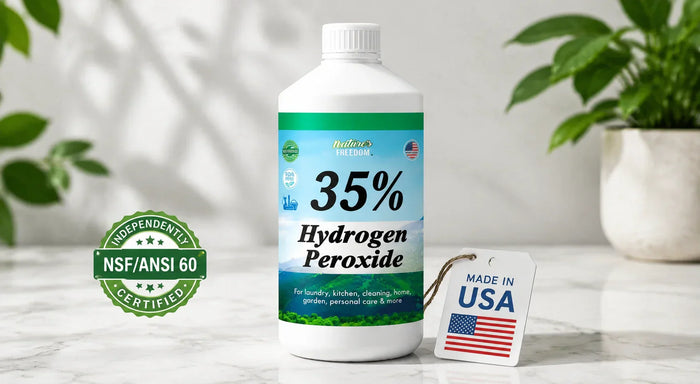
For sequential mold treatment, the quality and verified concentration of both starting products directly affects the result. Nature's Freedom 35% hydrogen peroxide is NSF Certified to NSF/ANSI/CAN 60 for drinking water treatment chemicals and NSF/ANSI/CAN 50 for pool, spa, hot tub, and other recreational water treatment chemical use. Nature's Freedom 45% concentrated vinegar is NSF Certified to NSF/ANSI/CAN 60 for drinking water treatment chemicals. Both are independently verified to meet their stated concentrations and contain no stabilizers. Learn more on the Why Nature's Freedom page.
The EPA Safer Choice program recognizes both hydrogen peroxide and acetic acid as approved active ingredients for safer cleaning formulations.
• Nature's Freedom 35% H2O2 is NSF Certified to NSF/ANSI/CAN 60 for drinking water treatment chemicals and NSF/ANSI/CAN 50 for pool, spa, hot tub, and other recreational water treatment chemical use.
• Nature's Freedom 45% vinegar is NSF Certified to NSF/ANSI/CAN 60 for drinking water treatment chemicals.
• Both stabilizer-free - no residue accumulation on treated surfaces after decomposition.
• Both made in the USA under NSF-audited conditions.
Two Products. Two Mechanisms. One Complete Mold Treatment.
Nature's Freedom 35% hydrogen peroxide and 45% concentrated vinegar are both NSF-certified, stabilizer-free, and made in the USA. Used sequentially, they handle mold more thoroughly than either product alone. Browse the full hydrogen peroxide collection at naturesfreedom.com. Questions? Contact the Nature's Freedom team.
Frequently Asked Questions
1. Can you mix vinegar and hydrogen peroxide to kill mold?
No. Mixing them in the same container produces peracetic acid, a more corrosive compound with stronger irritant properties and no meaningful improvement in mold-killing effectiveness. Used sequentially - vinegar first, rinse, then hydrogen peroxide - the two products are significantly more effective against mold than either used alone.
2. What happens when you mix vinegar and hydrogen peroxide?
They react to form peracetic acid (CH3CO3H), a strong oxidizer with a pungent odor and stronger irritant properties for skin, eyes, and airways. The mixture is also less stable than either starting product, degrading faster and reducing effective mold contact time.
3. Is sequential application of vinegar and hydrogen peroxide safe?
Yes, when the rinse step between applications is completed. Apply vinegar, allow contact time, scrub, then rinse thoroughly with clean water before applying H2O2. The rinse removes acetic acid from the surface, preventing the peracetic acid formation that makes simultaneous mixing problematic.
4. Which kills mold better - vinegar or hydrogen peroxide?
They work through different mechanisms. Hydrogen peroxide kills mold through oxidation and leaves no residue. Vinegar disrupts mold structure and loosens established colonies from grout and caulk. For light mold on non-porous surfaces, hydrogen peroxide alone is sufficient. For heavy or recurring mold, the sequential protocol outperforms either product alone.
5. Which product goes first - vinegar or hydrogen peroxide?
Vinegar goes first, hydrogen peroxide goes second. Vinegar disrupts mold structure and loosens the colony from the substrate. After the rinse, hydrogen peroxide contacts the exposed organism and delivers its oxidative kill. Reversing the order reduces vinegar effectiveness without improving H2O2 performance.
6. Why use concentrated vinegar rather than standard household vinegar for mold?
Nature's Freedom 45% concentrated vinegar contains nine times more acetic acid than standard 5% household vinegar. The higher acid concentration is significantly more effective at disrupting mold cell structure, loosening established colonies from grout and caulk, and penetrating the biofilm matrix that anchors mold to surfaces.
Key Takeaways
• Never mix vinegar and hydrogen peroxide in the same container. The reaction forms peracetic acid - a more corrosive and irritating compound with no meaningful benefit over sequential use.
• Used sequentially (vinegar first, rinse, then hydrogen peroxide), the two products are more effective against mold than either used alone. Vinegar disrupts mold structure; H2O2 kills the exposed organism.
• Always rinse thoroughly between the vinegar and H2O2 applications. This single step prevents peracetic acid formation and is the most important safety measure in the sequential protocol.
• The correct order is vinegar first, hydrogen peroxide second. Applying H2O2 after vinegar has loosened the colony produces better kill rates than H2O2 alone on an intact colony.
• Nature's Freedom 45% vinegar is NSF Certified to NSF/ANSI/CAN 60 for drinking water treatment chemicals. Nature's Freedom 35% H2O2 is NSF Certified to NSF/ANSI/CAN 60 for drinking water treatment chemicals and NSF/ANSI/CAN 50 for pool, spa, hot tub, and other recreational water treatment chemical use. Both are stabilizer-free. See also: hydrogen peroxide mold removal and does hydrogen peroxide kill black mold.