
This guide is for homeowners who have found black mold on tile, grout, sealed wood, or painted walls and want to know whether hydrogen peroxide is an appropriate treatment. It covers the correct concentration, step-by-step protocol, PPE requirements, surface limitations, and when to stop and call a licensed professional.
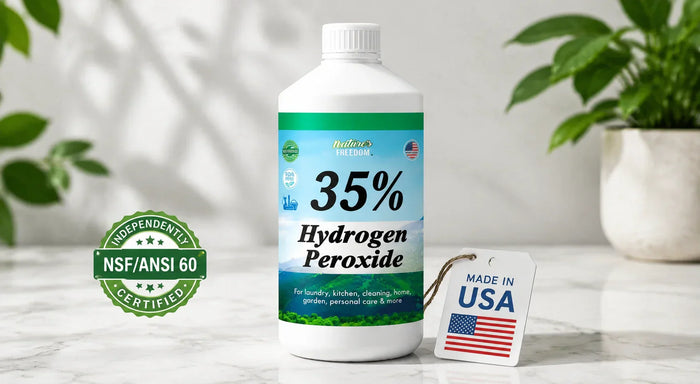
Yes. Hydrogen peroxide kills black mold on accessible surfaces through oxidation - it destroys fungal cell structures rather than bleaching visible discoloration. Use 6% concentration, allow 10 minutes of contact time, scrub firmly, and remove all loosened material. Wear an N95 respirator, nitrile gloves, and safety goggles before starting. Nature's Freedom 35% H2O2 is NSF Certified to NSF/ANSI/CAN 60 for drinking water treatment chemicals and NSF/ANSI/CAN 50 for pool, spa, hot tub, and other recreational water treatment chemical use - independently verified stabilizer-free and made in the USA. For black mold on drywall, structural wood, or any area larger than 10 square feet, professional remediation is appropriate.
What Is Black Mold and How Is It Different?
Black mold refers specifically to Stachybotrys chartarum, a distinct mold species with higher mycotoxin production than most common household mold varieties. The term is widely misapplied - many mold species appear black or dark green, including Cladosporium and Aspergillus species that grow in bathrooms without water damage. Stachybotrys requires high-cellulose materials and prolonged moisture, and does not typically establish on tile, grout, or caulk.
|
Property |
Stachybotrys (Black Mold) |
Common Household Mold |
|
Growth substrate |
High-cellulose: drywall, wood, paper |
Wide range of surfaces |
|
Moisture requirement |
Requires prolonged water damage |
Grows in standard humidity |
|
Mycotoxin production |
Yes, trichothecene mycotoxins |
Generally lower toxin levels |
|
H2O2 effective? |
Yes on accessible surfaces |
Yes on accessible surfaces |
|
Professional remediation? |
More often - deeper penetration |
Less often for small areas |
According to the EPA mold cleanup guidelines, species identification is less important for DIY cleanup decisions than the size of the affected area and the material it is growing on.
Does Hydrogen Peroxide Kill Black Mold on Surfaces?
Yes. Hydrogen peroxide kills black mold through the same oxidative mechanism it uses against all mold species. 6% concentration provides the stronger oxidizing action that Stachybotrys colonies require. According to PubChem (National Institutes of Health), hydrogen peroxide has documented broad-spectrum antimicrobial activity against fungal organisms. Reactive oxygen destroys fungal cell membranes and spore structures on contact.
• Kills the mold organism on accessible surfaces through direct oxidative contact.
• Removes visible black discoloration from the surface through oxidation.
• Penetrates slightly deeper into semi-porous surfaces such as grout than bleach.
• Does not reach mold growth inside drywall, structural wood, or other porous materials.
• Does not neutralize mycotoxins already deposited in porous materials.
For a full comparison of H2O2 vs. bleach for mold treatment, see the hydrogen peroxide mold removal guide.
How to Treat Black Mold with Hydrogen Peroxide
PPE REQUIRED BEFORE STARTING: Do not begin treatment until PPE is in place. Scrubbing black mold releases spores and mycotoxins into the air. Required: N95 or P100 respirator, nitrile gloves, safety goggles, old clothing or disposable coveralls.
|
Step |
Action |
Detail |
Why It Matters |
|
1 |
PPE before starting |
N95 mask, goggles, gloves, old clothing |
Scrubbing releases spores and mycotoxins |
|
2 |
Ventilate the area |
Open windows, run exhaust fan |
Disperses disturbed spores out of the space |
|
3 |
Prepare 6% H2O2 |
Mix 1 part 35% H2O2 with 4.8 parts water |
Higher concentration for deeper penetration |
|
4 |
Apply to surface |
Spray thoroughly, saturate the area |
Full saturation contacts all mold growth |
|
5 |
Allow 10 min contact |
Do not wipe or disturb during contact |
Oxidation needs dwell time to penetrate hyphae |
|
6 |
Scrub firmly |
Stiff brush on grout; softer brush on walls |
Breaks up colonies and lifts surface growth |
|
7 |
Wipe and rinse |
Remove all loosened mold material |
Dead mold still contains mycotoxins |
|
8 |
Repeat if needed |
Heavy infestations may need 2 to 3 treatments |
Multiple sessions remove successive layers |
|
9 |
Fix moisture source |
Fix leaks, improve ventilation, reduce humidity |
Treatment without moisture control leads to regrowth |
The CDC NIOSH recommends appropriate respiratory protection when working in environments with significant mold presence. PPE is not optional for this application.
Where Hydrogen Peroxide Does Not Kill Black Mold
Hydrogen peroxide is a contact-based treatment. On porous materials where mold penetrates deep, surface application has no effect on growth below the surface layer.
• Drywall: Stachybotrys establishes on drywall paper during prolonged water damage. By the time visible black mold appears, it has typically penetrated through the paper facing into the gypsum core. Affected drywall must be removed and replaced.
• Structural wood: floor joists, wall studs, and subflooring with black mold penetration require professional assessment. Structural integrity is as important as mold removal.
• Insulation and ceiling tiles: porous materials that cannot be effectively treated by surface application. Removal and replacement is required.
The EPA mold cleanup guidelines recommend professional remediation for infestations exceeding 10 square feet. This threshold is particularly relevant for black mold, which indicates prolonged moisture damage that often affects structural materials beyond the visible area.
When to Call a Professional for Black Mold
DIY hydrogen peroxide treatment is appropriate for contained black mold on tile, grout, painted walls, and window frames where the affected area is small and the material is non-porous or semi-porous. Professional remediation is appropriate when:
• The affected area exceeds 10 square feet.
• The mold is on or behind drywall, ceiling tiles, or insulation.
• Structural wood components are affected.
• The mold has returned repeatedly after surface treatment.
• Anyone in the household has respiratory conditions, a compromised immune system, or health symptoms associated with mold exposure.
• You cannot identify or correct the moisture source that caused the growth.
Why NSF-Certified 35% H2O2 Matters for Black Mold Treatment
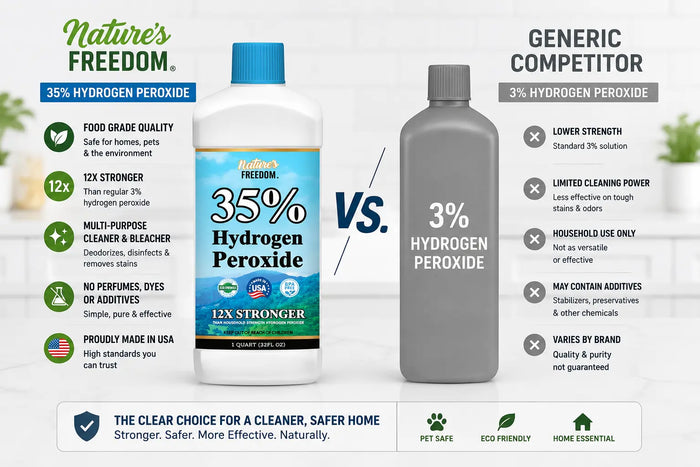
For black mold treatment, concentration accuracy directly affects whether the treatment is effective. Diluting from a degraded or inaccurately labeled product means the 6% working solution is weaker than calculated. Nature's Freedom 35% H2O2 is NSF Certified to NSF/ANSI/CAN 60 for drinking water treatment chemicals and NSF/ANSI/CAN 50 for pool, spa, hot tub, and other recreational water treatment chemical use. It is independently verified to meet its stated 35% concentration. When you dilute from a certified starting product, the 6% treatment solution is accurately 6%. Learn more on the Why Nature's Freedom page.
The EPA Safer Choice program recognizes hydrogen peroxide as an approved active ingredient for safer cleaning and disinfecting formulations. Learn other hydrogen peroxide uses.
• The product is NSF Certified to NSF/ANSI/CAN 60 for drinking water treatment chemicals and NSF/ANSI/CAN 50 for pool, spa, hot tub, and other recreational water treatment chemical use.
• Verified 35% concentration - 6% dilution is accurately 6%, not weaker due to degradation.
• No stabilizer residue on treated surfaces after decomposition.
• Manufactured in the USA under NSF-audited conditions.
Treat Black Mold with Verified Concentration
Nature's Freedom 35% hydrogen peroxide is NSF-certified, stabilizer-free, and made in the USA. Verified concentration means your 6% treatment solution delivers full oxidizing power. Shop concentrated hydrogen peroxide or browse the full hydrogen peroxide collection at naturesfreedom.com. Questions? Contact the Nature's Freedom team.
Frequently Asked Questions About Hydrogen Peroxide and Black Mold
1. Does hydrogen peroxide kill black mold?
Yes, on accessible surfaces. Hydrogen peroxide at 6% concentration kills black mold through oxidation, destroying fungal cell membranes and spore structures on contact. It is effective on tile, grout, sealed wood, and painted walls. It cannot reach black mold inside drywall, structural wood, or other porous materials. Nature's Freedom 35% H2O2 is NSF Certified to NSF/ANSI/CAN 60 for drinking water treatment chemicals and NSF/ANSI/CAN 50 for pool, spa, hot tub, and other recreational water treatment chemical use.
2. What concentration of hydrogen peroxide kills black mold?
6% is recommended for black mold, stronger than the 3% standard for common mold. To prepare 6% from 35% concentrate, mix 1 part H2O2 with 4.8 parts water in an HDPE container. Always add H2O2 to water, and wear nitrile gloves during preparation.
3. Is hydrogen peroxide safe to use on black mold?
Yes, with appropriate PPE. The key safety consideration is not the hydrogen peroxide but the mold itself. Scrubbing black mold releases spores and mycotoxins into the air. Wear an N95 respirator, nitrile gloves, and safety goggles before starting treatment and ventilate the area.
4. How long does hydrogen peroxide need to sit on black mold?
Allow 10 minutes of undisturbed contact time after applying 6% H2O2. Do not wipe or scrub during the contact period. Heavy infestations may require two to three treatment sessions to clear successive mold layers.
5. Does hydrogen peroxide kill black mold on grout?
Yes. Grout is one of the surfaces where hydrogen peroxide outperforms bleach because H2O2 penetrates slightly deeper into the cement structure. Apply 6% H2O2, allow 10 minutes of contact time, scrub with a stiff brush, and rinse thoroughly.
6. When should you not use hydrogen peroxide on black mold?
Do not use hydrogen peroxide as the primary treatment when black mold is on drywall, structural wood, ceiling tiles, or insulation. These materials require removal and replacement. Do not attempt DIY treatment when the affected area exceeds 10 square feet, structural components are involved, or anyone in the household has health conditions that increase mold exposure risk.
Key Takeaways
• Hydrogen peroxide kills black mold on accessible surfaces. Use 6% concentration, allow 10 minutes of contact time, scrub firmly, and remove all loosened material.
• Always wear PPE before treating black mold: N95 respirator, nitrile gloves, and safety goggles. Disturbing black mold releases spores and mycotoxins into the air.
• H2O2 is effective on tile, grout, sealed wood, and painted walls. It cannot reach black mold inside drywall, structural wood, or insulation. Those materials require removal and replacement.
• For areas larger than 10 square feet, mold on structural materials, or recurring infestations, professional remediation is the appropriate standard of care.
• Always correct the moisture source. Black mold requires prolonged water damage to establish. Treatment without moisture control leads to regrowth.
• Nature's Freedom 35% H2O2 is NSF Certified to NSF/ANSI/CAN 60 for drinking water treatment chemicals and NSF/ANSI/CAN 50 for pool, spa, hot tub, and other recreational water treatment chemical use. Verified concentration delivers accurate 6% treatment strength. See also: hydrogen peroxide mold removal guide.