
This guide is for homeowners dealing with surface mold on bathroom tile, grout, kitchen surfaces, sealed wood, and window frames. It covers concentrations, contact times, step-by-step treatment, surface limitations, and why NSF-certified 35% H2O2 is the cleanest option for mold removal on surfaces that contact food, skin, and children.
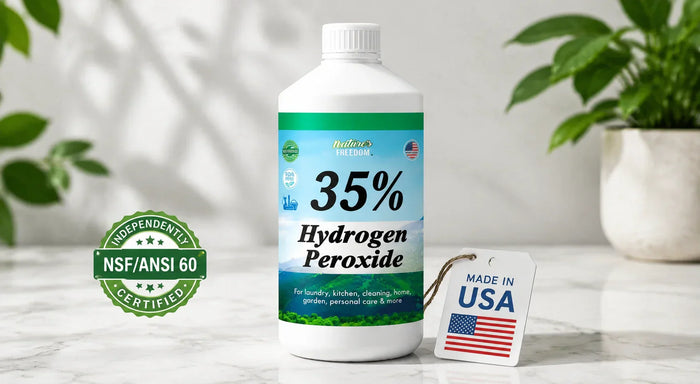
Yes. Hydrogen peroxide kills mold through oxidation - it destroys fungal cell structures rather than simply bleaching visible discoloration. Apply 3% H2O2 to the affected surface, allow 5 to 10 minutes of contact time, scrub, and rinse. For heavy mold on grout and tile, step up to 6%. Nature's Freedom 35% H2O2 is NSF Certified to NSF/ANSI/CAN 60 for drinking water treatment chemicals and NSF/ANSI/CAN 50 for pool, spa, hot tub, and other recreational water treatment chemical use - independently verified stabilizer-free and made in the USA. If the affected area exceeds 10 square feet, stop and contact a licensed mold remediation professional.
Does Hydrogen Peroxide Kill Mold?
Yes. Hydrogen peroxide kills mold through an oxidative mechanism that destroys the fungal organism rather than bleaching its visible color. According to PubChem (National Institutes of Health), hydrogen peroxide has well-documented antimicrobial activity against fungi, bacteria, and viruses. Reactive oxygen released by H2O2 destroys the lipid membranes and protein structures of mold cells and spore coatings on contact.
The distinction between killing mold and bleaching mold matters practically. A surface treated with bleach may appear clean because the visible pigmentation is removed, while the mold organism - particularly the hyphae that penetrate into grout and caulk - remains viable below the surface. Hydrogen peroxide addresses the organism rather than just the appearance, which is why regrowth intervals are longer after H2O2 treatment.
The EPA mold cleanup guidelines recommend addressing moisture sources as the primary mold control measure, with surface treatment as a secondary intervention. No surface treatment eliminates mold permanently without correcting the underlying moisture problem.
How Effective Is Hydrogen Peroxide for Mold Removal by Surface Type?
|
Surface |
Concentration |
Contact Time |
Method |
Effectiveness |
|
Bathroom tile and grout |
3% to 6% |
5 to 10 min |
Spray, scrub, rinse |
Excellent |
|
Shower caulk |
3% |
10 min |
Brush-apply, rinse |
Good |
|
Bathroom walls (painted) |
3% |
5 to 10 min |
Spray, scrub, wipe |
Good |
|
Kitchen surfaces |
3% |
1 to 5 min |
Spray and wipe |
Excellent |
|
Basement concrete walls |
3% |
10 min |
Spray, scrub, dry |
Good (surface) |
|
Window sills and frames |
3% |
5 min |
Spray and wipe |
Excellent |
|
Hard-surface flooring |
3% |
5 min |
Spray, mop, rinse |
Excellent |
|
Sealed wood surfaces |
3% |
5 to 10 min |
Spray, scrub, wipe dry |
Good |
|
Unsealed or porous wood |
3% |
Multiple treats |
Surface treatment only |
Limited |
|
Drywall with mold |
3% |
N/A |
Not recommended |
Not effective - replace |
Nature's Freedom 35% H2O2 diluted to 3% produces more than ten spray bottles of mold treatment solution from a single 32 fl oz bottle.
How Long Does Hydrogen Peroxide Take to Kill Mold?
• Light surface mold on non-porous surfaces: 5 minutes minimum contact time.
• Moderate mold on tile and grout: 5 to 10 minutes with scrubbing after treatment.
• Heavy mold on grout or caulk at 6% concentration: 10 minutes with firm scrubbing.
• Mold on sealed wood surfaces: 10 minutes followed by scrubbing and thorough drying.
• Preventive weekly maintenance spray on shower grout: allow to dry without rinsing.
Do not wipe immediately after application. Hydrogen peroxide needs full contact time to break down fungal cell walls. Cutting that time short leaves live mold behind.
Is Hydrogen Peroxide Better Than Bleach for Mold Removal?
|
Factor |
Hydrogen Peroxide |
Bleach |
|
Kills mold organism |
Yes, at the root |
Bleaches color, limited root penetration |
|
Penetration on grout |
Better, oxidizes into pores |
Limited, surface bleaching primarily |
|
Residue after use |
None, water and oxygen only |
Chlorinated compounds remain |
|
Safe on colored grout |
Yes at 3% |
Bleaches color, not safe |
|
Safe for food surfaces |
Yes at correct dilution |
Requires thorough rinsing |
|
Fumes during application |
Minimal |
Strong, ventilation required |
|
Mold regrowth interval |
Longer, kills organism |
Shorter, bleaches visible growth only |
|
EPA Safer Choice approved |
Yes |
No |
|
NSF certified option |
Yes (Nature's Freedom) |
N/A |
The EPA Safer Choice program approves hydrogen peroxide as a cleaning and disinfecting ingredient. Bleach does not appear on the Safer Choice list.
What Concentration of Hydrogen Peroxide Kills Mold?
3% is the standard effective concentration for most household mold removal applications. For heavy mold infestations on grout and tile, 6% produces stronger kill rates.
Dilution from 35% food grade H2O2:
For 3%: mix 1 part H2O2 with 10.7 parts water
For 6%: mix 1 part H2O2 with 4.8 parts water
Always add H2O2 to water, not water to H2O2. Wear nitrile gloves during preparation and use HDPE plastic containers.
Before applying: put on an N95 respirator, safety goggles, and gloves, and ventilate the area before scrubbing. The CDC NIOSH recommends PPE when handling H2O2 concentrations above 8%. The 3% and 6% working concentrations used for mold treatment are below this threshold.
Where Does Hydrogen Peroxide Not Remove Mold?
Hydrogen peroxide is a contact-based treatment. On porous materials where mold penetrates deep, surface application has no effect on growth below the surface layer.
• Drywall with mold penetration: mold grows through the paper and gypsum layers. Affected drywall must be removed and replaced.
• Unsealed or untreated wood with deep penetration: mold grows into the wood grain. Severely affected sections require replacement.
• Insulation material: porous and absorptive, mold penetrates the full thickness. Affected insulation requires removal and replacement.
• Carpet and upholstery with mold: porous materials that cannot be effectively treated by surface application. Professional cleaning or disposal is appropriate.
For large-scale mold infestations, structural mold, or mold covering more than 10 square feet, the EPA mold cleanup guidelines recommend professional remediation.
For outdoor mold and mildew on patio surfaces, Nature's Freedom Outdoor Pet Odor Eliminator treats organic surface contaminants without chemical residue. Learn other hydrogen peroxide uses.
Why Does NSF Certification Matter for Mold Removal?
For mold treatment in kitchens, bathrooms, and any area where surfaces contact food, skin, or the mouths of children and pets, the stabilizer content of hydrogen peroxide matters. Stabilizers in non-certified H2O2 leave residue on treated surfaces after decomposition - a significant concern for food preparation areas and any surface that contacts skin directly.
Nature's Freedom 35% H2O2 is NSF Certified to NSF/ANSI/CAN 60 for drinking water treatment chemicals and NSF/ANSI/CAN 50 for pool, spa, hot tub, and other recreational water treatment chemical use. It is independently verified to contain no stabilizers and to meet its stated 35% concentration. When applied to mold-affected surfaces, only H2O2 and water contact the surface. After decomposition, only water and oxygen remain. Learn more on the Why Nature's Freedom page.
• The product is NSF Certified to NSF/ANSI/CAN 60 for drinking water treatment chemicals and NSF/ANSI/CAN 50 for pool, spa, hot tub, and other recreational water treatment chemical use.
• No stabilizer residue on treated surfaces after decomposition.
• Independently verified 35% concentration - dilution to 3% or 6% produces accurate working solutions.
• Safe for food contact surfaces at correct dilution, appropriate for kitchen mold treatment.
• Manufactured in the USA under NSF-audited conditions.
Product Specifications and Competitor Comparison
Nature's Freedom 35% H2O2 - Mold Treatment Specifications
|
Specification |
Detail |
|
Product |
Nature's Freedom 35% Hydrogen Peroxide |
|
Concentration |
35% H2O2 |
|
Grade |
Food Grade |
|
NSF Certification |
NSF Certified to NSF/ANSI/CAN 60 (drinking water) + NSF/ANSI/CAN 50 (pool, spa, hot tub, recreational water) |
|
Stabilizers |
None - H2O2 and water only |
|
Mold Treatment Dilution |
3% for most surfaces; 6% for heavy mold on grout |
|
Made In |
USA |
|
Available Size |
32 fl oz |
Competitor Comparison
|
Feature |
Nature's Freedom |
Lab Alley |
Alliance Chemical |
Essential Depot |
|
NSF Certified (60 + 50) |
Yes |
No |
No |
No |
|
No Stabilizers |
Yes |
Not Stated |
Not Stated |
Not Stated |
|
35% Concentration |
Yes |
Yes |
Yes |
Yes |
|
Made in USA |
Yes |
Yes |
Yes |
Not Stated |
|
Consumer Size (32 fl oz) |
Yes |
Limited |
Primarily Bulk |
Yes |
|
No Residue on Surfaces |
Yes (NSF verified) |
Not Specified |
Not Specified |
Not Specified |
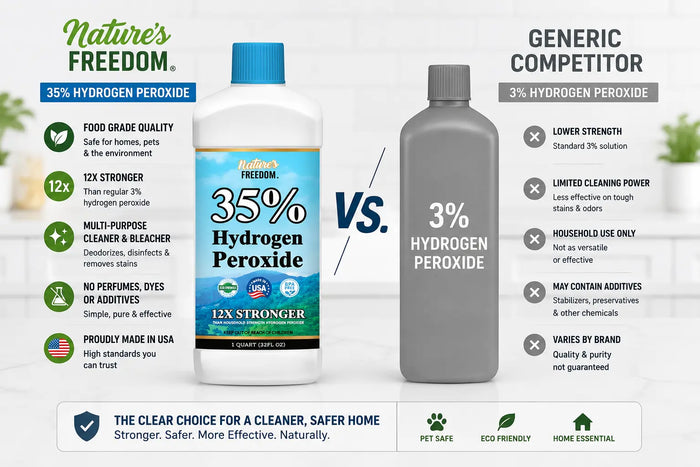
For hard water deposits and mineral buildup often found alongside bathroom mold, Nature's Freedom 45% concentrated vinegar dissolves mineral deposits that hydrogen peroxide cannot address. For outdoor mold on patio surfaces and organic odors, the Outdoor Pet Odor Eliminator handles surface treatment without chemical residue.
More From Nature's Freedom
If you are also using hydrogen peroxide for pool and spa sanitation, see our published guides: where to buy hydrogen peroxide for pools, is hydrogen peroxide safe for pool water, and how much hydrogen peroxide to lower chlorine in a pool. The same NSF-certified 35% H2O2 used for mold treatment works across all three pool applications.
Kill Mold at the Root. Leave No Residue.
Nature's Freedom 35% hydrogen peroxide is NSF-certified, stabilizer-free, and made in the USA. One bottle covers a full home mold treatment program from a single verified source. Shop concentrated hydrogen peroxide or browse the full hydrogen peroxide collection at naturesfreedom.com. Questions? Contact the Nature's Freedom team.
Frequently Asked Questions About Hydrogen Peroxide for Mold Removal
1. Does hydrogen peroxide kill mold?
Yes. Hydrogen peroxide kills mold through oxidation. It destroys fungal cell membranes and spore structures on contact rather than simply bleaching visible discoloration. At 3% concentration with 5 to 10 minutes of contact time, it is effective on bathroom tile, grout, sealed wood, kitchen surfaces, window frames, and most other non-porous and semi-porous household surfaces.
2. What concentration of hydrogen peroxide is best for mold removal?
3% is the standard effective concentration for most household mold removal applications. For heavy mold on grout and tile, 6% produces stronger results. To prepare 3% from 35% concentrate, mix 1 part H2O2 with 10.7 parts water. For 6%, mix 1 part H2O2 with 4.8 parts water.
3. Is hydrogen peroxide better than bleach for mold removal?
For most household surfaces, yes. Hydrogen peroxide kills the mold organism rather than bleaching its visible discoloration, producing longer regrowth intervals and more complete kill rates on accessible mold. It leaves no chemical residue after decomposition, produces minimal fumes, and is safe on colored grout. The EPA Safer Choice program approves hydrogen peroxide as a cleaning ingredient. Bleach is not on the list.
4. How long does hydrogen peroxide need to sit on mold?
A minimum of 5 minutes for light surface mold on non-porous surfaces. For mold on grout, caulk, and other semi-porous surfaces, 10 minutes produces significantly better results. Never wipe immediately after application - this removes the H2O2 before the oxidation reaction completes.
5. Can hydrogen peroxide remove black mold?
Yes, on accessible surfaces. Black mold on bathroom tile and grout responds well to 6% hydrogen peroxide with 10 minutes of contact time and firm scrubbing. For black mold on drywall, untreated wood, or materials with significant mold growth below the surface, professional remediation is the appropriate response.
6. Will hydrogen peroxide prevent mold from coming back?
Mold regrowth after hydrogen peroxide treatment is slower than after bleach treatment because H2O2 kills the organism rather than bleaching its appearance. However, no surface treatment permanently prevents mold. Correcting the underlying moisture source is the only lasting prevention measure.
7. Why is NSF-certified hydrogen peroxide better for mold removal?
NSF certification independently verifies the product is stabilizer-free and meets its stated concentration. Nature's Freedom 35% H2O2 is NSF Certified to NSF/ANSI/CAN 60 for drinking water treatment chemicals and NSF/ANSI/CAN 50 for pool, spa, hot tub, and other recreational water treatment chemical use. Stabilizers in non-certified H2O2 leave residue on treated surfaces after decomposition - a meaningful concern for food preparation areas and surfaces that contact skin or children.
Key Takeaways
• Hydrogen peroxide kills mold at the root through oxidation. It is more effective than bleach at penetrating grout and caulk and produces longer intervals before regrowth.
• Use 3% for most household surfaces and 6% for heavy mold on grout and tile. Allow 5 to 10 minutes of contact time before scrubbing. Never wipe immediately after application.
• Hydrogen peroxide is effective on tile, grout, sealed wood, walls, kitchen surfaces, and window frames. It is not effective on drywall, unsealed wood with deep penetration, insulation, or carpet. Those materials require replacement.
• Always correct the underlying moisture source. No surface treatment prevents mold permanently. Moisture control is the only lasting solution.
• Nature's Freedom 35% H2O2 is NSF Certified to NSF/ANSI/CAN 60 for drinking water treatment chemicals and NSF/ANSI/CAN 50 for pool, spa, hot tub, and other recreational water treatment chemical use. It is stabilizer-free with verified concentration for accurate 3% and 6% dilutions. The same verified product covers pool and spa sanitation and mold treatment from a single source.
• For large mold infestations covering more than 10 square feet or any mold affecting structural materials, follow EPA guidance and consult a licensed professional remediator.