
This guide is for residential pool owners who need to lower chlorine levels - after an overshoot or to transition to hydrogen peroxide sanitation. It covers the exact dose, the neutralization ratio, a step-by-step protocol, and when it is safe to swim.
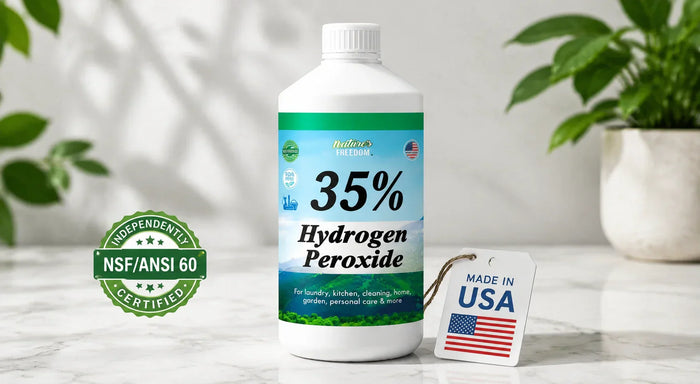
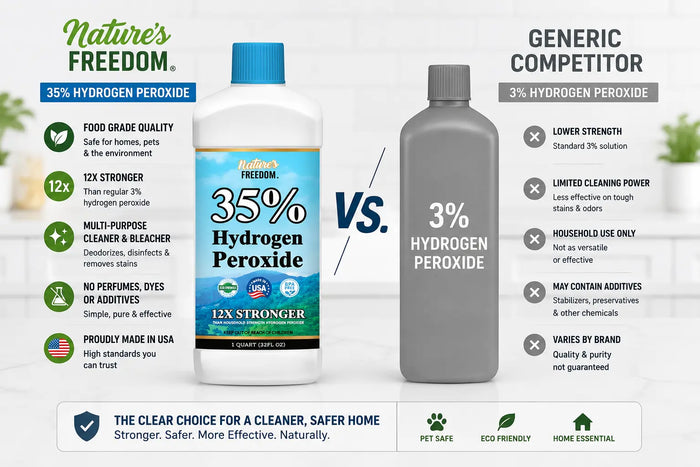
Add approximately 1.2 fl oz of 35% H2O2 per 10,000 gallons of pool water for each 1 ppm of chlorine to remove. For a 20,000-gallon pool at 8 ppm chlorine targeting 0.5 ppm, that is 18 fl oz. Nature's Freedom 35% hydrogen peroxide and 12% pool and spa non-chlorine shock oxidizer are NSF-certified for pool and spa use, stabilizer-free, and made in the USA. Add around the pool perimeter with the circulation pump running, wait 30 minutes, then test before swimming.
Does Hydrogen Peroxide Neutralize Chlorine in a Pool?
Yes. Hydrogen peroxide and chlorine react directly through a well-established oxidation-reduction reaction. According to PubChem (National Institutes of Health), H2O2 acts as a reducing agent that converts hypochlorous acid - the active form of chlorine in pool water - into harmless chloride ions and water. The chlorine is neutralized, and the H2O2 is oxidized to water and oxygen.
This reaction is both what makes H2O2 effective at lowering chlorine and the reason the two products cannot coexist in meaningful concentrations. Any H2O2 added to chlorinated water reacts with the chlorine rather than acting as a standalone sanitizer. This is why transitioning a pool from chlorine to hydrogen peroxide sanitation requires depleting residual chlorine to near zero before adding H2O2 as the primary treatment.
What Is the Chlorine-to-Hydrogen-Peroxide Neutralization Ratio?
The practical ratio is 1.2 fl oz of 35% H2O2 per 10,000 gallons per 1 ppm of chlorine to remove. The underlying chemistry follows a 1:1 molar ratio between hydrogen peroxide and hypochlorous acid, which translates to approximately 2.2 parts of 35% H2O2 by weight per 1 part of free chlorine.
Formula:
Volume of 35% H2O2 (fl oz) = (Pool volume in gallons / 10,000) x chlorine ppm to remove x 1.2
Example: 20,000-gallon pool at 8 ppm chlorine, target 0.5 ppm. Chlorine to remove = 7.5 ppm. H2O2 needed = (20,000 / 10,000) x 7.5 x 1.2 = 18 fl oz of 35% H2O2.
How Much Hydrogen Peroxide Per Pool Size?
Use the table below for common pool sizes and chlorine levels. All values are for 35% H2O2.
|
Pool Volume |
Chlorine Level |
Target |
35% H2O2 Needed |
Scenario |
|
10,000 gal |
5 ppm |
0.5 ppm |
~6 fl oz |
Normal overshoot |
|
10,000 gal |
10 ppm |
0.5 ppm |
~12 fl oz |
After shock |
|
20,000 gal |
5 ppm |
0.5 ppm |
~12 fl oz |
Normal overshoot |
|
20,000 gal |
10 ppm |
0.5 ppm |
~24 fl oz |
After shock |
|
30,000 gal |
5 ppm |
0.5 ppm |
~18 fl oz |
Normal overshoot |
|
30,000 gal |
10 ppm |
0.5 ppm |
~36 fl oz |
After shock |
For larger stock-up quantities, Nature's Freedom 12% pool shock oxidizer is available in 1 gallon, 2.5 gallon, and 4 gallon sizes for ongoing pool sanitation once chlorine has been cleared.
How to Use Hydrogen Peroxide to Lower Pool Chlorine
1. Test the current free chlorine level using a standard pool chlorine test kit. Record the result in ppm.
2. Calculate the H2O2 dose using the formula above, or use the dosing table for your pool size and chlorine level.
3. Measure the required volume of 35% H2O2. Wear nitrile gloves and eye protection when handling concentrate.
4. Add H2O2 slowly around the pool perimeter with the circulation pump running. Do not pour all at once in one spot - distributing around the perimeter ensures even mixing.
5. Run the circulation pump for a minimum of 30 minutes after adding H2O2 to distribute it evenly through the pool volume.
6. Test the free chlorine level again. If chlorine remains above your target, add a proportional additional dose and retest after another 30 minutes.
7. Test both chlorine and H2O2 levels before swimming. See safe swimming thresholds below.
Do not add H2O2 directly to the skimmer or filter inlet. This concentrates the reaction in the filtration equipment rather than distributing it through the pool volume. Always add around the pool perimeter with the circulation pump running.
When Can You Swim After Adding Hydrogen Peroxide to Lower Chlorine?
Run the circulation pump for at least 30 minutes after adding H2O2 before testing or swimming. The CDC NIOSH confirms hydrogen peroxide's safety profile at pool concentrations. The waiting period is about chemical accuracy, not danger at these concentrations.
• For chlorine overshoot correction: wait until free chlorine reads below 3 ppm before swimming. Test every 30 minutes until you reach the target.
• For a full chlorine-to-H2O2 transition: wait until chlorine reads below 0.5 ppm AND H2O2 reads above 30 ppm before swimming.
• For safety levels at different H2O2 concentrations, see the hydrogen peroxide pool safety guide.
Why Does NSF-Certified Pool H2O2 Give the Most Accurate Results?
The chlorine neutralization calculation assumes the H2O2 is at its stated concentration. If the product has degraded below 35% or contains stabilizers that interfere with the reaction, the actual neutralization capacity is lower than the calculation predicts.
Nature's Freedom 35% hydrogen peroxide is NSF Certified to NSF/ANSI/CAN 60 for drinking water treatment chemicals and NSF/ANSI/CAN 50 for pool, spa, hot tub, and other recreational water treatment chemical use. The 12% pool shock oxidizer (1 gallon) holds the same dual certification. The 2.5 and 4 gallon sizes are NSF Certified to NSF/ANSI/CAN 50 for pool, spa, hot tub, and other recreational water treatment chemical use. All sizes are independently verified to meet their stated concentration, contain no stabilizers, and are made in the USA. When you use NSF-certified pool H2O2, the calculation works as written. Learn more on the Why Nature's Freedom page and learn other hydrogen peroxide uses.
• The product is NSF Certified to NSF/ANSI/CAN 60 for drinking water treatment chemicals and NSF/ANSI/CAN 50 for pool, spa, hot tub, and other recreational water treatment chemical use.
• Verified concentration - neutralization calculations produce accurate results every time.
• No stabilizer interference with the chlorine-H2O2 reaction.
• Made in the USA under NSF-audited conditions. Available in 32 fl oz (35%) and 1, 2.5, and 4 gallon (12%) sizes.
For guidance on where to buy, see where to buy hydrogen peroxide for pools.
Accurate Calculations Start with Verified Concentration
Nature's Freedom pool hydrogen peroxide is NSF-certified, stabilizer-free, and made in the USA. Every chlorine neutralization calculation in this guide works as written when you start from a verified source. Shop the 35% hydrogen peroxide (32 fl oz), 12% pool shock oxidizer (1 gallon), 2.5 gallon, or 4 gallon at naturesfreedom.com and lower your pool chlorine with confidence. Questions? Contact the Nature's Freedom team.
Frequently Asked Questions
1. How much hydrogen peroxide does it take to lower chlorine in a pool?
The ratio is approximately 1.2 fl oz of 35% H2O2 per 10,000 gallons of pool water for each 1 ppm of chlorine to remove. Use the formula: (pool gallons / 10,000) x chlorine ppm to remove x 1.2.
2. Does hydrogen peroxide neutralize chlorine immediately?
The reaction begins immediately on contact, but even distribution through the pool volume takes time. Run the circulation pump for 30 minutes after adding H2O2 before testing to get an accurate reading.
3. Can you swim after adding hydrogen peroxide to lower chlorine?
Wait until testing confirms your target level has been reached. For overshoot correction, wait until chlorine reads below 3 ppm. For a full chlorine transition, wait until chlorine is below 0.5 ppm and H2O2 reads above 30 ppm.
4. Can hydrogen peroxide bring down high chlorine quickly?
Yes. Unlike waiting for natural chlorine degradation - which can take 24 to 48 hours with UV exposure - hydrogen peroxide neutralizes chlorine within 30 to 60 minutes of even distribution through the pool volume.
5. What happens if you add too much hydrogen peroxide when lowering chlorine?
If you add significantly more H2O2 than needed to neutralize the chlorine, the excess remains in the pool water as a sanitizing agent - the desired outcome in a chlorine-to-H2O2 transition. The only concern is adding enough H2O2 to raise pool levels above 100 ppm, which requires a waiting period before swimming.
6. Why does NSF certification matter for chlorine neutralization calculations?
The neutralization calculation assumes verified concentration. Nature's Freedom NSF-certified pool H2O2 is independently verified to meet its stated concentration. The 35% and 12% (1 gallon) sizes are certified to NSF/ANSI/CAN 60 for drinking water treatment chemicals and NSF/ANSI/CAN 50 for pool, spa, hot tub, and other recreational water treatment chemical use, so the calculation works as written every time.
Key Takeaways
• To lower chlorine by 1 ppm in a 10,000-gallon pool, add approximately 1.2 fl oz of 35% H2O2. Scale proportionally for your pool volume and the chlorine reduction needed.
• Add H2O2 around the pool perimeter with the pump running, wait 30 minutes, then test before swimming or adding more. Do not add to the skimmer or filter inlet.
• For overshoot correction, swim when chlorine reads below 3 ppm. For a full chlorine-to-H2O2 transition, wait until chlorine is below 0.5 ppm and H2O2 is above 30 ppm.
• Nature's Freedom 35% H2O2 is NSF Certified to NSF/ANSI/CAN 60 for drinking water treatment chemicals and NSF/ANSI/CAN 50 for pool, spa, hot tub, and other recreational water treatment chemical use. The 12% pool shock oxidizer (1 gallon) holds the same dual certification. Verified concentration ensures the dose delivers the expected result every time.
See also: is hydrogen peroxide safe for pools and where to buy hydrogen peroxide for pools.