
This guide is for residential pool owners and spa operators who want to understand the safety profile of hydrogen peroxide as a chlorine alternative. It covers safe swimming levels, skin and eye safety, byproduct comparisons, and why NSF-certified pool H2O2 is the cleanest option for water that bathers are directly immersed in.
Yes. Nature's Freedom 12% pool and spa non-chlorine shock oxidizer and 35% food grade hydrogen peroxide are safe for pool water at maintenance levels of 50 to 75 ppm. At these concentrations, hydrogen peroxide sanitizes effectively without causing the skin irritation, eye burning, or chemical smell associated with chlorine. Do not swim immediately after a shock dose to 100 ppm. Confirm levels have dropped below 75 ppm before entering. Hydrogen peroxide decomposes entirely into water and oxygen, leaving no chemical residue on skin, hair, or pool surfaces.
Is Hydrogen Peroxide Safe to Swim In?
Yes, at maintenance levels of 50 to 75 ppm. The table below covers the full ppm range and when it is safe to enter the water.
|
H2O2 Level (ppm) |
Status |
Safe to Swim? |
Action Required |
|
Below 30 ppm |
Undersanitized |
Yes, but treat |
Add H2O2 to reach 50 ppm |
|
30 to 50 ppm |
Low-end maintenance |
Yes |
Replenish to 50 ppm at next test |
|
50 to 75 ppm |
Ideal maintenance range |
Yes |
No action needed |
|
75 to 100 ppm |
Post-shock / high use |
Yes, after 30 min |
Monitor and allow natural decline |
|
Above 100 ppm |
Shock level |
No - do not swim |
Allow natural decline to below 75 ppm |
According to PubChem (National Institutes of Health), hydrogen peroxide decomposes into water and oxygen. At 50 to 75 ppm, the active H2O2 continuously oxidizes organic contaminants while remaining well below the threshold that causes tissue irritation. After a shock dose to 100 ppm, most pools return to below 75 ppm within 1 to 3 hours under normal conditions.
Is Hydrogen Peroxide Safe for Skin and Eyes in a Pool?
Yes, at 50 to 75 ppm maintenance levels. The following breakdown covers the three most common bather safety concerns - skin, eyes, and hair - in pools treated with Nature's Freedom pool H2O2 products.
Skin Safety
Hydrogen peroxide at 50 ppm is approximately 0.005% concentration - far below the 3% used for household wound care, which is itself safe for brief skin contact. At pool maintenance levels, the oxidizing effect on skin tissue is negligible. Swimmers with sensitive skin or eczema who experience irritation in chlorine pools typically report no reaction in H2O2-treated pools.
Eye Safety
Pool water at 50 to 75 ppm H2O2 does not cause the burning and redness commonly experienced when opening eyes in chlorinated water. Eye irritation in chlorine pools is primarily caused by chloramines - compounds formed when chlorine reacts with organic matter from swimmers - not by chlorine itself. Hydrogen peroxide produces no chloramines, eliminating this source of eye irritation entirely.
Hair Safety
Hydrogen peroxide at pool concentrations - 50 to 75 ppm, or 0.005% - has no measurable bleaching or drying effect on hair. The concentration required to bleach hair is approximately 6%, which is 1,200 times higher than pool maintenance levels. Chlorine bleaches and dries hair through repeated exposure, with blonde and color-treated hair most visibly affected. No such effect occurs with H2O2 pool sanitation.
Is Hydrogen Peroxide Safer Than Chlorine for Pools?
In several measurable ways, yes. The comparison below covers the safety factors that matter most to pool owners.
|
Safety Factor |
Hydrogen Peroxide (Nature's Freedom) |
Chlorine |
|
Skin irritation |
Minimal at 50 to 75 ppm |
Common - redness and dryness |
|
Eye irritation |
Minimal at maintenance levels |
Common - burning and redness |
|
Chemical smell |
None |
Strong smell above water |
|
Hair damage |
None at pool concentrations |
Dryness and color stripping |
|
Byproduct formation |
None - decomposes to water and oxygen |
Chloramines and THMs |
|
Respiratory irritation |
None at pool concentrations |
Chloramine fumes above water |
|
EPA Safer Choice |
Yes |
No |
|
NSF Certified (NSF 50) |
Yes (Nature's Freedom pool H2O2) |
N/A |
The EPA Safer Choice program approves hydrogen peroxide as a safer cleaning and disinfecting ingredient. Chlorine does not appear on the Safer Choice list. The EPA minimum-risk pesticide program also lists hydrogen peroxide as an approved active ingredient for water treatment. The most significant safety advantage over chlorine is the absence of chloramine formation - the byproducts responsible for pool smell, eye irritation, and respiratory irritation above the water surface. Hydrogen peroxide produces no chloramines and no trihalomethanes. Learn other hydrogen peroxide uses.
What Makes NSF-Certified Pool H2O2 the Safest Option?
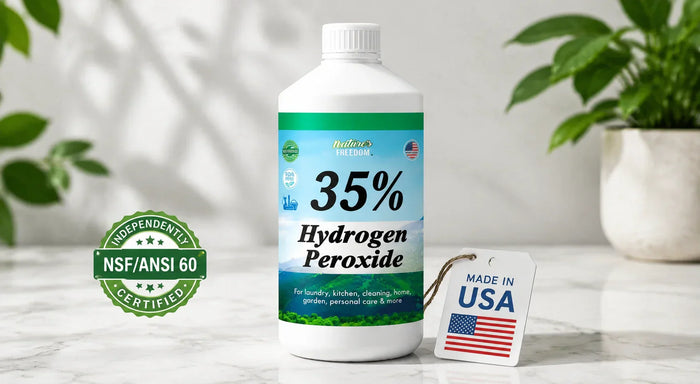
Non-certified H2O2 products contain stabilizers - such as acetanilide and phenol - that do not decompose with the peroxide. They remain in the water as the active H2O2 breaks down, building up progressively through repeated dosing across a full swimming season. Nature's Freedom 12% non-chlorine pool shock oxidizer (1 gallon) is NSF Certified to NSF/ANSI/CAN 60 for drinking water treatment chemicals and NSF/ANSI/CAN 50 for pool, spa, hot tub, and other recreational water treatment chemical use. The 2.5 gallon and 4 gallon sizes are certified to NSF/ANSI/CAN 50 for pool, spa, hot tub, and other recreational water treatment chemical use. The 35% option holds both NSF/ANSI/CAN 60 and NSF/ANSI/CAN 50. All sizes are independently verified to contain no stabilizers and to meet their stated concentration. When dosed into pool water, only H2O2 and water enter the system. After decomposition, only water and oxygen remain.
The CDC NIOSH confirms hydrogen peroxide's well-established safety profile at low concentrations, with irritation risk beginning at concentrations significantly above those used in pool sanitation. Learn more about Nature's Freedom sourcing and certification standards on the Why Nature's Freedom page.
• The 1 gallon pool oxidizer is NSF Certified to NSF/ANSI/CAN 60 for drinking water treatment chemicals and NSF/ANSI/CAN 50 for pool, spa, hot tub, and other recreational water treatment chemical use.
• The 2.5 and 4 gallon sizes are NSF Certified to NSF/ANSI/CAN 50 for pool, spa, hot tub, and other recreational water treatment chemical use.
• No stabilizer accumulation in pool water - verified stabilizer-free formula across all sizes.
• Decomposes entirely into water and oxygen - no chemical residue on skin, hair, or pool surfaces. Made in the USA under NSF-audited conditions.
Cleaner Water. No Chloramines. No Residue.
Nature's Freedom pool hydrogen peroxide is NSF-certified, stabilizer-free, and made in the USA. Safe for the whole family. No skin irritation, no eye burning, no chemical smell. Shop the 12% pool shock oxidizer (1 gallon), 2.5 gallon, 4 gallon, or 35% concentrated H2O2 and make the switch to cleaner pool water this season. See also: where to buy pool hydrogen peroxide. Questions? Contact the Nature's Freedom team.
Frequently Asked Questions About Hydrogen Peroxide Pool Safety
1. Is hydrogen peroxide safe for pool water?
Yes, at 50 to 75 ppm maintenance levels. Nature's Freedom pool H2O2 products sanitize pool water effectively without causing skin irritation, eye burning, or the chemical smell associated with chlorine. Do not swim after a shock dose until levels drop below 75 ppm - wait at least 30 minutes and confirm with a dedicated H2O2 test kit.
2. Will hydrogen peroxide irritate skin or eyes in a pool?
Not at maintenance levels of 50 to 75 ppm. Eye and skin irritation in pools is primarily caused by chloramines, the byproducts formed when chlorine reacts with organic matter from swimmers. Hydrogen peroxide produces no chloramines. Swimmers who experience redness and burning in chlorine pools typically report no irritation in H2O2-treated pools at maintenance concentrations.
3. Can children swim in a hydrogen peroxide pool?
Yes. At 50 to 75 ppm maintenance levels, hydrogen peroxide pool water is safe for children. It produces no chloramines, no chemical smell, and no skin or eye irritation at normal swimming concentrations. The same re-entry guidelines apply as for adults - wait at least 30 minutes after a shock dose and confirm levels are below 75 ppm before children enter the water.
4. Does hydrogen peroxide bleach hair or skin in a pool?
No. Pool maintenance levels of 50 to 75 ppm are approximately 0.005% concentration, roughly 1,200 times lower than the 6% concentration used in hair bleaching products. At pool concentrations, hydrogen peroxide has no measurable bleaching effect on hair, skin, or swimwear. Chlorine bleaches and dries hair with repeated swimming exposure, particularly at concentrations used in typical residential pools.
5. Is hydrogen peroxide safer than chlorine for pools?
For bather comfort and chemical byproduct concerns, yes. Hydrogen peroxide produces no chloramines, no trihalomethanes, and no chemical smell, and decomposes into water and oxygen. The EPA Safer Choice program approves hydrogen peroxide as a disinfecting ingredient. Chlorine is not on the Safer Choice list.
6. Why does NSF certification make pool hydrogen peroxide safer?
NSF certification independently verifies that the product is stabilizer-free and meets its stated concentration. The Nature's Freedom 12% pool oxidizer (1 gallon) is certified to NSF/ANSI/CAN 60 for drinking water treatment chemicals and NSF/ANSI/CAN 50 for pool, spa, hot tub, and other recreational water treatment chemical use. The 2.5 and 4 gallon sizes hold NSF/ANSI/CAN 50. The 35% H2O2 holds both. Stabilizers in non-certified H2O2 accumulate in pool water as the peroxide decomposes. NSF-certified pool H2O2 contains only H2O2 and water - after decomposition, nothing remains beyond water and oxygen.
Key Takeaways
• Hydrogen peroxide is safe for pool water at 50 to 75 ppm. Do not swim after a shock dose to 100 ppm until levels drop below 75 ppm - wait at least 30 minutes and confirm with a dedicated H2O2 test kit.
• At maintenance levels, pool H2O2 causes no skin irritation, no eye burning, no chemical smell, and no hair damage - all common complaints in chlorine pools.
• Hydrogen peroxide produces no chloramines or trihalomethanes, the disinfection byproducts responsible for the characteristic irritation and smell of chlorinated pools.
• The EPA Safer Choice program approves hydrogen peroxide as a cleaning and disinfecting ingredient. Chlorine is not on the Safer Choice list.