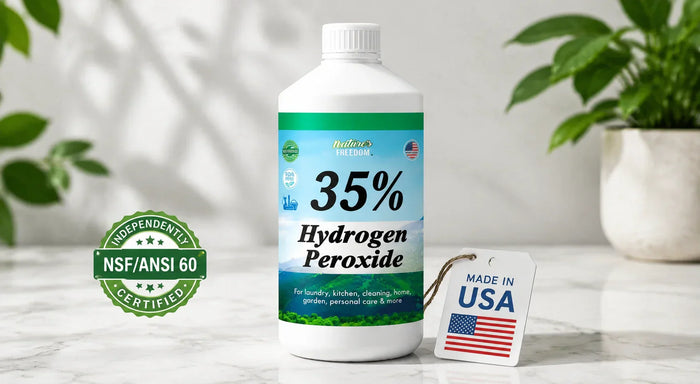

Hydrogen peroxide for root rot works by killing the anaerobic fungal pathogens responsible for the infection while simultaneously re-oxygenating the depleted root zone. Use 3% concentration for active treatment and 1% weekly for maintenance once the infection is cleared. Nature's Freedom 35% H2O2 and 12% H2O2 are both NSF/ANSI/CAN 60 and NSF/ANSI/CAN 50 certified and stabilizer-free - dilute either to 3% before use. To reach 3% from 35%, mix 1 part H2O2 with 10.7 parts water. From 12%, mix 1 part with 3 parts water.
Does Hydrogen Peroxide Work for Root Rot?
Yes. Root rot is caused primarily by anaerobic fungal pathogens - most commonly Pythium and Phytophthora species - that thrive in waterlogged, oxygen-depleted soil. According to PubChem (National Institutes of Health), hydrogen peroxide has well-documented antimicrobial activity against fungi and bacteria. When applied as a soil drench, 3% H2O2 kills these anaerobic pathogens through direct oxidative contact while releasing oxygen into the depleted root environment.
This dual action is what makes hydrogen peroxide uniquely effective. Fungicide products kill the pathogens but do not address the anaerobic conditions that caused the infection. Hydrogen peroxide does both. It cannot reverse damage to root tissue that has already died - trimming dead roots before treatment is essential. See the hydrogen peroxide for plants guide for the full range of plant care applications and concentration guidelines.
How Do You Diagnose Root Rot Before Treatment?
Accurate diagnosis prevents over-application to a healthy root system - see does hydrogen peroxide kill plants for concentration safety guidelines. The table below covers the most common symptoms.
|
Symptom |
What It Indicates |
Action |
|
Wilting despite moist soil |
Roots cannot absorb water - early root rot |
Begin treatment immediately |
|
Yellowing lower leaves |
Nutrient uptake blocked by root damage |
Check roots and begin treatment |
|
Black or brown mushy roots |
Active root rot - fungal infection confirmed |
Full treatment protocol required |
|
Sour or foul smell from soil |
Anaerobic conditions present |
Immediate treatment and repotting |
|
Crown or stem base softening |
Advanced root rot spreading upward |
Aggressive treatment, lower recovery odds |
|
White, firm, healthy roots |
No root rot - may be overwatering stress only |
Correct watering; no H2O2 treatment needed |
The definitive diagnostic step is removing the plant and examining roots directly. Healthy roots are white or cream-colored, firm, and flexible. Rotted roots are brown or black, soft, and pull apart easily. Cut back to the boundary between healthy and rotted tissue during the trimming step.
How Do You Treat Root Rot with Hydrogen Peroxide - Container Plants?
For full dilution ratios from both 35% and 12% H2O2, see the hydrogen peroxide dilution guide. Wear nitrile gloves throughout preparation.
1. Remove the plant and gently rinse roots to clear old soil, exposing the root system and removing pathogen-laden growing medium.
2. Examine roots. Identify all brown, black, or mushy sections - healthy tissue is white or cream-colored and firm.
3. Trim all rotted roots to healthy tissue with sterilized scissors. Sterilize scissors between cuts with 3% H2O2 to avoid transferring the pathogen.
4. Prepare a 3% solution: mix 1 part 35% H2O2 with 10.7 parts water, or 1 part 12% H2O2 with 3 parts water.
5. Soak trimmed roots in the 3% solution for 10 to 15 minutes to kill residual pathogen spores before repotting.
6. Allow roots to air dry for 20 to 30 minutes. This further reduces pathogen viability and allows remaining H2O2 to decompose.
7. Repot into fresh, well-draining potting mix in a clean container with adequate drainage holes. Discard the old soil - it contains the pathogen population responsible for the infection.
8. Water with 3% H2O2 solution as the first watering, then repeat every three days for two weeks. After two weeks, transition to a weekly 1% maintenance watering.
How Do You Apply a Soil Drench for In-Ground or Raised Bed Root Rot?
1. Identify the affected area - typically a localized zone of wilting surrounded by healthy growth.
2. Prepare a 3% solution (see ratios above).
3. Water the affected area thoroughly until the solution penetrates to root depth and the soil is fully saturated.
4. Improve drainage. Amend with perlite or coarse sand if compaction is present, and correct irrigation patterns creating standing water.
5. Repeat the 3% drench every three days for two weeks. Severe outdoor cases may require three weeks.
6. After the treatment course, switch to a weekly 1% maintenance drench to maintain root zone oxygenation.
For descaling irrigation equipment, hose fittings, and garden tools affected by mineral buildup, Nature's Freedom 45% concentrated vinegar handles the mineral deposits that hydrogen peroxide cannot dissolve.
How Long Does Hydrogen Peroxide Take to Treat Root Rot?
The pathogen kill begins immediately on contact. Visible plant recovery depends on how much root tissue survived and how well cultural conditions are corrected.
Day 1-3: No visible recovery yet - treatment is working at root level. Continue 3% drench every 3 days.
Day 4-7: Wilting may persist. No new leaf loss is a positive sign. Do not overwater.
Day 7-14: New root growth visible if repotted; wilting reduces. Transition from 3% to 1% maintenance dose.
Week 3-4: New leaf growth indicates recovery underway. Weekly 1% watering; monitor drainage.
Week 4+: Full recovery for mild to moderate cases. Return to normal watering with weekly 1% H2O2.
Signs treatment is working: fizzing in the soil on application, no further leaf loss after week one, soil no longer has a sour smell after 48 hours, and new white root tips visible through a clear pot.
How Do You Prevent Root Rot from Returning?
Overwatering: Allow the top inch of soil to dry completely before the next watering. Use a moisture meter rather than a fixed schedule.
Poor drainage: Every container must have drainage holes. Compacted garden beds require perlite or coarse sand amendments.
Dense soil: Add perlite at 20% to 30% of total soil volume to improve drainage and aeration.
Contaminated soil: Never reuse soil from a container where root rot occurred - the pathogen survives in the growing medium.
A weekly 1% hydrogen peroxide maintenance watering keeps the root zone oxygenated and inhospitable to anaerobic pathogens year-round. The EPA Safer Choice program recognizes hydrogen peroxide as an approved active ingredient for safer formulations, appropriate for edible plants and ongoing use in organic growing systems. Learn other hydrogen peroxide uses.
Why Does NSF-Certified H2O2 Produce the Best Results for Root Rot?
The effectiveness of root rot treatment depends directly on the concentration reaching the pathogen. Drugstore 3% hydrogen peroxide degrades over time and contains stabilizers that interfere with the oxidation reaction - a partially degraded bottle may allow a portion of the pathogen population to survive, leading to relapse. The CDC NIOSH Pocket Guide confirms hydrogen peroxide's broad-spectrum antimicrobial activity against fungi and bacteria - the precise mechanism that makes it effective against Pythium and Phytophthora.
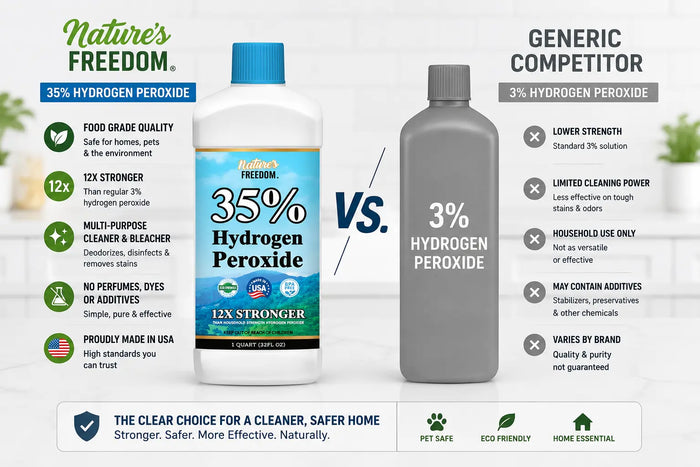
Nature's Freedom 35% H2O2 and 12% H2O2 are both NSF/ANSI/CAN 60 and NSF/ANSI/CAN 50 certified - independently verified concentration, no stabilizers. Diluted to 3%, only H2O2 and water reach the pathogen, and only water and oxygen remain after decomposition. See what is food grade hydrogen peroxide for a full breakdown of how stabilizer-free NSF-certified H2O2 differs from drugstore peroxide. Learn more about why Nature's Freedom holds these certifications.
- NSF-verified 35% and 12% concentration - full-strength treatment solution on every dilution
- No stabilizers - no interference with the oxidation reaction at treatment concentration
- Safe for edible plants and produce at correct dilution - appropriate for vegetable gardens and herbs
- Manufactured in the USA under NSF-audited conditions
Nature's Freedom 35% hydrogen peroxide is NSF Certified to NSF/ANSI/CAN 60 for drinking water treatment chemicals and NSF/ANSI/CAN 50 for pool, spa, hot tub, and other recreational water treatment chemical use.
Treat Root Rot at the Source
Nature's Freedom 35% H2O2 is NSF/ANSI/CAN 60 and NSF/ANSI/CAN 50 certified, stabilizer-free, and made in the USA. One bottle covers the full root rot treatment course and months of preventive maintenance from a single verified source.
Shop concentrated hydrogen peroxide | Browse the full collection | Contact Nature's Freedom
Frequently Asked Questions
1. How do you use hydrogen peroxide for root rot?
For container plants: remove, trim all rotted roots to healthy tissue, soak in 3% H2O2 for 15 minutes, repot in fresh soil, and water with 3% solution every three days for two weeks. For in-ground plants: apply a 3% soil drench every three days for two weeks. After the treatment course, switch to a weekly 1% maintenance dose to prevent recurrence.
2. How much hydrogen peroxide do you use for root rot?
Use 3% for active treatment - mix 1 part 35% H2O2 with 10.7 parts water, or 1 part 12% H2O2 with 3 parts water. Apply enough to saturate the root zone and drain freely from the bottom. After two weeks, switch to 1% for weekly maintenance - mix 1 part 35% H2O2 with 34 parts water.
3. How long does hydrogen peroxide take to treat root rot?
The pathogen kill begins on contact. Visible recovery takes one to two weeks for mild to moderate cases. Wilting typically reduces within the first week as the root zone is re-oxygenated. New leaf growth appears in weeks two to four. Advanced root rot with crown damage has a lower recovery rate and may take longer.
4. Can you use hydrogen peroxide for root rot without repotting?
Yes. Apply 3% H2O2 as a soil drench to the root zone every three days for two weeks. Without removing and trimming dead roots, the pathogen load is higher and recovery is slower, but the treatment still kills active pathogens and re-oxygenates the root zone. For container plants where removal is possible, the repotting method produces faster results. See the full protocol in hydrogen peroxide for plants.
5. Why does NSF-certified hydrogen peroxide work better for root rot?
NSF certification independently verifies the product meets its stated concentration and contains no stabilizers. Stabilizers in non-certified hydrogen peroxide can interfere with the oxidation reaction, allowing a portion of the pathogen population to survive and leading to relapse after treatment stops. Nature's Freedom NSF-certified 35% H2O2 and 12% H2O2 ensure full-strength treatment on every application throughout the two-week course.
Key Takeaways
- Use 3% H2O2 for root rot treatment: 1 part 35% H2O2 with 10.7 parts water, or 1 part 12% H2O2 with 3 parts water. Apply every three days for two weeks, then switch to weekly 1% maintenance.
- For container plants: remove, trim all rotted roots, soak in 3% H2O2 for 15 minutes, repot in fresh soil, water with 3% solution for two weeks.
- Hydrogen peroxide kills the anaerobic pathogens and re-oxygenates the root zone simultaneously - the dual action is what makes it uniquely effective compared to fungicides alone.
- Visible recovery takes one to two weeks for mild to moderate cases. Never reuse soil from a container where root rot occurred - the pathogen survives in the growing medium.
- Prevent recurrence by correcting drainage, avoiding overwatering, and using a weekly 1% H2O2 maintenance watering to keep the root zone oxygenated.
- Nature's Freedom 35% H2O2 and 12% H2O2 are both NSF Certified to NSF/ANSI/CAN 60 and NSF/ANSI/CAN 50 - stabilizer-free, verified concentration ensures full-strength treatment on every application.