
Yes, does vinegar and water kill weeds - but only if the starting concentration of the vinegar is high enough. Adding water to vinegar lowers its acetic acid concentration, which directly reduces its weed-killing effectiveness. If you start with 5% grocery-store white vinegar and dilute it further with water, the result is too weak to kill most weeds at the root. If you start with 45% concentrated vinegar, diluting it to around 20% to 25% still produces an effective formula. For best results on outdoor weeds, skip the water entirely and apply 45% concentrated vinegar undiluted. For the complete weed-killing guide, see Vinegar and Salt Weed Killer: Does It Work?.
Why Adding Water to Vinegar Reduces Weed-Killing Effectiveness
According to PubChem (National Institutes of Health) - Acetic Acid, acetic acid kills weeds by stripping moisture from plant cells on contact and, at high enough concentrations, penetrating into the crown of the plant to prevent root regrowth. The mechanism is concentration-dependent: the more acetic acid present, the faster and deeper the kill.
Research published in EPA Minimum Risk Pesticides found that acetic acid concentrations below 20% are insufficient to reliably kill most weed species at the root. Adding water to an already-dilute vinegar reduces it further below this threshold - the result wilts surface foliage temporarily but leaves the root system intact, allowing the plant to recover within days. For the full concentration breakdown by weed type, see What Concentration of Vinegar Kills Weeds?.
The key point: water does not add anything useful to a weed-killing formula. It only dilutes the active ingredient. For outdoor weed control, always apply concentrated vinegar undiluted.
Does Vinegar and Water Kill Weeds? Dilution Results by Concentration
|
Mixture |
Final Concentration |
Kills Weeds? |
Notes |
|
45% + no water |
45% |
Yes |
Fastest; best for all weed types |
|
45% + 1:1 water |
22.5% |
Yes |
Still effective; slower kill speed |
|
45% + 1:3 water |
11.25% |
Unreliable |
Below effective threshold for roots |
|
5% grocery vinegar |
5% |
No |
Surface burn only; roots survive |
|
5% + water (any) |
<5% |
No |
Ineffective at any dilution |
Diluting 45% concentrated vinegar 1:1 with water still produces a 22.5% solution - above the effective threshold and capable of killing most annual weeds. Starting with 5% grocery vinegar and diluting it at all produces a formula below 5%, which is ineffective for weed control under almost any conditions.
When Should You Dilute Concentrated Vinegar with Water?
Concentrated vinegar is diluted with water for indoor cleaning tasks, not for outdoor weed control. Dilution ratios for cleaning are designed to make the formula safe for surfaces that full-strength acetic acid would etch or damage.
|
Task |
Dilution |
Notes |
|
Weed killing (outdoors) |
Undiluted |
Full strength needed for root penetration |
|
General surface cleaning |
1:10 (vinegar:water) |
Safe on most sealed surfaces |
|
Heavy limescale/descaling |
1:3 (vinegar:water) |
Appliances and hard water deposits |
|
Mold treatment |
Undiluted or 1:1 |
Non-porous surfaces only |
|
Floor cleaning |
1:10 (vinegar:water) |
Not for natural stone or unsealed wood |
For weed killing specifically, the correct answer is always undiluted. Concrete, pavers, gravel, and soil are not at risk of etching from concentrated acetic acid, and full strength is needed to penetrate weed tissue effectively.
What Vinegar Should You Use for Killing Weeds?
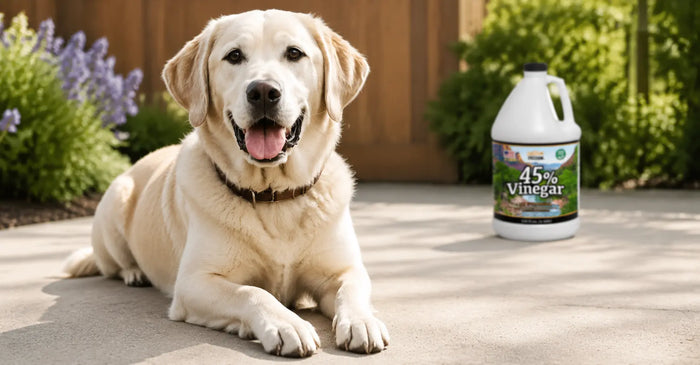
The vinegar that produces reliable weed-kill results is concentrated acetic acid at 20% to 45% - not the white distilled vinegar on grocery shelves. Nature's Freedom 45% Concentrated Vinegar is NSF Certified to NSF/ANSI/CAN 60 for drinking water treatment chemicals and made in the USA. At 45% acetic acid, it is the strongest residential-grade concentration available and produces kill rates comparable to synthetic contact herbicides without synthetic chemical residue. Apply undiluted directly to weed foliage.
What to Avoid
- 5% white distilled vinegar from grocery stores - too dilute for reliable weed kill at the root
- Diluting concentrated vinegar with water before applying to weeds - reduces effectiveness below the required threshold
- Products labeled 'cleaning vinegar' at 6% to 8% - still too weak for weed control
- Unverified marketplace sellers without an exact acetic acid percentage on the label
Safety: 45% concentrated vinegar is a corrosive irritant. Always wear nitrile or rubber gloves and safety glasses when handling undiluted solution. Keep children and pets away from treated areas until fully dry.
Tips for Getting the Best Results
- Apply on a hot, dry, sunny day with no rain forecast for at least 24 hours. Heat accelerates the desiccation effect and rain dilutes the formula before it can act.
- Apply in the morning so the treatment has a full day of sun exposure.
- Coat leaves and stems thoroughly. Focus on the crown at soil level to reduce root regrowth.
- Add half a teaspoon of dish soap per quart if treating waxy-leaved weeds. The soap acts as a surfactant and improves leaf adhesion. See How to Make Natural Weed Killer with Vinegar for the full recipe with mixing steps.
- Add 1 cup of salt per gallon if treating driveways, pavers, or any permanent no-grow zone. Salt suppresses regrowth by creating a saline soil environment. For the full decision guide on when to add salt, see Will Salt and Vinegar Kill Weeds? The EPA classifies acetic acid as a minimum-risk pesticide active ingredient - no re-entry interval required once the surface is fully dry.
- Reapply to perennial weeds every 5 to 7 days for two to three rounds to exhaust the root system.
Browse the full range of concentrated vinegar products.
The Bottom Line: Does Vinegar and Water Kill Weeds?
Does vinegar and water kill weeds? Yes - if the vinegar base starts at a high enough concentration. Diluting 5% grocery vinegar with water makes the problem worse, not better. For reliable outdoor weed control, use Nature's Freedom 45% Concentrated Vinegar, NSF Certified to NSF/ANSI/CAN 60 for drinking water treatment chemicals, applied undiluted on a hot, dry day. Reserve dilution for indoor cleaning tasks where full-strength acetic acid would damage surfaces. For the complete weed control guide, see Vinegar and Salt Weed Killer: Does It Work? Browse the full range or contact Nature's Freedom.
Frequently Asked Questions
1. Will diluted vinegar kill weeds?
It depends on the starting concentration and the dilution ratio. Diluting Nature's Freedom 45% Concentrated Vinegar 1:1 with water produces a 22.5% solution, still above the effective threshold for weed control. Diluting further, or starting with 5% grocery-store vinegar and adding water, produces a formula too weak to kill most established weeds at the root. For reliable results, apply 45% concentrated vinegar undiluted.
2. What ratio of vinegar to water kills weeds?
There is no water-to-vinegar ratio that improves weed-killing effectiveness. Water only reduces concentration. If using 45% concentrated vinegar and wanting to reduce handling risk slightly, a 1:1 dilution (final concentration 22.5%) is the maximum dilution that stays above the 20% effective threshold. For all practical weed control purposes, use the vinegar undiluted.
3. Does the temperature of the water matter?
No. Temperature does not meaningfully affect the weed-killing performance of the final solution. What matters is the acetic acid concentration, the weather conditions at application (hot and sunny is best), and whether rain occurs within 24 hours after applying.
4. Why does adding dish soap work but adding water does not?
Dish soap acts as a surfactant, reducing surface tension and helping the formula adhere to leaf surfaces rather than beading off. It does not dilute the acetic acid concentration. Adding water, by contrast, directly reduces the concentration of the active ingredient. A small amount of dish soap improves the formula; water weakens it.
5. Can I make vinegar weed killer more effective by heating it?
Heating vinegar does not increase its acetic acid concentration. It evaporates the water component faster, which could slightly raise the concentration of a solution over time, but this is not a practical or safe method for increasing effectiveness. The correct approach is to start with a higher-concentration product. Nature's Freedom 45% Concentrated Vinegar is already at the maximum effective residential-grade concentration and requires no modification.
Key Takeaways
- Does vinegar and water kill weeds? Yes - but only when the vinegar starts at a high enough concentration. Diluting already-weak 5% grocery vinegar makes the problem worse, not better. Read the complete guide to 45% concentrated vinegar.
- The minimum effective acetic acid concentration for reliable weed kill is 20%. At 45% undiluted, results are fastest and most reliable.
- Water reduces concentration and weed-killing effectiveness. Reserve water dilution for indoor cleaning tasks where full-strength acetic acid would damage surfaces.
- If dilution is needed for handling safety, a maximum 1:1 dilution of 45% vinegar still produces a 22.5% solution above the effective threshold.
- Nature's Freedom 45% Concentrated Vinegar is NSF Certified to NSF/ANSI/CAN 60 for drinking water treatment chemicals and made in the USA - the recommended product applied undiluted.
- Add dish soap as a surfactant to improve leaf adhesion. Add salt only for driveways and permanent no-grow zones where soil recovery is not needed.