
Concentrated vinegar safety depends on the handling precautions taken before and during use - not after it dries. At 45% acetic acid, concentrated vinegar is classified as a GHS corrosive irritant requiring gloves and eye protection for all handling. It is not a highly toxic industrial chemical. With basic PPE, it is safe for residential use across weed control, cleaning, and descaling applications. Once applied and fully dry, acetic acid breaks down into water and carbon dioxide, leaving no toxic residue. This guide covers GHS classification, PPE, first aid, storage, dilution, and surface compatibility for Nature's Freedom 45% Concentrated Vinegar.
TL;DR
- Concentrated vinegar at 45% acetic acid is classified as a GHS corrosive irritant: Skin Irritation Category 1, Eye Damage Category 1. Gloves and safety glasses are required for all handling.
- The primary acute risk is eye contact. Immediate 20-minute continuous rinsing and medical attention are required for any eye exposure.
- Once dried on a surface, acetic acid breaks down into water and carbon dioxide. No toxic residue remains. Safe for children and pets after full drying.
- Store in sealed HDPE, glass, or stainless steel containers. Never mix with bleach or hydrogen peroxide.
- Nature's Freedom 45% Concentrated Vinegar is NSF Certified to NSF/ANSI/CAN 60 for drinking water treatment chemicals and ships with a full GHS-compliant Safety Data Sheet.
What Is the GHS Safety Classification for Concentrated Vinegar?
Under the GHS framework - the international standard for chemical hazard communication used on Safety Data Sheets (SDS) and product labels worldwide - 45% acetic acid is classified as Skin Irritation Category 1, Eye Damage Category 1, and STOT SE (Specific Target Organ Toxicity, Single Exposure) Category 3 for respiratory tract irritation. These classifications indicate a genuine hazard requiring PPE, but not a hazard in the same tier as industrial acids or acutely toxic chemicals. The SDS for Nature's Freedom 45% Concentrated Vinegar documents these classifications in full. NSF International independently certifies the formula to NSF/ANSI/CAN 60 for drinking water treatment chemicals, confirming it meets verified safety and quality standards for residential use.
|
Hazard |
GHS Classification |
Prevention |
|
Skin contact |
Skin Irrit. Cat. 1 |
Nitrile or rubber gloves; rinse with water 15 min if contacted |
|
Eye contact |
Eye Dam. Cat. 1 |
Safety glasses or goggles; rinse 20 min continuously; seek medical attention |
|
Vapor inhalation |
STOT SE Cat. 3 |
Work outdoors or in ventilated space; avoid prolonged direct inhalation |
|
Ingestion |
Harmful if swallowed |
Keep sealed; not food grade at 45%; call Poison Control: 1-800-222-1222 |
|
Surface damage |
N/A (chemical) |
Do not use on marble, granite, limestone, aluminum, or cast iron |
What PPE Is Required for Handling Concentrated Vinegar?
The PPE required for concentrated vinegar safety is widely available and inexpensive. Under OSHA's Hazard Communication Standard (HCS 2012, 29 CFR 1910.1200), manufacturers are required to include PPE information on the product SDS and label. For 45% acetic acid, the minimum required PPE is chemical-resistant gloves and eye protection.
|
PPE Item |
Required For |
Specification |
|
Nitrile or rubber gloves |
All handling and application |
Minimum 4 mil; wrist-length; chemical-resistant |
|
Safety glasses or goggles |
All handling and application |
Goggles preferred for overhead or bulk application |
|
Long sleeves |
Outdoor spray application |
Prevents incidental splash on forearms |
|
Closed-toe shoes |
All outdoor application |
Prevents splash on feet |
|
Half-face respirator |
Enclosed spaces only |
Organic vapor cartridge; not required outdoors |
First Aid Procedures for Concentrated Vinegar Exposure
First aid for concentrated vinegar exposure follows the GHS SDS guidelines. The critical variable in all contact scenarios is how quickly rinsing begins.
Skin Contact
Remove contaminated clothing immediately. Rinse the affected area with large volumes of water for a minimum of 15 minutes. Do not apply neutralizing agents such as baking soda to skin - the heat generated by neutralization reactions can worsen irritation. If redness or pain persists after 15 minutes of rinsing, seek medical attention.
Eye Contact
Eye contact is the highest-priority first aid scenario for concentrated vinegar safety. Begin continuous rinsing with clean water or saline immediately and maintain rinsing for a minimum of 20 minutes. Do not rub the eyes. Seek medical attention immediately after rinsing regardless of symptom severity - delayed corneal injury is possible with acetic acid at this concentration. The American Academy of Ophthalmology recommends immediate professional evaluation for any chemical eye exposure.
Inhalation
Move to fresh air immediately. If coughing, throat irritation, or respiratory discomfort persists after 10 minutes in fresh air, seek medical attention. Acetic acid is classified as a STOT SE Category 3 respiratory irritant - the hazard is from vapor in enclosed spaces, not from normal outdoor application.
Ingestion
Do not induce vomiting. Rinse the mouth and drink a small amount of water if the person is conscious and able to swallow. Call US Poison Control at 1-800-222-1222 (poison.org) for immediate guidance. Seek emergency medical care. Nature's Freedom 45% Concentrated Vinegar is not food grade at this concentration and is not intended for consumption.
How to Store Concentrated Vinegar Safely
According to the SDS for 45% acetic acid, the product should be stored in a tightly sealed container made of HDPE (high-density polyethylene), glass, or stainless steel. Aluminum, galvanized metal, and standard metal containers react with acetic acid and will corrode. Store in a cool, dry location away from direct sunlight and heat sources above 40 degrees Celsius (104 degrees Fahrenheit). Keep away from oxidizing agents. Store in a location inaccessible to children.
Shelf life: Acetic acid is chemically stable and does not degrade when stored in a sealed container. The product retains full concentration for years when properly sealed.
Never mix 45% concentrated vinegar with bleach (sodium hypochlorite) or hydrogen peroxide in the same container. Acetic acid plus bleach produces chlorine gas, a toxic respiratory hazard. These products can be used separately on the same surface after thorough rinsing, but must never be combined.
Safe Dilution Ratios for Concentrated Vinegar
Diluting concentrated vinegar with water reduces both its effectiveness and its handling risk. For the complete dilution reference, see Concentrated Vinegar for Cleaning: The Complete Guide. The appropriate dilution depends entirely on the task.
|
Task |
Dilution (vinegar:water) |
Notes |
|
Weed killing (outdoors) |
Undiluted |
Full strength; PPE required throughout |
|
Heavy descaling / limescale |
1:3 |
15 to 30 min contact time on appliance surfaces |
|
Mold treatment (non-porous) |
Undiluted or 1:1 |
Tile grout, sealed concrete, caulk |
|
General surface cleaning |
1:10 |
Safe on most sealed surfaces when diluted |
|
Floor cleaning |
1:10 |
Not for natural stone or unsealed hardwood |
For weed control applications using concentrated vinegar, see Vinegar and Salt Weed Killer: Does It Work? For a comparison of weed control results with and without dilution, see Does Vinegar and Water Kill Weeds? For the full dilution guide by use case, see Concentrated Vinegar for Cleaning: The Complete Guide.
What Surfaces Are Not Safe for Concentrated Vinegar?
Acetic acid reacts with alkaline and reactive materials. The following surfaces must not be treated with concentrated vinegar at any dilution ratio, as repeated exposure causes irreversible damage.
- Natural stone: marble, granite, travertine, limestone, slate. Acetic acid dissolves calcium carbonate, the primary mineral in these stones.
- Aluminum and galvanized metal. Acetic acid oxidizes aluminum and zinc coatings, causing corrosion and pitting.
- Cast iron cookware and carbon steel. Repeated exposure strips protective coatings and causes rust.
- Unglazed or unfinished ceramic tile. Acid penetrates the porous surface and degrades the substrate over time.
- Unsealed hardwood and laminate flooring. Acid strips finish and raises wood grain.
Is Concentrated Vinegar Safe Around Children and Pets After Application?
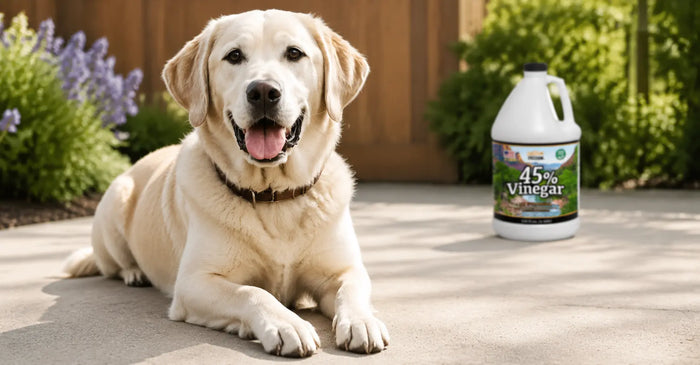
Once concentrated vinegar has fully dried on a surface, the acetic acid decomposes into water and carbon dioxide. There is no toxic residue after drying and no risk to children or pets who contact a treated surface after it has fully dried. The concentrated vinegar safety concern is exclusively during active handling and while the surface is wet. For the full pet-specific safety guide with drying times, see Is 45% Vinegar Safe for Pets?.
Keep children and pets away from treated areas until fully dry, typically one to two hours on a warm day. The salt component in weed-killer formulas presents a separate risk if dogs ingest salt directly from treated soil. On hard surfaces where salt dries into cracks, this risk is minimal.
Safe to Handle. Verified to Perform.
Nature's Freedom 45% Concentrated Vinegar is NSF Certified to NSF/ANSI/CAN 60 for drinking water treatment chemicals, made in the USA, and ships with a full GHS-compliant Safety Data Sheet. With the correct PPE and the guidance in this page, it is safe for residential use across every application covered. Browse the full vinegar range or contact Nature's Freedom.
Frequently Asked Questions: Concentrated Vinegar Safety
1. Is 45% concentrated vinegar more dangerous than bleach?
Bleach (sodium hypochlorite at 3% to 8%) and 45% concentrated vinegar are both classified as corrosive irritants, but they present different hazard profiles. Bleach is a stronger antimicrobial and can produce toxic chlorine gas when mixed with ammonia or acids. Concentrated vinegar does not produce toxic gases under normal use. Both require gloves and eye protection. The critical rule is never to mix them - acetic acid plus bleach produces chlorine gas. Contact Poison Control at 1-800-222-1222 immediately in the event of accidental chlorine gas exposure.
2. What is the pH of 45% concentrated vinegar?
A 45% acetic acid solution has a pH of approximately 2.0 to 2.4. Standard white vinegar at 5% acetic acid has a pH of approximately 2.5, and lemon juice is approximately pH 2.0. The pH difference between 5% and 45% vinegar is smaller than the concentration difference because acetic acid is a weak acid that does not fully dissociate in solution. The higher concentration drives the greater hazard, not the pH alone.
3. Does concentrated vinegar need to be disposed of as hazardous waste?
For typical residential quantities (gallons), concentrated vinegar can be diluted heavily with water and disposed of via household drains. Acetic acid is biodegradable and sewer-safe when diluted. Do not pour undiluted 45% solution directly into drains in large quantities. For large commercial volumes, contact your local waste management authority. The EPA classifies acetic acid as non-hazardous for disposal purposes at residential concentrations.
4. Can I use concentrated vinegar in a pressure washer or enclosed sprayer?
Yes, provided the components are compatible with acetic acid. HDPE, polypropylene, and stainless steel are compatible. Brass, copper, and aluminum fittings will corrode with repeated exposure to 45% acetic acid. Check your equipment manufacturer's chemical compatibility chart before using concentrated vinegar in any pressurized system.
5. Where can I find the full Safety Data Sheet for concentrated vinegar?
The SDS for Nature's Freedom 45% Concentrated Vinegar is available directly from the manufacturer. Under OSHA's Hazard Communication Standard (29 CFR 1910.1200), manufacturers are required to make the SDS available to customers. The SDS documents GHS hazard classifications, first aid procedures, PPE requirements, storage conditions, and emergency contact information. Contact Nature's Freedom directly or check the product listing at naturesfreedom.com for SDS access.
Key Takeaways: Concentrated Vinegar Safety
- Concentrated vinegar at 45% is classified under GHS as a corrosive irritant (Skin Irrit. Cat. 1, Eye Dam. Cat. 1). Gloves and eye protection are required for all handling.
- The primary acute risk is eye contact. Immediate 20-minute continuous rinsing and medical attention are required for any eye exposure. Contact Poison Control at 1-800-222-1222 for ingestion.
- Once dried on a surface, acetic acid breaks down into water and carbon dioxide. No toxic residue remains - safe for children and pets after full drying.
- Store in sealed HDPE, glass, or stainless steel containers away from heat, sunlight, and oxidizing agents. Never mix with bleach or hydrogen peroxide.
- Nature's Freedom 45% Concentrated Vinegar is NSF Certified to NSF/ANSI/CAN 60 for drinking water treatment chemicals and ships with a full GHS-compliant Safety Data Sheet.
- Never use on natural stone, aluminum, galvanized metal, cast iron, or unsealed wood surfaces. Read our 45% vinegar safety and use guide.