
An outdoor pet odor eliminator is a concentrated formula designed to break down urine compounds at the molecular level on outdoor surfaces, including grass, artificial turf, concrete patios, gravel, and dog runs. Unlike indoor sprays or air fresheners, outdoor formulas must penetrate porous and natural surfaces, withstand sun and rain exposure, and cover large areas efficiently. The most effective outdoor pet odor eliminators use enzymatic or microbial action to destroy the urea, uric acid, and ammonia that cause persistent odor, rather than masking the smell with fragrance. This guide covers how they work, which surfaces respond best, how to apply correctly, and which products perform across each use case. For the full product range, see Nature's Freedom Outdoor Pet Urine Odor Remover.
Outdoor Odor Eliminator: a product formulated for exterior surfaces (grass, turf, concrete, gravel) where sun, rain, and soil exposure require a different formulation than indoor enzyme cleaners.
What Causes Outdoor Pet Odor to Linger?
Outdoor pet urine odor persists because uric acid crystals bind to surfaces and resist breakdown from water alone. When urine dries in grass, turf, or concrete, the ammonia volatilizes first and the uric acid bonds to the substrate. According to PubChem (NIH) - Ammonia, ammonia is a volatile compound that releases rapidly from urine as it dries, producing the immediate sharp smell. The longer-lasting odor comes from uric acid, which is not water-soluble and does not break down with standard cleaning agents.
Standard hose-rinsing or soap-based cleaners remove surface residue but leave the crystallized uric acid compounds intact. Heat and humidity reactivate those crystals, which is why the smell returns after rain or on warm days. This reactivation cycle is the primary reason standard cleaning approaches fail to produce lasting results outdoors.
Dog urine also contains urea - a nitrogen compound that breaks down into ammonia over time through bacterial action in soil and on surfaces. This second breakdown phase contributes to the lingering odor cycle that persists weeks after the original deposit. The American Veterinary Medical Association notes that urine deposits from dogs are one of the most common sources of persistent outdoor odor complaints for pet owners.
How Does an Outdoor Pet Odor Eliminator Work?
Outdoor pet odor eliminators work by deploying enzymes or beneficial bacteria that digest the organic compounds in urine. The mechanism is biological, not chemical masking.
Enzymatic Action
Enzymes act as biological catalysts that accelerate the breakdown of specific organic compounds. In pet odor eliminators, protease enzymes break down protein waste from urine, urease targets urea directly and converts it before it can produce further ammonia, and lipase handles any fatty residue. Once those compounds are fully digested, the odor source no longer exists - there is nothing left to reactivate.
Enzyme Cleaner: a cleaning formula that uses biological enzymes to break down the uric acid crystals in pet urine at a molecular level, rather than just masking the odor.
Microbial Action
Microbial formulas use live bacteria strains that colonize the treated surface and continue breaking down waste compounds over time. Unlike single-dose enzyme products, microbial formulas can provide extended protection by maintaining active bacteria populations that continue processing new urine deposits. Both mechanisms are fundamentally different from masking sprays, which use fragrance to overpower odor without eliminating the underlying compounds.
Why Fragrance-Based Products Fail Outdoors
Fragrance-based outdoor sprays are designed to temporarily overpower odor with a stronger scent. They do not address the uric acid crystals that cause persistent smell. Because outdoor surfaces are exposed to sun, wind, and rain, fragrance disperses within hours and the underlying odor returns as uric acid reactivates with moisture. For outdoor use specifically, biological elimination is the only approach that produces lasting results.
Which Outdoor Surfaces Does a Pet Odor Eliminator Work On?
Different outdoor surfaces present different challenges for odor elimination. The correct application approach varies by surface type.
Natural Grass and Lawns
Enzymatic formulas are safe for grass and soil when used as directed. The ASPCA recommends using pet-safe cleaning products around animals, and properly formulated enzymatic cleaners meet this standard. The beneficial bacteria in microbial cleaners can support the soil microbiome rather than damage it, unlike bleach or high-acidity cleaners that kill turf and alter soil pH. Nature's Freedom Outdoor Pet Urine Odor Remover with hose-end sprayer is designed specifically for lawn coverage at full dilution, making it practical for large yards with multiple dog use areas.
Artificial Turf
Synthetic grass is one of the most challenging surfaces for pet odor because urine passes through the turf fibers and pools on the rubber infill and backing layer where it dries and crystallizes out of reach of surface sprays. Enzymatic cleaners are the recommended treatment for artificial turf because they penetrate the infill layer where standard sprays cannot reach. Apply enough volume to saturate below the fiber layer - surface dampening is not sufficient. Reapplication every two to four weeks is standard for high-traffic turf areas. Do not rinse after application; the product must dwell to complete the enzymatic process.
Concrete and Patios
Concrete is porous and absorbs urine below the surface level, concentrating odor compounds beneath the visible surface. An enzyme-based cleaner must be left wet for 10 to 15 minutes to allow penetration and digestion of subsurface deposits. For sealed concrete, coverage is more surface-level but still effective on the residue that causes odor. Pre-wetting dry concrete before applying the odor eliminator opens the surface pores and improves penetration depth.
Gravel and Dog Runs
Gravel presents the largest application challenge because liquid drains between stones and concentrates in the soil underneath. Hose-end applicators are particularly effective here because they deliver enough volume to saturate the gravel bed and reach the soil layer where odor compounds accumulate over time. A single targeted spray application will not be sufficient for gravel runs with heavy use - full saturation of the gravel depth is required.
Hose-End Sprayer: an attachment that connects directly to a garden hose, automatically diluting concentrated product to the correct ratio as water passes through it.
Decks and Wood Surfaces
Pressure-treated and sealed wood responds well to enzymatic treatment, though the surface must be allowed to dry fully between applications. Always confirm the formula is pH-neutral before applying to untreated or stained wood. Enzymatic cleaners formulated for outdoor use are generally safe on wood decking; harsh chemical cleaners or bleach-based products risk stripping sealants and damaging the wood surface.
Kennels and Runs
Kennel surfaces - typically concrete or compacted gravel - accumulate high concentrations of urine odor compounds with daily deposit cycles. The AVMA recommends regular sanitation of kennel environments as part of standard pet care practice. For kennels, enzymatic treatment applied after solid waste removal and a light pre-rinse produces the most thorough odor elimination. Weekly treatment schedules are standard for active kennels with multiple dogs.
Outdoor Pet Odor Eliminators Compared
Not all outdoor pet odor products use the same mechanism or format. The comparison below covers the five most commonly referenced products for outdoor use.
|
Product |
Mechanism |
Hose Sprayer |
Surface Coverage |
Pet-Safe |
Scent |
|
Nature's Freedom Outdoor |
Enzymatic |
Yes |
Yard, Turf, Concrete, Gravel, Decks |
Yes |
Light / Neutral |
|
Simple Green Outdoor |
Microbial |
Yes |
Grass, Turf, Patios |
Yes |
Fresh Scent |
|
Rocco and Roxie |
Enzymatic |
No |
Primarily Indoor / Spot Outdoor |
Yes |
Minty |
|
Nature's Miracle Yard |
Enzymatic |
Yes |
Yard, Patios |
Yes |
Variable |
|
Angry Orange |
Chemical / Masking |
No (Concentrate) |
Indoor and Outdoor Spot |
Yes |
Strong Citrus |
Nature's Freedom offers the combination most relevant to large-area outdoor use: enzymatic elimination, a built-in hose-end sprayer, and a 1-gallon concentrate sized for ongoing yard maintenance. Products without a hose attachment, such as Rocco and Roxie, are better suited to spot treatment and indoor use. Angry Orange and similar fragrance-forward products do not address the uric acid source and are not suitable for long-term outdoor odor control. For product details, visit naturesfreedom.com/collections/all.
How to Choose the Right Outdoor Pet Odor Eliminator
The right product depends on the surface you are treating, the size of the area, and how frequently deposits occur.
|
Use Case |
Recommended Format |
Key Feature to Look For |
|
Large lawn / full yard |
Hose-end sprayer concentrate |
Volume coverage; enzymatic formula |
|
Artificial turf |
Enzymatic, high-volume |
Penetrates infill layer; no rinse required |
|
Concrete patio or kennel |
Enzymatic, dwell-time formula |
10-15 min dwell; pH-neutral for concrete safety |
|
Gravel dog run |
Hose-end, high-volume |
Saturates depth; reaches sub-gravel soil |
|
Spot treatment (deck, furniture) |
Trigger spray, enzyme-based |
Targeted; pH-neutral for wood and fabric |
|
Multi-surface / ongoing maintenance |
Hose-end 1-gallon concentrate |
Cost-effective for large-area weekly use |
For ongoing yard maintenance across multiple surface types, a hose-end 1-gallon concentrate is the most cost-effective format. Nature's Freedom Outdoor Pet Urine Odor Remover covers all six use cases in the table above with a single product. The EPA Safer Choice program evaluates cleaning product ingredients for safety and environmental impact - look for products that align with Safer Choice criteria when selecting pet odor solutions for regular outdoor use.
How to Apply an Outdoor Pet Odor Eliminator Effectively
Correct application is as important as product choice. Incorrect application - particularly surface dampening rather than full saturation - is the most common reason outdoor odor treatments fail.
1. Remove solid waste from the surface before applying. Enzymatic cleaners work on liquid urine compounds; solid waste must be removed first to allow product contact with the treated surface.
2. Pre-wet the area lightly if the surface is dry concrete or gravel. Pre-wetting opens surface pores and improves penetration depth, particularly on dense concrete and compacted gravel.
3. Attach the hose-end sprayer and set the dilution to the manufacturer's recommended ratio for the surface type. For heavily soiled areas, a more concentrated ratio is appropriate.
4. Apply the product evenly, ensuring the entire affected area is saturated, not just surface-dampened. For artificial turf and gravel, apply until you see runoff beginning, confirming the product has reached the base layer.
5. Allow the formula to dwell for a minimum of 10 minutes before the area dries. Do not rinse. The enzymatic process requires dwell time - rinsing before completion stops the breakdown mid-process.
6. For heavily soiled areas or old, set-in odors, a second application 24 to 48 hours later will complete the enzymatic breakdown. Old uric acid deposits may require two full cycles to fully eliminate.
For artificial turf and gravel runs: apply until surface runoff begins. This confirms the product has reached the infill or sub-gravel layer where uric acid concentrates. Surface dampening alone will not eliminate deep-set odor.
Is Outdoor Pet Odor Eliminator Safe for Pets, Children, and Plants?
A properly formulated outdoor pet odor eliminator is safe for pets, children, and plants when used as directed. Enzymatic and microbial formulas do not contain bleach, chlorine, or high-acidity compounds that damage turf or soil. The AVMA advises pet owners to review product ingredient lists and SDS documents before applying any cleaning or treatment product in areas where pets have regular access.
Nature's Freedom Outdoor Pet Urine Odor Remover is specifically formulated to be gentle on grass and plant life while remaining effective on urine odor compounds. After the treated surface has dried, re-entry by pets is generally considered safe. For artificial turf with rubber infill, allow additional drying time before pet access, as infill retains moisture and product longer than natural surfaces.
Always review the Safety Data Sheet (SDS) of any product before first use. If you are concerned about product safety for specific plants or grass varieties, the ASPCA Pet Poison Prevention resource provides guidance on common household product safety around animals.
Recommended Maintenance Schedule by Surface Type
|
Surface |
Frequency |
Notes |
|
Natural lawn (1-2 dogs) |
Weekly |
Treat entire high-use area; no rinse |
|
Natural lawn (3+ dogs) |
Every 3 to 4 days |
Increase frequency for high-deposit zones |
|
Artificial turf |
Every 2 to 4 weeks |
Saturate infill layer; allow full dwell time |
|
Concrete kennel |
Weekly |
Pre-wet; 10-15 min dwell; no rinse |
|
Gravel dog run |
Every 2 weeks |
Saturate full depth; treat sub-gravel layer |
|
Wood deck (spot use) |
As needed |
Treat after each incident; allow full drying |
|
High-traffic turf (kennel) |
Weekly |
After solid waste removal; full saturation |
Can Vinegar Be Used as an Outdoor Pet Odor Eliminator?
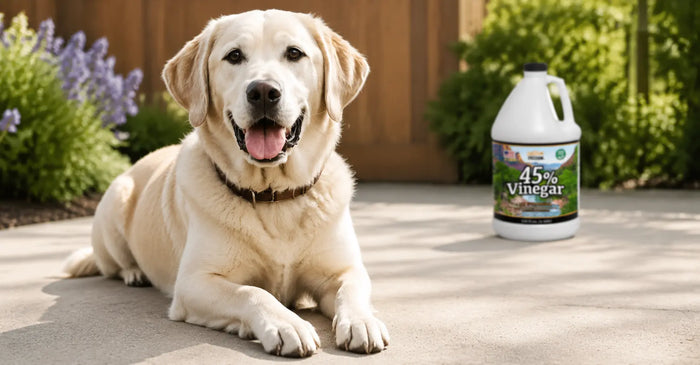
White vinegar at 5% is sometimes suggested as a home remedy for pet odor. While acetic acid does have some antimicrobial properties, it does not contain the protease and urease enzymes needed to break down uric acid crystals. Dilute vinegar may temporarily reduce the ammonia smell but does not eliminate the underlying uric acid deposit. Concentrated vinegar at 45% is effective for weed control but is not recommended for use in areas where pets have access due to the corrosive irritant classification. For pet-safe outdoor use, enzymatic products are the correct choice. For weed control applications in outdoor areas, see Vinegar and Salt Weed Killer: Does It Work? and Is 45% Vinegar Safe for Pets? for guidance on keeping these applications separate.
The Bottom Line: Outdoor Pet Odor Eliminator
Outdoor pet odor eliminators that work permanently use enzymatic or microbial action to break down the uric acid, urea, and ammonia at the source. Fragrance-based products and standard soap cleaners do not address the crystallized uric acid deposits that cause odor to return with heat and moisture. For large outdoor areas, a hose-end sprayer enzymatic concentrate is the most practical and effective format. Nature's Freedom Outdoor Pet Urine Odor Remover delivers enzymatic elimination across the full outdoor surface range - yard, artificial turf, concrete, gravel, and kennel - in a single 1-gallon hose-end sprayer format designed for ongoing maintenance. One gallon. No scrubbing. No smell coming back. Questions? Contact the Nature's Freedom team.
Frequently Asked Questions
1. What is the best outdoor pet odor eliminator for large yards?
For large yards, a hose-end sprayer product with an enzymatic or microbial formula is the most practical choice. It delivers consistent coverage across wide areas without requiring repeated manual spraying. Nature's Freedom Outdoor Pet Urine Odor Remover connects directly to a standard garden hose and treats the full yard in a single pass. Products without a hose attachment, such as Rocco and Roxie, are better suited for spot treatment.
2. How long does it take for an outdoor pet odor eliminator to work?
Most enzymatic formulas begin breaking down uric acid within minutes of application, but full odor elimination on set-in or heavy deposits takes 24 to 48 hours. For fresh spots, one application is usually sufficient. For areas with months of accumulated odor, two applications spaced 24 hours apart produce the most complete result.
3. Why does dog urine smell keep coming back outside after cleaning?
Dog urine smell returns outdoors because uric acid crystals survive water rinsing and standard soap-based cleaning. Heat and moisture reactivate the crystals, releasing ammonia odor again. The only way to stop the cycle is to break down the uric acid compounds with an enzymatic cleaner that digests them completely. Surface cleaning removes visible residue but does not address the crystallized compounds bonded to the substrate.
4. Can I use an outdoor pet odor eliminator on artificial turf?
Yes. Enzymatic formulas are specifically recommended for artificial turf because they penetrate the rubber infill and backing where urine pools. Apply enough volume to saturate below the turf fibers, allow a minimum dwell time of 10 minutes, and do not rinse. For high-traffic turf areas, scheduled maintenance applications every two to four weeks prevent buildup from accumulating to problematic levels.
5. Is it safe to let my dog back on the lawn after applying pet odor eliminator?
For enzymatic and microbial formulas, the treated surface is generally safe for pets once it has dried fully. Enzymatic cleaners do not use chlorine, bleach, or harsh acids that leave toxic residue. For added caution, allow 30 minutes of drying time in warm weather before allowing pet access. For artificial turf with rubber infill, extend the waiting period as infill retains moisture longer than natural grass or concrete.
6. How is outdoor pet odor eliminator different from indoor pet odor spray?
Outdoor formulas are engineered for higher volume coverage, UV resistance, and penetration into porous surfaces like gravel, soil, and turf infill. Indoor sprays are typically lower concentration, designed for carpet, upholstery, and hard floor spot treatment. Using an indoor product outdoors will produce inadequate coverage for large areas and insufficient penetration for outdoor surfaces. Hose-end delivery systems are specific to outdoor formats and do not exist in indoor products.
7. What other Nature's Freedom products work for outdoor cleaning?
Nature's Freedom produces concentrated cleaning and horticultural products for a range of outdoor applications. For outdoor surface cleaning and descaling, see the full product range. For weed control in outdoor areas, concentrated vinegar at 45% is an effective natural herbicide - see Concentrated Vinegar for Cleaning and How to Use Concentrated Vinegar to Kill Weeds for related applications. Contact the team at naturesfreedom.com/pages/contact for product guidance.
Key Takeaways
- Outdoor pet odor eliminators work by breaking down uric acid, urea, and ammonia at the molecular level - not by masking smell with fragrance. Enzymatic and microbial formulas are the only mechanisms that permanently eliminate the source.
- Uric acid crystals bond to outdoor surfaces and reactivate with heat and moisture. Standard hose-rinsing and soap-based cleaners do not remove them.
- The right product format for large outdoor areas is a hose-end sprayer concentrate. Trigger spray or pump products are appropriate for spot treatment only.
- Artificial turf requires full saturation below the fiber layer to reach the infill and backing where uric acid pools. Surface dampening is not sufficient.
- For set-in or heavily accumulated odors, two applications 24 to 48 hours apart produce more complete results than a single heavy application.
-
Nature's Freedom Outdoor Pet Urine Odor Remover is an enzymatic formula with a built-in hose-end sprayer designed for yards, turf, kennels, concrete, and gravel - the complete outdoor surface range.