
Yes, hydrogen peroxide is safe for colored clothes at 3% concentration with standard contact times. Fading risk is low for light and medium colors, moderate for dark and saturated colors, and significantly lower in every case than chlorine bleach. Nature's Freedom also offers 12% H2O2 for heavy-duty tasks, but for colored fabrics, 3% is always the correct concentration - never apply 12% or higher directly to colored fabric. The two variables that control color safety are concentration and contact time. Keep both within the guidelines below and most colored garments will come through treatment without any visible change.
Is Hydrogen Peroxide Safe for Colored Clothes - Can It Cause Fading?
It can, but only when concentration is too high or contact time is too long - both easy to control. According to PubChem (National Institutes of Health), H2O2 releases reactive oxygen that breaks apart chromophore structures - the molecular configurations responsible for visible color. Most fabric dyes are synthetic chromophores. At 3% with contact times of 10 to 15 minutes, the vast majority of colorfast dyes are unaffected. The oxidation at this concentration targets surface soil and bacteria, not the more stable bonds in quality synthetic dyes.
Three fading risk factors to control:
-
Concentration: Use 3% for all colored fabric applications. Never apply 12% or 35% undiluted directly to colored fabric.
-
Contact time: Keep to 10 minutes maximum on direct application. Longer contact increases cumulative oxidation on dye molecules.
-
Color depth: Darker, more saturated colors carry higher risk. Bright reds, royal blues, and deep blacks contain more dye molecules than pastels and mid-tones.
Which Colored Fabrics Are Safe to Treat with Hydrogen Peroxide?
Lighter colors and synthetic fabrics carry lower risk. Darker, more saturated colors and natural dyed fibers carry higher risk. Silk and wool are unsafe at any color or concentration due to fiber damage - not dye damage. For a full explanation of H2O2 grades and how concentration affects safety, see what is food grade hydrogen peroxide.
|
Fabric and Color |
Safe at 3%? |
Notes |
|
Light-colored cotton / linen (pastels) |
Yes |
Safe at standard contact times |
|
Medium-colored cotton |
Spot-test |
Test before full application |
|
Dark cotton (navy, black) |
Spot-test |
Short contact only; monitor closely |
|
Bright saturated colors (red, royal blue) |
Spot-test |
Higher risk; limit contact time |
|
Polyester (light to medium) |
Yes |
Generally colorfast at 3% |
|
Polyester (dark) |
Spot-test |
Dye formulations vary by brand |
|
Athletic synthetics (any color) |
Yes |
Safe for odor treatment |
|
Denim |
Spot-test |
Fades unevenly; always test first |
|
Silk (any color) |
No |
Damages silk fibers regardless of color |
|
Wool (any color) |
No |
Oxidizing action damages wool protein |
How Do You Spot-Test Colored Clothes Before Using Hydrogen Peroxide?
A spot-test takes two minutes and eliminates guesswork. Always dilute to 3% first - mix 1 part 35% H2O2 with 10.7 parts water - and run this test before treating any colored garment for the first time.
1. Find a hidden area - an interior seam, inside of a hem, or hidden section under a collar.
2. Apply a small amount of 3% H2O2 to dampen the fabric, not soak it.
3. Allow 10 to 15 minutes without disturbing the treated area.
4. Rinse with cold water and allow to dry fully under good lighting.
5. If color is unchanged, proceed. If any fading or color shift is visible, do not use hydrogen peroxide on that garment.
How Do You Use Hydrogen Peroxide Safely on Colored Laundry?
Three methods apply, ranked from lowest to highest fading risk. Learn the full hydrogen peroxide use guide.
Rinse Cycle Method - Lowest Risk
Add half a cup of 3% H2O2 to the rinse compartment. The machine dilutes it further before it contacts fabric. This delivers gentle brightening and odor elimination with virtually no fading risk on colorfast fabrics. Use for regular maintenance washing of colored loads.
Bleach Dispenser Method - Odor and Disinfecting
Add 1 cup of 3% H2O2 to the bleach dispenser. Safe for most light to medium-colored fabrics. For dark colors, use the rinse cycle method and spot-test first.
Direct Pre-Treatment - Stains on Colored Fabric
Apply 3% H2O2 to the stain only - not to surrounding fabric. Allow 10 minutes maximum, then rinse immediately with cold water and wash. Never allow the treated area to dry before rinsing on colored fabric.
For washing machine descaling and drum deodorizing, Nature's Freedom 45% concentrated vinegar dissolves mineral deposits that hydrogen peroxide cannot address. See is 45% vinegar safe for guidance on using concentrated vinegar in appliances.
Hydrogen Peroxide vs. Bleach on Colored Clothes
Hydrogen peroxide fading on colored fabric is gradual and avoidable. Bleach damage is instant and permanent. The EPA Safer Choice program approves hydrogen peroxide as a safer cleaning ingredient specifically because of its clean decomposition profile and lower risk to fabrics compared to chlorine alternatives.
|
Factor |
H2O2 at 3% |
Chlorine Bleach |
|
Effect on colored fabrics |
Mild; low fading risk at 3% |
Severe; strips color instantly |
|
Safe for light colors |
Yes |
No |
|
Safe for dark colors |
With spot-test |
No |
|
Damage reversible? |
Yes - fading is gradual |
No - instant and permanent |
|
Residue in fabric after wash |
None |
Chlorinated compounds remain |
|
Fiber damage over time |
Minimal at 3% |
Significant; weakens fibers |
|
EPA Safer Choice approved |
Yes |
No |
Why Is NSF-Certified H2O2 the Safest Option for Colored Fabrics?
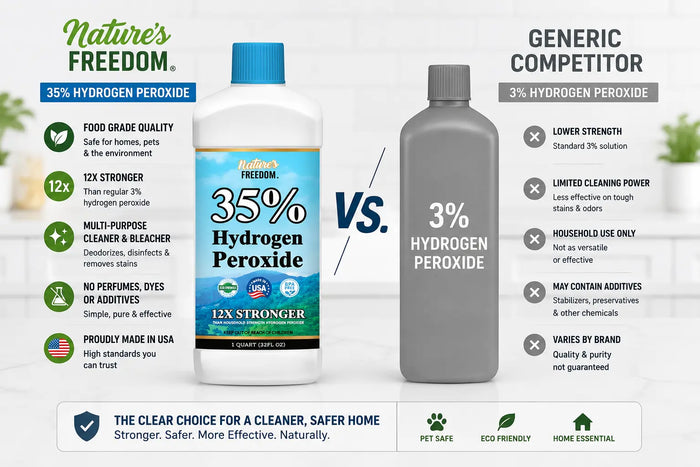
Drugstore 3% hydrogen peroxide contains stabilizers - acetanilide and phenol - that do not fully rinse from fabric in the wash cycle. On colored fabrics, residual stabilizer accumulation gradually dulls color over repeated treatments, even when no visible fading occurs after individual washes. The CDC NIOSH Pocket Guide confirms H2O2's antimicrobial effectiveness operates at concentrations well below those that pose significant risk to most synthetic dyes.
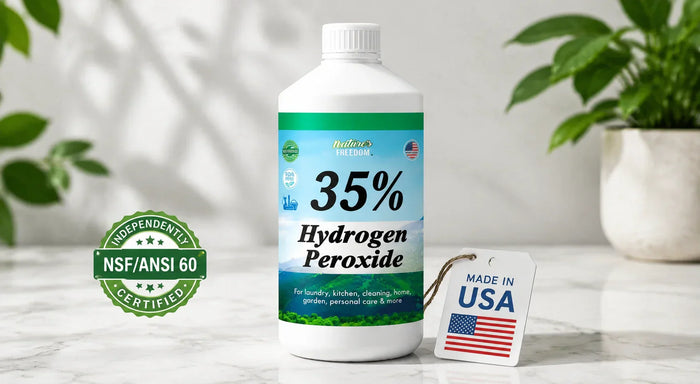
Nature's Freedom 35% H2O2 is NSF/ANSI/CAN 60 and NSF/ANSI/CAN 50 certified and contains no stabilizers. When diluted to 3% and used on colored fabric, only H2O2 and water enter the fiber. After decomposition, nothing remains - no stabilizer residue, no gradual dye interaction, no cumulative dullness. For heavy-duty disinfecting tasks on whites or surfaces (never directly on colored fabric), Nature's Freedom 12% H2O2 carries the same dual NSF certifications and the same stabilizer-free formula. Learn more about why Nature's Freedom holds NSF certifications.
-
No stabilizer residue accumulating in dyed fabric fibers over repeated treatments
-
Independently verified 35% concentration - accurate dilution to 3% every time
-
Manufactured in the USA under NSF-audited conditions
Nature's Freedom 35% hydrogen peroxide is NSF Certified to NSF/ANSI/CAN 60 for drinking water treatment chemicals and NSF/ANSI/CAN 50 for pool, spa, hot tub, and other recreational water treatment chemical use.
Safe for Colors. Tough on Stains and Odor.
Nature's Freedom 35% hydrogen peroxide is NSF/ANSI/CAN 60 and NSF/ANSI/CAN 50 certified, stabilizer-free, and made in the USA. Diluted to 3%, it handles odor, stains, and bacteria in colored loads without the fading risk of bleach.
Shop concentrated hydrogen peroxide | Browse the full collection | Contact Nature's Freedom
Frequently Asked Questions
1. Is hydrogen peroxide safe for colored clothes?
Yes, at 3% with standard contact times. Most colorfast fabrics in light to medium colors show no fading. Darker and more saturated colors carry more risk and benefit from a spot-test first. Silk and wool are not safe at any concentration due to fiber damage.
2. Will hydrogen peroxide fade dark-colored clothes?
It can with direct application and extended contact. For dark colors - navy, black, deep jewel tones - use the rinse cycle method (half a cup of 3% H2O2 in the rinse compartment) rather than direct application. Always spot-test a hidden seam before the first treatment.
3. How long can hydrogen peroxide sit on colored fabric?
Ten minutes is the safe maximum for direct 3% H2O2 application. Rinse immediately with cold water after that. Do not allow the treated area to dry before rinsing. For the rinse cycle method, contact time is controlled by the machine and is too brief to cause fading on most colorfast fabrics.
4. Does hydrogen peroxide damage colored fabric the same way bleach does?
No. Chlorine bleach strips color instantly and irreversibly at any concentration. Hydrogen peroxide at 3% poses a gradual, time-dependent fading risk that is significantly milder and largely avoidable through correct use.
5. Can you use hydrogen peroxide on colored polyester?
Generally yes. Polyester dyes are typically more chemically stable than natural fiber dyes and resist oxidation at 3%. Light to medium polyester colors are safe for standard laundry use. Dark polyester benefits from a spot-test first, as dye formulations vary between manufacturers.
Key Takeaways
-
Hydrogen peroxide at 3% is safe for most colored clothes. Fading risk is low for light and medium colors, moderate for dark and saturated colors, and avoidable with correct handling.
-
Keep concentration at 3% and direct application contact time to 10 minutes maximum. Never apply 12% or 35% H2O2 directly to colored fabric.
-
Always spot-test a hidden interior seam before treating any colored garment for the first time - the test takes two minutes and prevents irreversible fading.
-
The rinse cycle method (half a cup of 3% H2O2 in the rinse compartment) is the lowest-risk approach for colored loads and safe for virtually all colorfast fabrics.
-
Hydrogen peroxide fading is gradual and avoidable. Bleach damage is instant and permanent - H2O2 is the clear safer choice for colored laundry.
-
Nature's Freedom 35% H2O2 is NSF Certified to NSF/ANSI/CAN 60 and NSF/ANSI/CAN 50 - stabilizer-free, so no residue accumulates in dyed fabric fibers over repeated treatments.