
Hydrogen peroxide whitens white fabrics, removes organic stains, eliminates odors at the bacterial source, and replaces chlorine bleach in the washing machine - with no chlorinated residue left in fibers. Add 1 cup of 3% H2O2 to the bleach compartment per standard load, or half a cup to the rinse cycle for odor control on colored items. NSF-certified 35% food grade H2O2 diluted to 3% outperforms drugstore peroxide because it contains no stabilizers - the only compounds entering your wash cycle are H2O2 and water.
What Does Hydrogen Peroxide Do in Laundry?
Hydrogen peroxide works through oxidation - releasing reactive oxygen on contact with organic compounds in fabric. That reaction drives three distinct laundry functions. See what is food grade hydrogen peroxide for a full breakdown of how H2O2 grades and concentrations differ.
Whitening and Brightening
Oxidation breaks apart the compounds responsible for yellowing in white and light-colored fabrics - sweat residue, mineral deposits, and optical brightener buildup from detergents. Hydrogen peroxide reverses this at the fiber level without the fiber damage associated with chlorine bleach.
Stain Removal
Organic stains - blood, sweat, grass, wine, coffee, food - are particularly vulnerable to oxidation. Reactive oxygen breaks apart the chromophore molecules responsible for visible color, decolorizing or loosening the stain enough for the wash cycle to remove it entirely.
Odor Elimination
Laundry odors originate from bacteria embedded in textile fibers - particularly in athletic wear, gym clothing, and towels that remain damp. According to PubChem (National Institutes of Health), hydrogen peroxide has well-documented antimicrobial activity against bacteria and fungi. It kills the organisms responsible for odor rather than masking smell with fragrance.
How Do You Use Hydrogen Peroxide in the Washing Machine?
Hydrogen peroxide can be used in three ways: as a bleach substitute, a rinse cycle booster, or a pre-soak for heavily stained items. Read here everything hydrogen peroxide uses beyond laundry.
As a Bleach Substitute
Add 1 cup (8 fl oz) of 3% hydrogen peroxide to the bleach compartment of a standard top-loading or front-loading washing machine. Run the wash cycle as normal. For heavily soiled loads or strong odors, increase to 2 cups. Always use the bleach dispenser - do not pour directly onto dry fabric in the drum.
As a Rinse Cycle Booster
Add half a cup of 3% H2O2 to the rinse cycle for brightening and odor control on colored loads. This avoids the fading risk of full-cycle use and works particularly well for athletic wear and towels.
As a Pre-Soak
For heavily stained items:
1. Fill a basin with cold water and add 3% H2O2 to reach a 1% to 3% solution.
2. Submerge the stained garment and soak for 30 to 60 minutes.
3. Wash immediately on the appropriate cycle. Do not allow H2O2 to dry on fabric before washing.
To dilute 35% H2O2 to 3% for laundry: mix 1 part H2O2 with 10.7 parts water. One 32 fl oz bottle produces more than ten full-load doses. Full dilution ratios are in the hydrogen peroxide dilution guide.
How Do You Use Hydrogen Peroxide to Brighten White Clothes?
White fabrics respond particularly well to hydrogen peroxide - there is no color risk at standard concentrations.
For Yellowed Whites
1. Fill the machine or a large basin with hot water and add 1 to 2 cups of 3% hydrogen peroxide.
2. Submerge white garments and soak for 30 minutes before running the wash cycle.
3. Wash on the hottest setting appropriate for the fabric type.
4. Air dry in sunlight where possible - sunlight enhances the brightening effect on white fabrics.
For Collar, Cuff, and Sweat Stains
Apply 3% H2O2 directly to the stained area with a soft brush or cloth. Allow 15 to 30 minutes of contact time, then wash immediately. For older set-in stains, scrub gently with a brush after applying H2O2. For heavy collar buildup, mix 3% H2O2 with a small amount of baking soda to form a paste, apply, allow to dry, then brush off and wash.
Which Stains Does Hydrogen Peroxide Remove from Laundry?
Hydrogen peroxide is most effective on organic stains. All methods below use 3% H2O2. Wash immediately after every contact period.
|
Stain Type |
Conc. |
Method |
Contact Time |
|
Sweat and deodorant |
3% |
Apply directly, rub in gently |
15-30 min |
|
Blood (fresh) |
3% |
Apply cold, never hot water |
10 min |
|
Blood (dried) |
3% |
Soak in cold 3% solution |
30 min |
|
Grass |
3% |
Apply directly, scrub lightly |
15 min |
|
Wine (red) |
3% |
Apply immediately, blot, do not rub |
10 min |
|
Coffee or tea |
3% |
Apply and let sit |
10-15 min |
|
Mold or mildew on fabric |
3% |
Apply, let sit, scrub |
30 min |
|
General yellowing (whites) |
3% |
Soak before wash |
30-60 min |
|
Collar and cuff grime |
3% |
Apply, scrub with brush |
15 min |
Blood stains require cold water only. Hot water sets blood protein into fabric permanently. Apply 3% H2O2 to cold, damp fabric, allow to fizz for 10 minutes, then rinse cold and wash.
Can Hydrogen Peroxide Replace Bleach in Laundry?
Yes. For the vast majority of laundry applications, hydrogen peroxide achieves the same whitening, disinfecting, and stain-fighting results as chlorine bleach - with meaningful practical advantages.
-
No chlorine smell in laundry or on skin after washing
-
No residual chlorine compounds left in fabric fibers
-
Safe on most colored fabrics at 3% - bleach strips color
-
Does not weaken cotton and synthetic fiber strength over repeated use
-
Decomposes into water and oxygen - nothing harmful remains in wastewater
The EPA Safer Choice program approves hydrogen peroxide as an active ingredient for cleaning formulations; chlorine bleach does not appear on that list. For households with children or pets, the residue-free decomposition profile matters. One exception: clinical or institutional laundry requiring hospital-grade pathogen elimination should follow facility-specific protocols. Learn more about why Nature's Freedom holds NSF certifications.
Which Fabrics Are Safe to Wash with Hydrogen Peroxide?
3% hydrogen peroxide is safe for most synthetic and natural fabrics. The exceptions are protein-based natural fibers, which are vulnerable to oxidizing agents.
|
Fabric Type |
Safe at 3%? |
Notes |
|
White cotton |
Yes |
Excellent brightening results |
|
White linen |
Yes |
Effective for yellowing and stains |
|
Cotton blends (colored) |
Spot-test first |
Extended contact may lighten some dyes |
|
Polyester |
Yes |
Safe at 3%; test darker colors first |
|
Nylon and spandex |
Spot-test first |
Generally safe; test before full use |
|
Athletic wear (synthetic) |
Yes |
Excellent for odor elimination |
|
Silk |
Not recommended |
H2O2 can weaken silk fibers and alter sheen |
|
Wool |
Not recommended |
Oxidizing action damages wool protein structure |
|
Delicate lace or embroidery |
Not recommended |
Use professional cleaning only |
When treating a garment type for the first time, apply a small amount of 3% H2O2 to a hidden interior seam and allow 10 minutes before proceeding.
For washing machine descaling and mineral deposit removal from detergent dispensers, use Nature's Freedom 45% concentrated vinegar - hydrogen peroxide does not dissolve mineral deposits. See is 45% vinegar safe for guidance on using concentrated vinegar around your home and appliances.
Why Does NSF-Certified 35% H2O2 Perform Better for Laundry?
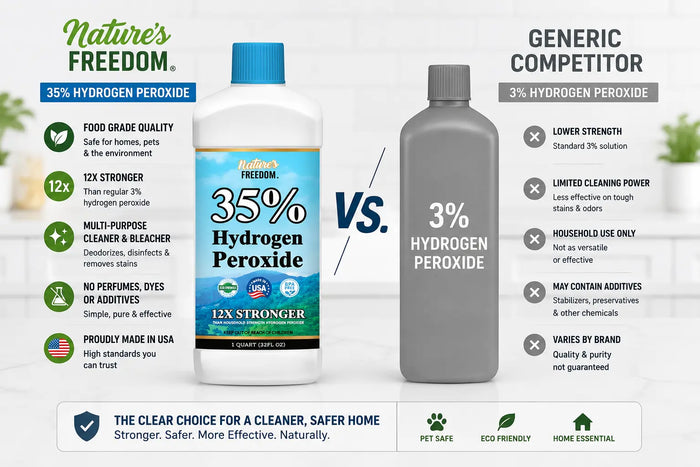
NSF-certified 35% H2O2 is stabilizer-free, which matters specifically for laundry. Most hydrogen peroxide products contain stabilizers such as acetanilide and phenol that deposit on fabric fibers during the wash cycle - contributing to dullness, reduced absorbency in towels, and a subtle chemical smell over time.
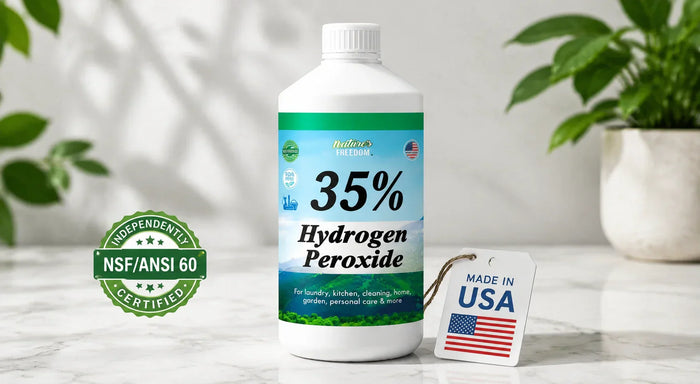
Nature's Freedom 35% H2O2 is NSF/ANSI/CAN 60 and NSF/ANSI/CAN 50 certified, independently verified to contain no stabilizers and to meet its stated 35% concentration. When diluted to 3% for laundry use, the only compounds entering your wash cycle are H2O2 and water. After decomposition, only water remains in the fabric. Browse the full hydrogen peroxide collection for available sizes.
What NSF certification confirms for laundry use:
-
No stabilizer residue deposited on fabric fibers during the wash cycle
-
Independently verified 35% concentration for accurate dilution every time
-
Manufactured in the USA under NSF-audited conditions
-
Safe for food contact surface sanitation at correct dilution
Nature's Freedom 35% hydrogen peroxide is NSF Certified to NSF/ANSI/CAN 60 for drinking water treatment chemicals and NSF/ANSI/CAN 50 for pool, spa, hot tub, and other recreational water treatment chemical use.
Upgrade Your Laundry Routine
Nature's Freedom 35% hydrogen peroxide is NSF/ANSI/CAN 60 and NSF/ANSI/CAN 50 certified, stabilizer-free, and made in the USA. One bottle produces a full season of laundry peroxide from a single concentrated source.
Shop concentrated hydrogen peroxide | Browse the full collection | Contact Nature's Freedom
Frequently Asked Questions About Hydrogen Peroxide for Laundry
1. How do you use hydrogen peroxide in laundry?
Add 1 cup (8 fl oz) of 3% H2O2 to the bleach compartment and run the cycle as normal. For odor control on colored loads, add half a cup to the rinse cycle. For stain pre-treatment, apply 3% H2O2 directly, allow 10 to 30 minutes depending on stain type, then wash immediately. Full dilution ratios are in the hydrogen peroxide dilution guide.
2. How much hydrogen peroxide should you put in laundry?
1 cup (8 fl oz) of 3% solution per standard load as a bleach substitute. For heavily soiled loads, increase to 2 cups. For the rinse cycle booster method, use half a cup. More is not more effective - oversaturation can affect fabric color on some materials.
3. Will hydrogen peroxide bleach colored clothes?
At 3% with normal wash cycle exposure, hydrogen peroxide is safe for most colored fabrics. Extended direct contact at higher concentrations can cause fading on darker dyes. For colored garments, add H2O2 to the dispenser rather than applying it directly to fabric. Always spot-test a hidden interior seam on unfamiliar fabrics before first use.
4. Can hydrogen peroxide remove sweat stains from white shirts?
Yes. Apply 3% H2O2 directly to sweat-stained areas and allow 15 to 30 minutes contact time, then wash immediately. For older set-in stains, scrub gently with a soft brush after applying H2O2. The oxidation reaction breaks apart perspiration compounds and deodorant residue that cause yellow discoloration.
5. Is hydrogen peroxide safe in HE washing machines?
Yes. Add it to the bleach dispenser as you would liquid bleach. It does not produce excess foam that can cause issues in HE machines and decomposes into water and oxygen during the cycle without leaving residue in the drum or dispensers.
6. Why does NSF certification matter for hydrogen peroxide used in laundry?
NSF certification independently verifies no stabilizers are present and the stated 35% concentration is accurate. Stabilizers in non-certified hydrogen peroxide deposit on fabric fibers over time, causing dullness and residue buildup. With Nature's Freedom NSF-certified H2O2, the only compound entering your wash cycle is pure H2O2 and water. After decomposition, nothing remains in the fabric except clean fiber.
Key Takeaways
-
Add 1 cup of 3% H2O2 to the bleach compartment as a direct bleach substitute, or half a cup to the rinse cycle for odor control and brightening on colored loads.
-
Hydrogen peroxide removes organic stains - sweat, blood, grass, wine, coffee - through oxidation. Apply directly and allow 10 to 30 minutes before washing.
-
Safe on white cotton, linen, polyester, and most synthetics at 3%. Avoid on silk, wool, and delicate embroidery.
-
Decomposes into water and oxygen in the wash cycle, leaving no chemical residue in fabric fibers - unlike chlorine bleach, which leaves chlorinated compounds behind.
-
Nature's Freedom 35% H2O2 is NSF Certified to NSF/ANSI/CAN 60 for drinking water treatment chemicals and NSF/ANSI/CAN 50 for pool, spa, hot tub, and other recreational water treatment chemical use, and stabilizer-free. One 32 fl oz bottle diluted to 3% produces more than ten full-load doses.
-
For washing machine descaling and detergent dispenser cleaning, use Nature's Freedom concentrated vinegar - hydrogen peroxide does not dissolve mineral deposits.