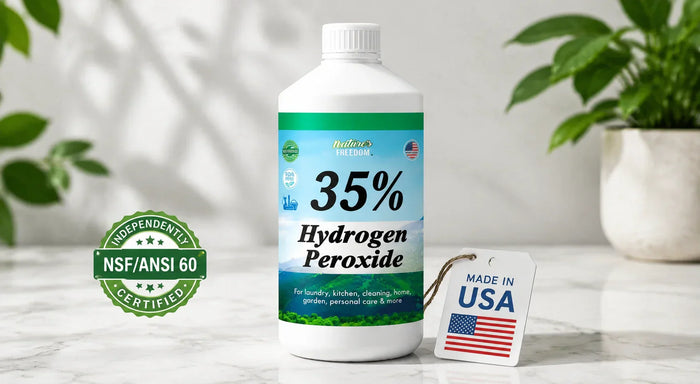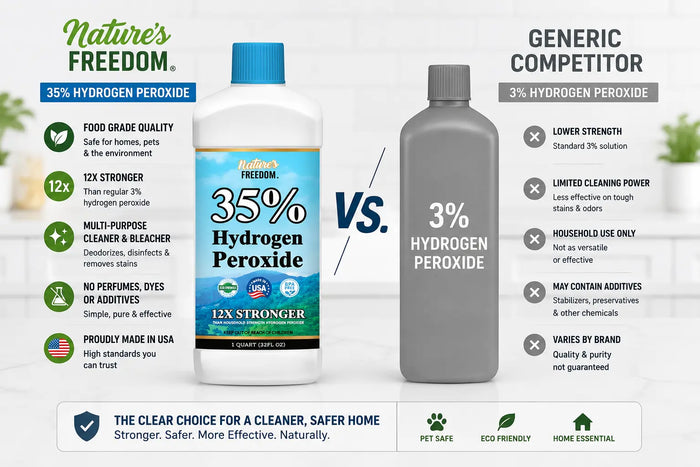

Yes, hydrogen peroxide removes a wide range of organic stains from clothes, including sweat, blood, wine, grass, coffee, and mold, through oxidation. It breaks apart the molecular bonds in stain compounds and either decolorizes or loosens them for the wash cycle to carry away. Nature's Freedom offers NSF-certified 35% H2O2 and 12% H2O2 - both stabilizer-free, both NSF/ANSI/CAN 60 and NSF/ANSI/CAN 50 certified. For stain removal, dilute either to 3% before fabric contact. Hydrogen peroxide is not effective on grease or oil, which require a surfactant-based degreaser first.
Does Hydrogen Peroxide Remove Stains from Clothes - How Does It Work?
Hydrogen peroxide removes stains through oxidation - releasing reactive oxygen that breaks apart the molecular bonds in organic stain compounds. Proteins in blood, tannins in wine, chlorophyll in grass, and compounds in sweat are all organic chromophores: molecular configurations that give stains their visible color. Once those bonds break, the stain decolorizes or loosens enough for the wash cycle to remove it. According to PubChem (National Institutes of Health), H2O2 demonstrates well-documented oxidizing and antimicrobial activity at household cleaning concentrations. The CDC NIOSH Pocket Guide confirms its broad-spectrum antimicrobial properties - the same action that kills odor-causing bacteria in fabric also drives oxidation of organic stain compounds.
The key distinction from bleach: chlorine bleach leaves chlorinated compounds in fabric after treatment. Hydrogen peroxide decomposes into water and oxygen - nothing chemical remains in the fiber. See what is food grade hydrogen peroxide for a full breakdown of H2O2 grades and how they differ.
Which Stains Does Hydrogen Peroxide Remove from Clothes?
All methods below use 3% hydrogen peroxide - diluted from Nature's Freedom 35% H2O2 at 1 part H2O2 to 10.7 parts cold water. Full dilution ratios are in the hydrogen peroxide dilution guide. Wash immediately after every contact period.
|
Stain |
Conc. |
Contact Time |
Effectiveness |
|
Sweat and deodorant |
3% |
15-30 min |
Excellent |
|
Blood (fresh) |
3% |
10 min (cold only) |
Excellent |
|
Blood (dried/set) |
3% |
30 min (cold soak) |
Good |
|
Red wine |
3% |
10-15 min |
Good |
|
Grass |
3% |
15 min |
Good |
|
Coffee or tea |
3% |
10-15 min |
Good |
|
Yellow underarm staining |
3% |
30 min |
Excellent |
|
Mold or mildew spots |
3% |
30 min |
Good |
|
Grease or oil |
3% |
N/A |
Poor - use degreaser first |
Blood stains: cold water only. Hot water permanently sets blood protein into fabric. Apply 3% H2O2 to cold, damp fabric, allow to fizz for 10 minutes, then rinse cold before washing.
Grease and oil: H2O2 is an oxidizer, not a surfactant. Apply dish soap or degreaser first, rinse, then follow with H2O2 if organic discoloration remains.
How Do You Use Hydrogen Peroxide on Stained Clothes?
1. Act quickly. Fresh stains respond significantly better than dried or set-in ones.
2. Blot excess material first. For liquid stains, blot gently - do not rub. Rubbing spreads the stain and pushes it deeper into the fiber.
3. Dilute 35% H2O2 to 3%: mix 1 part H2O2 with 10.7 parts cold water. For 12% H2O2, mix 1 part H2O2 with 3 parts cold water to reach 3%.
4. Apply enough 3% H2O2 to fully saturate the stained area. For collar and underarm stains, use a soft brush to work it gently into the fabric.
5. Allow the minimum contact time for the stain type (see table above). Do not wipe or rub during this period.
6. Rinse with cold water, then wash immediately on the appropriate cycle for the fabric.
7. Check the stain before drying. Heat from a dryer permanently sets any remaining stain compound. If discoloration remains, repeat the treatment before drying.
Which Fabrics Are Safe to Treat with Hydrogen Peroxide?
3% hydrogen peroxide is safe for most common laundry fabrics. Silk and wool are the primary exceptions - both are protein-based fibers that are damaged by oxidizing agents at any concentration.
|
Fabric |
Safe at 3%? |
Notes |
|
White cotton / linen |
Yes |
Best results; no color risk |
|
Polyester (white or light) |
Yes |
Safe; spot-test darker colors |
|
Athletic synthetics |
Yes |
Excellent for sweat and odor |
|
Cotton blends (colored) |
Spot-test |
Extended contact may lighten some dyes |
|
Dark-colored fabric |
Spot-test |
Risk of fading with prolonged contact |
|
Silk |
No |
Oxidizing action weakens silk fibers |
|
Wool |
No |
Damages wool protein structure |
|
Suede or leather |
No |
Will cause surface staining and damage |
Before treating any colored garment for the first time, apply a small amount of 3% H2O2 to a hidden interior seam, allow 10 minutes, then rinse and check for color change. For washing machine descaling and mineral deposit removal, use Nature's Freedom 45% concentrated vinegar - hydrogen peroxide does not dissolve mineral deposits. See is 45% vinegar safe for guidance on concentrated vinegar around appliances and surfaces.
Why Does NSF-Certified H2O2 Work Better for Stain Removal?
Drugstore 3% hydrogen peroxide contains stabilizers - acetanilide and phenol - that do not fully rinse from fabric in the wash cycle. On stained garments, those stabilizers accumulate in the fiber over repeated treatments, contributing to dullness and residue that attracts future soiling. The EPA Safer Choice program recognizes hydrogen peroxide as an approved active ingredient for safer cleaning formulations specifically because of its clean decomposition profile.
Nature's Freedom 35% H2O2 and 12% H2O2 are both NSF/ANSI/CAN 60 and NSF/ANSI/CAN 50 certified and contain no stabilizers - only H2O2 and water. After decomposition, only water remains in the fabric. No residue, no buildup, no interference with future washes. For stain removal, the 12% option reduces dilution math - mix 1 part 12% H2O2 with 3 parts water to reach 3%. Learn more about why Nature's Freedom holds these NSF certifications.
Nature's Freedom 35% hydrogen peroxide is NSF Certified to NSF/ANSI/CAN 60 for drinking water treatment chemicals and NSF/ANSI/CAN 50 for pool, spa, hot tub, and other recreational water treatment chemical use. Learn other hydrogen peroxide uses.
One Bottle. Every Stain. No Residue.
Nature's Freedom 35% H2O2 is NSF/ANSI/CAN 60 and NSF/ANSI/CAN 50 certified, stabilizer-free, and made in the USA. One 32 fl oz bottle dilutes into a full season of stain treatment solution.
Shop concentrated hydrogen peroxide | Browse the full collection | Contact Nature's Freedom
Frequently Asked Questions
1. Does hydrogen peroxide remove stains from clothes?
Yes, for most organic stains. It is highly effective on sweat, blood, wine, grass, coffee, mold, and general yellowing through oxidation. It is not effective on grease or oil, which require a surfactant-based degreaser. Apply 3% H2O2 directly to the stain, allow the minimum contact time for the stain type, then wash immediately.
2. How long should you leave hydrogen peroxide on a stain?
Most organic stains need 10 to 15 minutes minimum. Sweat stains and yellowed underarms benefit from 15 to 30 minutes. Dried blood and set-in mold need up to 30 minutes. Always wash immediately after the contact period - do not allow H2O2 to dry on the fabric, and never put a treated garment in the dryer without confirming the stain is removed.
3. Will hydrogen peroxide bleach colored clothes?
At 3% with 10 to 15 minute contact times, hydrogen peroxide is safe for most light and medium-colored colorfast fabrics. Fading risk increases with higher concentrations, longer contact times, and darker colors. Always spot-test a hidden seam before treating any colored garment for the first time. Avoid on silk, wool, and genuine leather at any concentration.
4. Does hydrogen peroxide work on dried or set-in stains?
Yes, with reduced effectiveness compared to fresh stains. For dried blood, a 30-minute cold soak in 3% H2O2 loosens protein bonds before washing. For other dried organic stains, apply 3% H2O2, cover loosely to slow evaporation, and allow 20 to 30 minutes before scrubbing gently and washing. Heat-set stains that have gone through a hot dryer are significantly harder to treat.
5. Why does NSF-certified hydrogen peroxide remove stains better?
NSF certification verifies no stabilizers are present and the stated concentration is accurate. Stabilizers in non-certified hydrogen peroxide deposit in fabric fibers during treatment and accumulate over time. Nature's Freedom NSF-certified 35% H2O2 is stabilizer-free - only the oxidizing agent enters the fabric, and only water remains after decomposition.
Key Takeaways
-
Hydrogen peroxide removes organic stains - sweat, blood, wine, grass, coffee, mold - through oxidation. It is not effective on grease or oil.
-
Always use cold water for blood stains. Hot water permanently sets blood protein into fabric fibers.
-
Allow 10 to 30 minutes contact time depending on stain type. Applying and immediately wiping significantly reduces effectiveness.
-
Safe on white cotton, linen, polyester, and most light-colored synthetics at 3%. Spot-test colored fabric before use. Avoid on silk, wool, and leather.
-
Never put a treated garment in the dryer until the stain is confirmed removed - heat permanently sets any remaining stain compound.
-
Nature's Freedom 35% H2O2 and 12% H2O2 are both NSF Certified to NSF/ANSI/CAN 60 and NSF/ANSI/CAN 50 - stabilizer-free, so no chemical residue is left in fabric after treatment.