
Yes - food grade hydrogen peroxide expires. It decomposes gradually into water and oxygen, losing oxidizing power over time. Stored correctly in a cool, dark location in its original container, Nature's Freedom 35% H2O2 lasts up to 24 months unopened and 12 to 18 months after opening. 12% H2O2 follows the same degradation pattern at its starting concentration. A degraded bottle looks identical to fresh product but delivers less oxidizing power per dose - which is why NSF-certified starting concentration matters.
Does Food Grade Hydrogen Peroxide Expire - How Long Does It Last?
Shelf life depends almost entirely on storage conditions. The table below covers realistic shelf life for 35% H2O2 and 12% H2O2 under different conditions. According to PubChem (National Institutes of Health), hydrogen peroxide is an inherently unstable oxidizing agent that undergoes spontaneous decomposition to water and oxygen.
|
Storage Condition |
Unopened Life |
Opened Life |
Degradation Rate |
|
Cool, dark, original container |
Up to 24 months |
12-18 months |
~1% per month |
|
Room temperature, dark |
12-18 months |
6-12 months |
~1.5% per month |
|
Warm or fluctuating temperature |
6-12 months |
3-6 months |
Higher, varies |
|
Exposed to light |
3-6 months |
1-3 months |
Significantly accelerated |
|
Diluted to 3% (any storage) |
N/A |
2-4 weeks |
Rapid - prepare fresh |
The most important row: diluted solutions degrade far faster than the concentrate. Prepare diluted working solutions fresh for each use. For all dilution ratios from both 35% and 12% H2O2, see the hydrogen peroxide dilution guide.
What Causes Food Grade Hydrogen Peroxide to Degrade?
Four factors significantly accelerate the natural decomposition of hydrogen peroxide. The CDC NIOSH Pocket Guide identifies hydrogen peroxide as an unstable oxidizer - understanding these degradation factors is part of safe handling practice, not just a quality concern.
- Light exposure: UV and visible light catalyze the decomposition reaction. A clear container in ambient light degrades several times faster than product stored in its original opaque container. Never transfer 35% or 12% H2O2 to a clear bottle for long-term storage.
- Heat and temperature fluctuation: Every 10 degrees Celsius increase in storage temperature approximately doubles the decomposition rate. Temperature cycling between warm and cool accelerates degradation more than a consistently elevated temperature. Store in a stable, cool location.
- Contamination: Introducing organic material through a dirty measuring cup or used dropper dramatically accelerates local decomposition. Always use a dedicated clean measuring tool and never pour unused solution back into the original bottle.
-
Container material: Certain metals catalyze H2O2 decomposition on contact. Store only in HDPE plastic or stainless steel. Never use aluminum or mild steel. The original HDPE bottle is the correct long-term storage container.
How Do You Store Food Grade Hydrogen Peroxide Correctly?
Correct storage is the most controllable factor in shelf life. The EPA Safer Choice program recognizes hydrogen peroxide's clean decomposition profile as an environmental advantage - proper storage extends shelf life and ensures performance at its labeled concentration. For safety guidance on handling 35% and 12% H2O2 concentrate, see is food grade hydrogen peroxide safe. Learn other hydrogen peroxide uses.
- Store in the original HDPE container - do not transfer to another bottle for long-term storage
- Keep in a cool, stable-temperature location: a basement, pantry, or refrigerator. Avoid storage near heat-generating appliances
- Keep away from direct light - inside a cupboard or cabinet, not on an open shelf
- Cap tightly after every use - loose caps accelerate evaporation and light exposure
- Store away from combustible materials - 35% and 12% H2O2 are oxidizers that can accelerate ignition of nearby flammable materials
- Keep out of reach of children - the undiluted concentrate causes chemical burns on contact
-
Do not store diluted working solutions for more than two weeks - prepare fresh for each session
How Do You Tell If Food Grade Hydrogen Peroxide Has Lost Potency?
A degraded bottle looks identical to a fresh one. Three methods reliably detect potency loss.
The Fizz Test
Apply a small amount to a piece of raw meat, a cut potato, or fresh organic material. Fresh 3% H2O2 fizzes visibly and immediately - the bubbling is oxygen being released during oxidation. Little or no fizzing indicates significant potency loss. This test confirms whether the product is still active, not its actual concentration.
H2O2 Test Strips
Concentration test strips are available from laboratory supply retailers online. They provide a rough concentration reading confirming whether the product is still near its labeled strength. For concentration-sensitive applications - pool dosing, food contact surface sanitation - test strips are the appropriate verification method before use.
The Date Method
If you know the purchase date and storage conditions, the shelf life table above gives a reliable estimate. A bottle purchased 18 months ago, stored cool and dark, opened 6 months ago is likely still at 90% or better. The same bottle stored warm in ambient light for 18 months may be at 50% or below.
Why Does NSF Certification Give Food Grade H2O2 the Most Reliable Shelf Life?
NSF certification provides the only verified baseline for shelf life - and a verified baseline matters because degraded product is invisible. Shelf life depends on two factors you control (storage conditions) and one you cannot control with uncertified product (actual starting concentration). A product labeled 35% or 12% that was filled below that concentration, or has partially degraded before purchase, starts your clock from a lower baseline.
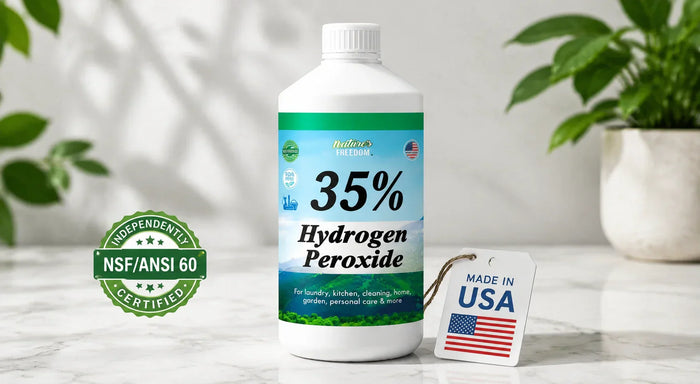
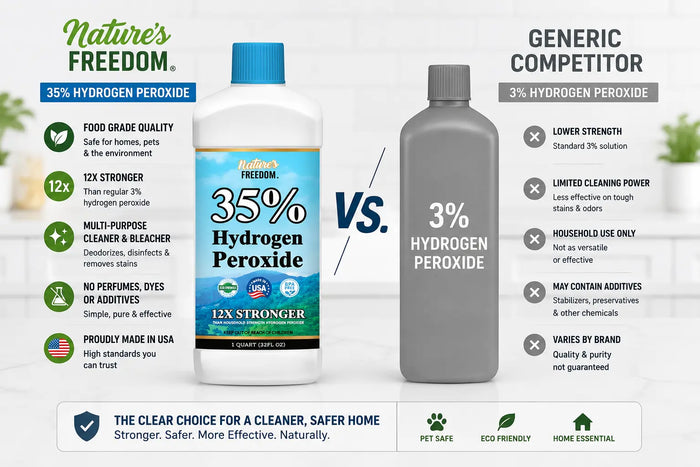
Nature's Freedom 35% H2O2 and 12% H2O2 are both NSF/ANSI/CAN 60 and NSF/ANSI/CAN 50 certified - independently verified to meet their stated concentrations at time of production. When you purchase either, you know the starting concentration is accurate and the shelf life table in this guide applies from day one. Learn more about the full range of applications in what is food grade hydrogen peroxide, and for plant care uses where H2O2 potency directly affects treatment outcomes, see hydrogen peroxide for plants. To purchase NSF-certified food grade H2O2, see where to buy food grade hydrogen peroxide. Learn more about why Nature's Freedom holds these certifications.
- Verified 35% and 12% concentration at production - shelf life timeline is accurate from day one
- No stabilizer content to mask potency loss - what you measure is what you have
-
Manufactured in the USA under NSF-audited conditions - consistent production quality batch to batch
Nature's Freedom 35% hydrogen peroxide is NSF Certified to NSF/ANSI/CAN 60 for drinking water treatment chemicals and NSF/ANSI/CAN 50 for pool, spa, hot tub, and other recreational water treatment chemical use.
Start Fresh. Start Verified.
Nature's Freedom 35% food grade H2O2 is NSF/ANSI/CAN 60 and NSF/ANSI/CAN 50 certified, stabilizer-free, and made in the USA. Verified 35% concentration from day one - store it right and it performs for up to 24 months.
Shop 35% food grade hydrogen peroxide | Browse the full collection | Contact Nature's Freedom
Frequently Asked Questions
1. Does food grade hydrogen peroxide expire?
Yes. Food grade hydrogen peroxide degrades into water and oxygen over time. Stored correctly, 35% H2O2 lasts up to 24 months unopened and 12 to 18 months after opening. Diluted solutions degrade significantly faster and should be prepared fresh for each use.
2. How long does 35% food grade hydrogen peroxide last?
Up to 24 months unopened when stored cool, dark, and in its original HDPE container. After opening, 12 to 18 months under the same conditions. Light, heat, temperature fluctuation, and contamination from dirty measuring tools all shorten shelf life significantly. Label opened bottles with the date.
3. How can you tell if hydrogen peroxide has gone bad?
Apply a few drops to raw meat or a cut potato. Active hydrogen peroxide fizzes visibly on contact with organic matter - the bubbles are oxygen being released. Little or no fizzing indicates potency loss. For concentration-sensitive applications, use H2O2 test strips. Visually, degraded H2O2 is indistinguishable from fresh product.
4. Does hydrogen peroxide lose potency after opening?
Yes. A properly stored opened bottle degrades at approximately 1 to 1.5% of its concentration per month. A 35% product stored correctly and opened 12 months ago is likely still around 30 to 32%. The same product stored poorly could be at 20% or below. Always test before using in concentration-sensitive applications.
5. Why does NSF-certified hydrogen peroxide have a more reliable shelf life?
NSF certification verifies the product meets its stated concentration at time of production. An uncertified product may have been filled below its stated 35% or 12% level, or partially degraded before purchase, meaning your shelf life clock starts from a lower baseline. With Nature's Freedom NSF-certified H2O2, you know the starting concentration is accurate - so the shelf life estimates in this guide apply from the day you receive it.
Key Takeaways
- Food grade hydrogen peroxide expires - it degrades into water and oxygen over time. Stored correctly, 35% H2O2 lasts up to 24 months unopened and 12 to 18 months after opening.
- The four main degradation accelerators are light exposure, heat, temperature fluctuation, and contamination from dirty measuring tools.
- Diluted working solutions lose potency much faster than the concentrate - prepare fresh dilutions for each use and do not store pre-diluted H2O2 for more than two weeks.
- Test for potency loss using the fizz test on organic matter or with H2O2 test strips before using in concentration-sensitive applications.
- Nature's Freedom 35% H2O2 and 12% H2O2 are both NSF Certified to NSF/ANSI/CAN 60 and NSF/ANSI/CAN 50 - independently verified to start at stated concentration, giving you a reliable baseline for the full shelf life timeline.