
Yes. Hydrogen peroxide is an effective cleaner for most household applications. It disinfects hard surfaces, removes organic stains, kills mold at the root, whitens laundry, and eliminates odors without leaving any chemical residue behind.
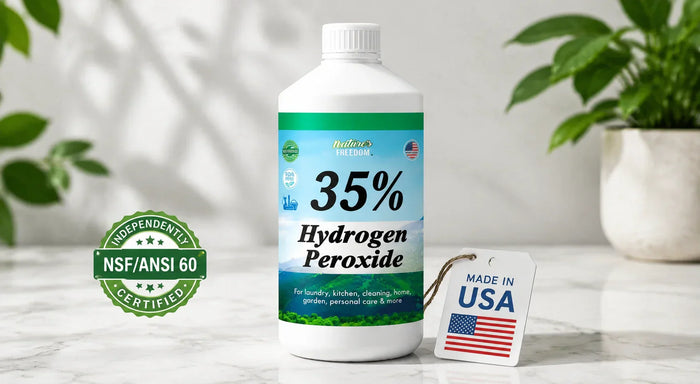
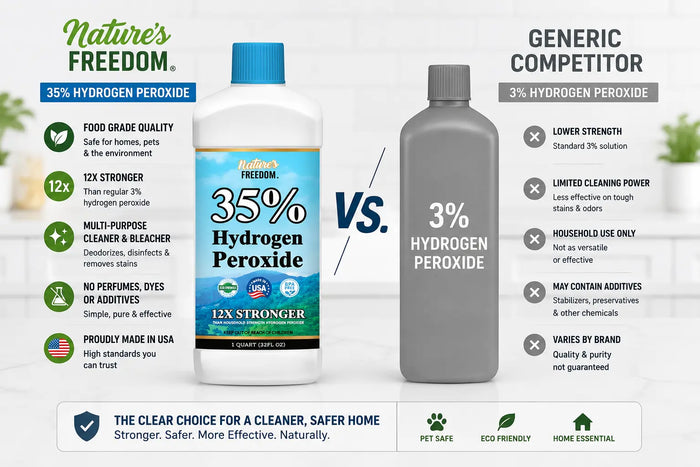
Concentration matters. Drugstore 3% handles light tasks. NSF-certified 12% H2O2 delivers stronger disinfecting for tougher jobs. NSF-certified 35% food grade H2O2 is the concentrated source you dilute to match any task - from produce rinsing to pool treatment. Hydrogen peroxide is not effective for grease removal or limescale.
What Makes Hydrogen Peroxide an Effective Cleaner?
Hydrogen peroxide releases reactive oxygen on contact with bacteria, viruses, fungi, or biofilm - destroying microbial cell walls and breaking stains apart at the molecular level. According to PubChem (National Institutes of Health), its decomposition products are water and oxygen, leaving no chemical residue. Where bleach leaves chlorinated compounds and vinegar leaves acetic acid, hydrogen peroxide simply disappears. See what is food grade hydrogen peroxide for a full breakdown of grades and applications.
Does Concentration Affect Cleaning Effectiveness?
Yes, concentration and contact time are the two most important factors. Drugstore 3% contains stabilizers (acetanilide, phenol) that leave trace residue. Nature's Freedom 12% H2O2 and 35% H2O2 both carry NSF/ANSI/CAN 60 and NSF/ANSI/CAN 50 certification with no stabilizers and no residue. The 12% is ready to use for heavy-duty tasks. The 35% dilutes to any target concentration. See the dilution guide for safe ratios.
What Does Hydrogen Peroxide Clean Well?
|
Application |
Concentration |
Effectiveness |
|
Kitchen surfaces / disinfecting |
3% or 12% |
Excellent |
|
Bathroom tile, grout, mold |
3% to 6% (12% for heavy mold) |
Excellent |
|
Laundry whitening and odor |
3% |
Excellent |
|
Produce rinsing |
1% (diluted from 12% or 35%) |
Good |
|
Pool and spa sanitation |
10% target (50 ppm) |
Good |
|
Stain pre-treatment (organic) |
3% or 12% |
Good |
For outdoor pet odor control, Nature's Freedom also offers an Outdoor Pet Odor Eliminator with an enzyme-based formula for yards and kennel areas.
Where Does Hydrogen Peroxide Fall Short?
Heavy grease and oil: Hydrogen peroxide is an oxidizer, not a surfactant. Use a degreaser first, then H2O2 to disinfect.
Mineral deposits and limescale: Calcium buildup requires acid. Use Nature's Freedom 45% concentrated vinegar - NSF certified to NSF/ANSI/CAN 60 - for descaling coffee makers, kettles, and showerheads.
Delicate surfaces: Avoid on unsealed marble, granite, leather, and suede. Spot-test colored fabrics before full application.
What Is the Difference Between 3%, 12%, and 35% Hydrogen Peroxide?
|
Factor |
3% (Drugstore) |
12% H2O2 |
35% H2O2 |
|
NSF Certified |
No |
Yes - NSF/ANSI/CAN 60 + 50 |
Yes - NSF/ANSI/CAN 60 + 50 |
|
Stabilizers |
Yes |
No |
No |
|
Residue |
Trace |
None |
None |
|
Best Use |
Light disinfecting |
Heavy-duty tasks |
Dilute to any target |
|
Food Contact Safe |
No |
Yes (correct dilution) |
Yes (correct dilution) |
Nature's Freedom 12% is the right choice for heavy-duty disinfecting without complex dilution math. The 35% H2O2 serves users who dilute for cleaning, produce rinsing, pool treatment, and ice machine descaling from one bottle.
One Bottle. Every Room. No Residue.
Nature's Freedom 12% and 35% H2O2 are NSF/ANSI/CAN 60 and NSF/ANSI/CAN 50 certified, stabilizer-free, and made in the USA. Browse the hydrogen peroxide collection or learn why Nature's Freedom holds these certifications. You can also learn everything hydrogen peroxide can do.
Frequently Asked Questions
1. Is hydrogen peroxide a good cleaner for everyday use?
Yes. At 3%, it disinfects, removes organic stains, neutralizes odors, and leaves no residue. For tougher jobs - heavy mold, persistent odors, faster kill times - Nature's Freedom 12% H2O2 delivers stronger performance without stabilizers. Neither concentration works for grease or limescale.
2. How effective is hydrogen peroxide at killing bacteria?
At 3%, hydrogen peroxide is a broad-spectrum antimicrobial against bacteria, viruses, and fungi - requiring a minimum of 30 seconds contact time for general disinfecting and up to 10 minutes for mold. At 12%, kill times are faster. The CDC NIOSH Pocket Guide and EPA Safer Choice program both recognize it as an effective disinfecting ingredient.
3. Is hydrogen peroxide better than bleach for home cleaning?
For most tasks, yes. It matches bleach's disinfecting performance with no chlorinated byproducts, no chemical residue, and minimal fumes. It is safe on colored fabrics at 3%; bleach strips color. Nature's Freedom 12% and 35% H2O2 add NSF certification - no bleach product carries that.
4. What surfaces should you avoid cleaning with hydrogen peroxide?
Avoid on unsealed marble, granite, leather, suede, and nubuck. On darker fabrics, concentrations above 3% can cause fading with extended contact. Always spot-test first.
5. Why is NSF-certified H2O2 better than drugstore 3% peroxide?
NSF certification independently verifies concentration and confirms no stabilizers are present. Drugstore 3% contains stabilizers that leave trace residue on cleaned surfaces. Nature's Freedom 35% H2O2 dilutes into more than ten spray bottles of 3% solution from one 32 fl oz bottle - stabilizer-free, cost-effective, and verified.
Key Takeaways
-
Hydrogen peroxide disinfects, removes organic stains, kills mold, whitens laundry, and eliminates odors - but is not effective for grease or limescale.
-
Contact time matters: 30 seconds minimum for general disinfecting, 5 to 10 minutes for mold. At 12%, kill times are faster.
-
It decomposes into water and oxygen with no chemical residue - safe for food contact surfaces, children's items, and pet areas.
-
Nature's Freedom 12% H2O2 is NSF Certified to NSF/ANSI/CAN 60 and NSF/ANSI/CAN 50 - stabilizer-free, no residue, ready for heavy-duty tasks.
-
Nature's Freedom 35% H2O2 carries the same dual NSF certifications and dilutes into 10+ spray bottles of 3% solution from one 32 fl oz bottle.
-
Use concentrated vinegar for descaling and limescale. Use hydrogen peroxide for disinfecting, stains, mold, and odor. Each handles what the other cannot.