
Hydrogen peroxide sanitizes pool water by releasing reactive oxygen that destroys bacteria, algae, and organic contaminants on contact. At a maintenance concentration of 50 ppm, it replaces chlorine as a complete pool sanitizer without producing chloramines, trihalomethanes, or the chemical smell and skin irritation associated with chlorine systems. This guide covers how to use Nature's Freedom 35% hydrogen peroxide (32 fl oz) as a pool oxidizer, including dosing, chlorine-to-H2O2 transition, algae treatment, and testing. Browse the full hydrogen peroxide collection for all available sizes.
What Is Hydrogen Peroxide and How Does It Work in a Pool?
Hydrogen peroxide (H2O2) is a broad-spectrum oxidizing agent that sanitizes pool water by releasing reactive oxygen molecules that destroy organic contaminants. According to PubChem (NIH), hydrogen peroxide is effective against bacteria, viruses, fungi, and spores. In pool water, dissolved H2O2 continuously releases reactive oxygen that oxidizes organic material - body oils, sunscreen residue, algae, and pathogens - as it enters the water.
Unlike chlorine, which reacts with organic matter to produce chloramines and trihalomethanes (THMs), hydrogen peroxide decomposes entirely into water and oxygen. Nothing accumulates in the water, nothing lingers on skin after swimming, and nothing creates the sharp chemical smell associated with a chlorine-treated pool.
For a full breakdown of all H2O2 applications beyond pools, read the complete hydrogen peroxide uses guide.
Why Use Hydrogen Peroxide Instead of Chlorine in a Pool?
The primary reason pool owners switch to hydrogen peroxide is the complete absence of chemical byproducts. Chlorine reacts with organic matter in pool water to produce chloramines and THMs - compounds responsible for red eyes, skin irritation, bleached hair, and the characteristic chlorine smell. H2O2 produces no such byproducts. The EPA Safer Choice program recognizes hydrogen peroxide as an approved active ingredient for safer cleaning and disinfecting formulations due to its clean decomposition profile.
Additional reasons pool owners choose hydrogen peroxide over chlorine:
-
No chlorine smell - H2O2 leaves no residual chemical odor on skin, hair, or swimwear after swimming
-
No skin or eye irritation at maintenance concentrations of 50 ppm
-
No chloramines or THMs - H2O2 decomposes into water and oxygen only, with no disinfection byproduct formation
-
No hair discoloration - chlorine causes green tint in blondes; H2O2 does not
-
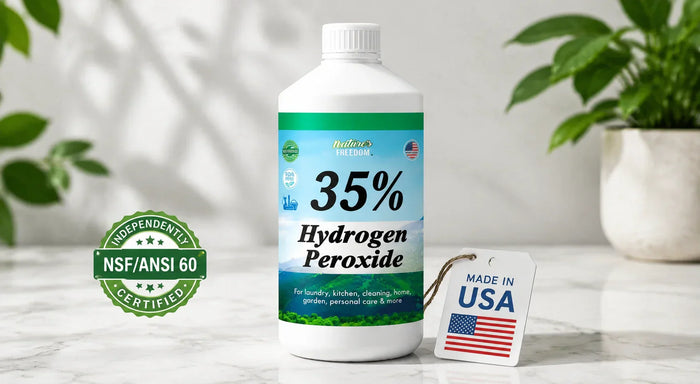
NSF-certified for pool use - Nature's Freedom 35% H2O2 is certified to NSF/ANSI/CAN 50 for pool, spa, hot tub, and other recreational water treatment chemical use, and to NSF/ANSI/CAN 60 for drinking water treatment chemicals
-
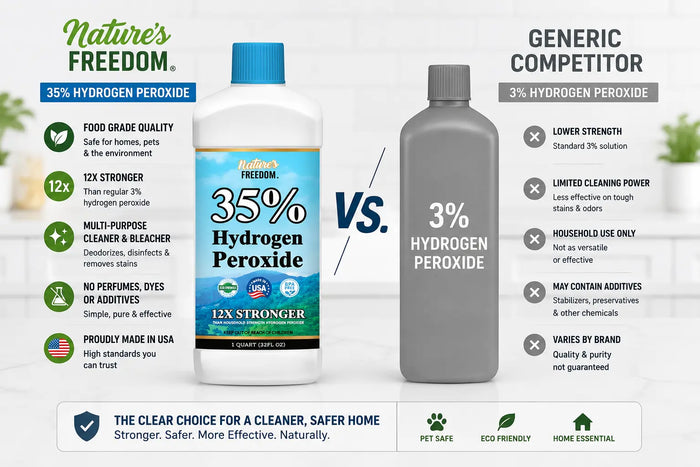
Food grade formulation - contains only H2O2 and purified water; no stabilizers. Read the food grade hydrogen peroxide guide for more detail.
How Much Hydrogen Peroxide Do You Add to a Pool?
Dosing is calculated by pool volume and target concentration in parts per million (ppm). Use the Nature's Freedom hydrogen peroxide pool calculator for exact volumes. The table below shows initial doses of 35% H2O2 required to reach 50 ppm (standard maintenance) and 100 ppm (shock treatment) for common pool sizes.
|
Pool Volume |
Target PPM |
35% H2O2 Dose |
Notes |
|
10,000 gallons |
50 ppm |
~1 quart (32 fl oz) |
Standard maintenance level |
|
15,000 gallons |
50 ppm |
~1.5 quarts (48 fl oz) |
Standard maintenance level |
|
20,000 gallons |
50 ppm |
~2 quarts (64 fl oz) |
Standard maintenance level |
|
10,000 gallons |
100 ppm |
~2 quarts (64 fl oz) |
Shock / active algae outbreak |
|
20,000 gallons |
100 ppm |
~4 quarts (128 fl oz) |
Shock / active algae outbreak |
|
300-500 gal (hot tub) |
50-75 ppm |
1-2 fl oz per week |
Adjust based on test results |
Dosing formula for 35% H2O2: multiply pool volume in gallons by 0.000031 to get the volume in gallons needed to reach 50 ppm. Multiply by 128 to convert gallons to fluid ounces. For 100 ppm shock treatment, double the amount.
Dosing Safety Rules
-
Always add hydrogen peroxide to pool water - do not add water to the concentrate
-
Pour slowly around the pool perimeter with the circulation pump running for even distribution
-
Wait at least 30 minutes before testing and at least 2 hours before swimming after a full shock dose to 100 ppm
-
Wear gloves and eye protection when handling the concentrate
How Do You Switch a Pool from Chlorine to Hydrogen Peroxide?
Transitioning from chlorine to hydrogen peroxide requires one critical preparation step: residual chlorine must be reduced to below 0.5 ppm before adding H2O2. Chlorine and hydrogen peroxide neutralize each other on contact. They do not combine to produce a stronger sanitizer - they cancel each other out, wasting both products and providing no sanitation benefit.
Chlorine-to-H2O2 Transition Protocol
1. Stop adding chlorine to the pool. Allow existing chlorine to deplete through natural degradation - typically 3 to 7 days of normal pool use with sun exposure.
2. Test chlorine levels with a standard chlorine test kit. Do not proceed until the free chlorine reading is at or below 0.5 ppm.
3. Thoroughly backwash or clean the pool filter to remove chlorine residue from the filter media.
4. Add the initial H2O2 dose to reach 50 ppm, using the dosing table above. Pour slowly around the perimeter with the pump running.
5. Run the circulation pump for at least 4 hours to distribute H2O2 evenly through the full pool volume.
6. Test H2O2 level with a dedicated hydrogen peroxide test kit to confirm the target concentration has been reached.
7. Establish a weekly testing and replenishment schedule to maintain 50 ppm throughout the swimming season.
Do not rush the depletion period. Adding H2O2 to water with significant residual chlorine wastes both products and delays the transition. The 3 to 7 day wait is the single most important step in a successful switch.
Does Hydrogen Peroxide Kill Pool Algae?
Yes. At 50 ppm, hydrogen peroxide prevents algae establishment by continuously oxidizing organic material before it can accumulate. For pools with visible algae growth, a shock dose to 100 ppm provides the rapid oxidative burst needed to kill an established algae colony.
Active Algae Outbreak Protocol
1. Brush pool walls, floor, and steps to break up algae colonies and expose them to the water.
2. Run the filter and backwash to remove organic debris.
3. Add a shock dose of 35% H2O2 to bring pool water to 100 ppm using the dosing table above.
4. Run the circulation pump continuously for 24 hours.
5. Vacuum dead algae from the pool floor after 24 hours.
6. Backwash the filter again after vacuuming.
7. Test H2O2 level and replenish to 50 ppm maintenance level once the shock dose has naturally degraded.
Green algae typically clears within 24 to 48 hours of a proper shock treatment. Mustard algae and black algae may require repeat treatment and more aggressive brushing. Consistent maintenance at 50 ppm prevents algae establishment between treatments.
How Do You Test Hydrogen Peroxide Levels in Pool Water?
Standard chlorine test strips and drop test kits do not measure hydrogen peroxide. A dedicated H2O2 test kit or H2O2-compatible test strips are required to monitor pool water concentration accurately. These are available from pool supply retailers and online.
|
Test Reading |
Level |
Action Required |
|
Below 30 ppm |
Insufficient |
Replenish immediately - level too low for effective sanitation |
|
30 to 50 ppm |
Acceptable |
Add H2O2 to bring back to 50 ppm at next scheduled test |
|
50 to 75 ppm |
Ideal |
Optimal maintenance range for most residential pools |
|
75 to 100 ppm |
High |
Safe to swim 30+ minutes after adding; post-shock or high-use level |
|
Above 100 ppm |
Do Not Swim |
Allow level to drop through natural degradation before use |
Test frequency: weekly minimum for maintained pools. Before and after heavy use events (pool parties, summer holidays). Before each use for hot tubs and spas. After rain or heavy debris events - organic matter accelerates H2O2 depletion.
NSF Certification for Nature's Freedom Hydrogen Peroxide Pool Products
For pool and spa water - an environment where bathers are directly immersed for extended periods - product purity and verified concentration are meaningful quality considerations. Stabilizers present in non-food-grade H2O2 accumulate progressively in pool water over an entire swimming season as the peroxide decomposes.
Nature's Freedom 35% hydrogen peroxide is certified to two independent NSF standards:
-
NSF/ANSI/CAN 50 - pool, spa, hot tub, and other recreational water treatment chemical use: certifies the product for direct-contact recreational water applications
-
NSF/ANSI/CAN 60 - drinking water treatment chemicals: certifies the product meets purity and safety requirements for water treatment use
The hydrogen peroxide solution is NSF Certified to NSF/ANSI/CAN 60 for drinking water treatment chemicals and NSF/ANSI/CAN 50 for pool, spa, hot tub, and other recreational water treatment chemical use. Stabilizer-free. Made in the USA under NSF-audited conditions.
Hydrogen Peroxide vs. Chlorine for Pool Sanitization
|
Property |
Hydrogen Peroxide (H2O2) |
Chlorine |
|
Active Agent |
H2O2 (reactive oxygen) |
Cl2 / hypochlorite |
|
Decomposition Products |
Water and oxygen only |
Chlorinated compounds |
|
Chemical Smell |
None |
Strong chlorine odor |
|
Skin and Eye Irritation |
Minimal at 50 ppm |
Common at standard levels |
|
Hair Discoloration |
None |
Green tint possible in blondes |
|
Byproduct Formation |
None |
Chloramines and THMs |
|
NSF Certified (Pool/Spa) |
Yes — NSF 50 + NSF 60 |
N/A |
|
EPA Safer Choice |
Yes |
No |
Related Products and Resources
Nature's Freedom 35% hydrogen peroxide is available in a 128 fl oz gallon size for larger pools, commercial applications, and users who treat multiple times per season.
For pool deck cleaning, hard water staining, and mineral deposit removal on surrounding surfaces, 45% concentrated vinegar handles tasks that H2O2 does not address.
Nature's Freedom hydrogen peroxide also has extensive home cleaning and laundry applications. See the hydrogen peroxide laundry guide for dosing and application guidance.
Clean Pool Water. No Chlorine. No Residue.
Nature's Freedom 35% hydrogen peroxide is NSF Certified to NSF/ANSI/CAN 50 for pool, spa, hot tub, and other recreational water treatment chemical use, and to NSF/ANSI/CAN 60 for drinking water treatment chemicals. Stabilizer-free and made in the USA. Shop the Nature's Freedom 35% hydrogen peroxide (32 fl oz) or the 128 fl oz gallon size and make the switch this season.
Frequently Asked Questions About Hydrogen Peroxide for Pools
1. Can hydrogen peroxide replace chlorine in a swimming pool?
Yes. At a maintenance concentration of 50 ppm, hydrogen peroxide sanitizes pool water as a complete chlorine substitute. It kills bacteria, viruses, and algae through oxidation without producing chloramines, THMs, or the skin and eye irritation associated with chlorine systems. The transition requires depleting existing chlorine to below 0.5 ppm before introducing H2O2 - the two chemicals neutralize each other rather than combining beneficially.
2. How much hydrogen peroxide do you need to sanitize a pool?
To reach 50 ppm maintenance level using 35% H2O2, add approximately 32 fl oz (1 quart) per 10,000 gallons of pool water. For shock treatment at 100 ppm, double that amount. Always add with the circulation pump running and allow at least 30 minutes before testing. Use the Nature's Freedom pool calculator for exact volumes by pool size.
3. How do you test hydrogen peroxide levels in a pool?
Use a dedicated H2O2 test kit or H2O2-specific test strips - standard chlorine test strips and drop test kits do not measure hydrogen peroxide. Test weekly for maintained pools, before and after heavy use events, and before each use for hot tubs. The target maintenance range is 50 to 75 ppm for residential pools.
4. Does hydrogen peroxide kill pool algae?
Yes. Consistent maintenance at 50 ppm prevents algae establishment through continuous oxidation of organic material. For active algae outbreaks, shock the pool to 100 ppm, brush all pool surfaces to break up algae colonies, and run the circulation pump for 24 hours. Most green algae clears within 24 to 48 hours of a proper shock treatment.
5. Is hydrogen peroxide safe for swimmers?
At the 50 ppm maintenance concentration used for pool sanitation, hydrogen peroxide is safe for swimmers. It produces no chloramines, no THMs, and decomposes into water and oxygen. After a shock dose to 100 ppm, wait at least 2 hours or until the level drops below 75 ppm as confirmed by an H2O2 test kit before swimming.
6. What is the difference between 35% and 12% hydrogen peroxide for pools?
35% hydrogen peroxide is a concentrate that is diluted into pool water to achieve the 50 ppm working concentration. 12% H2O2 pool-specific products are pre-formulated at a lower concentration and can be dosed more directly with lower dilution requirements. For large residential pools, 35% concentrate is more economical per dose due to its higher active concentration. Both Nature's Freedom 35% and pool-specific products are NSF-certified for recreational water treatment chemical use.
Key Takeaways
-
Hydrogen peroxide sanitizes pool water by releasing reactive oxygen that destroys bacteria, algae, and organic contaminants. At 50 ppm maintenance concentration, it replaces chlorine completely with no chloramine or THM byproduct formation.
-
When switching from chlorine to H2O2, allow residual chlorine to drop below 0.5 ppm before adding hydrogen peroxide. The two chemicals neutralize each other - they do not combine.
-
Dose to 50 ppm for ongoing maintenance using the dosing table or the Nature's Freedom pool calculator. Dose to 100 ppm for shock treatment following heavy use or visible algae growth. Wait at least 2 hours after a shock dose before swimming.
-
Standard chlorine test strips do not measure hydrogen peroxide. Use dedicated H2O2 test strips or a test kit. Test weekly for maintained pools and before each use for hot tubs.
-
Nature's Freedom 35% H2O2 is NSF Certified to NSF/ANSI/CAN 50 for pool, spa, hot tub, and other recreational water treatment chemical use, and to NSF/ANSI/CAN 60 for drinking water treatment chemicals. No stabilizers. Made in the USA.
-
H2O2 decomposes into water and oxygen with no residue in pool water, no chemical smell, no skin or eye irritation at maintenance concentrations, and no discoloration of hair or swimwear.