
TL;DR - What is 45 vinegar used for? Outdoor weed and moss control, appliance descaling, heavy-duty surface cleaning, drain maintenance, rust removal, and laundry care. It is nine times more concentrated than household vinegar, which is why it handles tasks that standard white vinegar cannot. For the complete dilution table covering all 12 uses, see the 45% Vinegar Uses: The Complete Reference Guide.
Most customers discover 45% concentrated vinegar through a weed control search, pick up a gallon, kill their driveway weeds, and then leave the rest sitting in the garage without realising it handles over a dozen other household jobs just as well. This post is for the person who wants the full picture from the start, or the one who just finished the weed job and is wondering what else the jug is good for.
Why 45% Vinegar Is Different From What You Have in the Kitchen
Standard household white vinegar is 5% acetic acid - appropriate for cooking, light surface cleaning, and laundry rinse cycles. At 5%, the acid is not strong enough to kill established weeds, dissolve significant mineral scale, or strip rust and algae from outdoor surfaces.
45% concentrated vinegar contains nine times the acetic acid. According to PubChem (National Institutes of Health) - Acetic Acid, acetic acid lowers pH on contact, disrupting cell membranes and causing rapid moisture loss. That mechanism operates with enough intensity at 45% to kill plant tissue in hours, dissolve calcium carbonate deposits in appliances, cut through iron oxide on metal surfaces, and handle outdoor cleaning tasks that require a genuinely strong acid. For the dilution formula to produce any working strength from 45%, see How to Dilute 45% Vinegar to 5%.
Outdoor Uses: Where 45% Vinegar Has the Most Impact
• Weed and grass control: The most common use and the one that drives most first-time purchases. 45% vinegar applied directly to foliage on a warm, sunny day kills annual weeds reliably within 24 hours and suppresses established perennials over multiple applications. It is non-selective - any green plant it contacts will be affected. See the full step-by-step weed killer guide for dilution ratios and application technique.
• Moss and algae removal from hard surfaces: Patios, driveways, stepping stones, retaining walls, and roof tiles accumulate moss and algae over time. Concentrated vinegar at a 1:3 to 1:5 dilution kills moss within 24 to 48 hours. Brush away the dead material, rinse, and the surface is clean without bleach or harsh chemicals.
• Concrete and paving stain removal: Rust stains from metal furniture legs, algae streaks on patio slabs, and organic discolouration on brick all respond to a 1:5 dilution applied with dwell time and a scrubbing brush. The acid lifts oxidation and organic material that water alone cannot shift.
• Fence line and total vegetation control: For areas where you want nothing growing at all - beneath decking, along fence bases, gravel zones - 45% vinegar at a 1:3 to 1:4 dilution handles total vegetation suppression without leaving soil-sterilising residues that prevent future replanting.
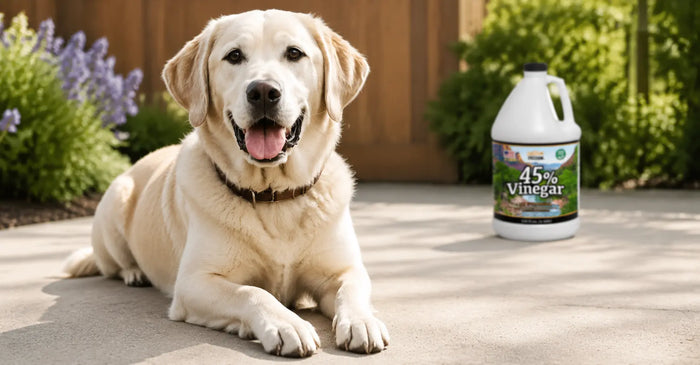
Nature's Freedom 45% Concentrated Vinegar is NSF Certified to NSF/ANSI/CAN 60 for drinking water treatment chemicals, made in the USA, and built for outdoor use.
Appliance Descaling: The Indoor Use Most People Discover Second
Hard water mineral deposits accumulate in any appliance that heats water. Coffee makers, electric kettles, showerheads, and dishwashers all suffer reduced efficiency and shortened lifespan when scale is left untreated. 45% concentrated vinegar at the right dilution is one of the most effective descaling agents available for household use.
• Coffee maker and kettle: A 1:8 or 1:10 dilution run through the appliance dissolves scale from heating elements and internal surfaces. For kettles, bring the diluted solution to a boil, let it sit for 30 minutes, then discard and rinse twice. For coffee makers, run a half cycle, pause for 30 minutes, complete the cycle, then run two plain water cycles.
• Showerhead: Fill a plastic bag with undiluted or lightly diluted 45% vinegar, submerge the showerhead, secure the bag, and soak for one to two hours. Mineral deposits blocking the spray holes dissolve completely with no scrubbing required.
• Dishwasher: Place a cup of diluted working solution in a bowl on the bottom rack and run an empty cycle on the hottest setting. This removes scale from spray arms and internal walls while deodorizing the unit.
For ice machines in food-contact environments, Nature's Freedom recommends the 35% hydrogen peroxide solution instead - hydrogen peroxide breaks down to water and oxygen with no acetic acid residue, making it better suited where treated surfaces contact food or beverages. Read the complete 45% vinegar reference guide.
Indoor Cleaning Applications
• Grout and tile: A 1:10 dilution strips soap scum, mildew staining, and grout haze from ceramic and porcelain tile. Apply, dwell for five minutes, scrub with a grout brush, and rinse. Do not use on natural stone - acetic acid permanently etches marble, granite, travertine, and slate.
• Drain maintenance: A 1:10 dilution poured down drains and left for 15 to 20 minutes before flushing with hot water keeps organic buildup from accumulating in drain lines. This is preventative maintenance, not a drain-unblocking treatment.
• Glass and windows: A 1:20 dilution removes mineral haze and hard water deposits. Apply with a microfibre cloth and dry immediately to prevent streaking.
• Rust removal: A 1:3 to 1:5 dilution applied with a cloth and left to dwell softens and lifts rust deposits from sinks, tools, and outdoor metal surfaces. Rinse and dry thoroughly after treatment to prevent re-oxidation.
• Laundry: A 1:30 or weaker dilution added to the rinse cycle softens fabric and removes excess detergent residue. Never use undiluted or lightly diluted concentrated vinegar directly on fabric.
What 45% Vinegar Is Not Used For
• Not for cooking or food preparation: Nature's Freedom concentrated vinegar is not formulated or approved for human consumption at any dilution. Use food-grade 5% vinegar for culinary purposes.
• Not a pre-emergent weed barrier: Vinegar kills plants it contacts but does not prevent dormant seeds from germinating. It has no lasting residual effect in soil. Seasonal reapplication is necessary for ongoing weed-free maintenance.
• Not effective on natural stone: Marble, granite, travertine, limestone, and slate are permanently damaged by acetic acid. Keep concentrated vinegar away from all natural stone surfaces.
• Not a substitute for mechanical drain clearing: Vinegar handles organic buildup as a maintenance measure. For a genuine blockage caused by solid material, a physical drain clearing method is required.
Choosing 45% Vinegar: Why NSF Certification Matters
All of the applications described in this post depend on the product actually delivering 45% acetic acid. A product that falls below that concentration produces weaker results across every use case. Nature's Freedom 45% Concentrated Vinegar is the only option independently verified to deliver the stated concentration, certified to NSF/ANSI/CAN 60 for drinking water treatment chemicals.
|
Brand |
NSF Certified |
Concentration |
Made in USA |
|
Nature's Freedom |
Yes - NSF/ANSI/CAN 60 |
45% |
Yes |
|
Calyptus |
No |
45% |
Yes |
|
Belle Chemical |
No |
45% |
Unknown |
|
Natural Armor |
No |
45% |
Unknown |
For households wanting both weed control and outdoor odor management, the Outdoor Pet Odor Eliminator pairs naturally with concentrated vinegar in an outdoor maintenance routine.
One Product. More Uses Than Most People Expect.
Now that you know what 45 vinegar is used for, every gallon in your kit works harder. Nature's Freedom Concentrated Vinegar at 45% acetic acid is NSF Certified to NSF/ANSI/CAN 60 for drinking water treatment chemicals, made in the USA, and ready for every application in this guide. Order the 45% Concentrated Vinegar - 1 Gallon. Browse the full concentrated vinegar collection, or contact the Nature's Freedom team with questions.
Frequently Asked Questions on Uses of 45% Vinegar
1. Is 45% vinegar the same as cleaning vinegar?
No. Cleaning vinegar sold in grocery stores is typically 6% acetic acid - marginally stronger than standard 5% white vinegar. 45% concentrated vinegar is more than seven times stronger than cleaning vinegar and is classified as a horticultural or industrial-grade product. They are not interchangeable for any of the applications described in this post.
2. Can 45% vinegar be used indoors?
Yes, at appropriate dilutions and with adequate ventilation. The 4-5% working solutions used for appliance descaling and drain maintenance are safe for indoor use. Undiluted or lightly diluted product should always be used outdoors or in well-ventilated spaces. Acetic acid vapors at high concentrations in enclosed spaces can irritate the respiratory tract.
3. How is 45% vinegar different from horticultural vinegar?
They are the same product described two different ways. Horticultural vinegar refers to high-concentration acetic acid solutions sold specifically for plant and outdoor use. 45% is one of the standard concentrations in this category. All horticultural vinegar at 45% concentration is the same type of product regardless of how the brand labels it.
4. Can I use 45% vinegar on my vegetable garden?
45% vinegar is non-selective and will kill vegetable plants just as readily as weeds. It is not appropriate for use in active vegetable beds. For weed control near vegetable gardens, use a paintbrush to apply concentrated vinegar precisely to individual weeds, keeping the acid away from cultivated plants entirely.
5. How long does one gallon last across all these uses?
A 1:10 dilution for indoor cleaning from one gallon produces approximately 10 gallons of working solution. A 1:3 dilution for outdoor weed control yields around 4 gallons of working solution. Most households with mixed indoor and outdoor use find a single gallon covers several months of regular use across multiple applications.
6. Is 45% vinegar organic?
Acetic acid at 45% concentration is used in certified organic agriculture as an approved herbicide alternative under USDA National Organic Program standards. The EPA classifies acetic acid as a minimum-risk pesticide active ingredient. Nature's Freedom 45% concentrated vinegar is not marketed as certified organic but is compatible with organic weed control practices.
Key Takeaways
• What is 45 vinegar used for? Outdoor weed and moss control, appliance descaling, drain maintenance, grout and tile cleaning, glass cleaning, rust removal, laundry care, and concrete surface treatment.
• Every application works because 45% acetic acid is nine times stronger than household vinegar, enabling it to handle tasks that lower concentrations cannot achieve effectively.
• 45% vinegar is not for cooking, is not a pre-emergent weed barrier, damages natural stone surfaces, and is not a substitute for mechanical drain clearing on blocked drains.
• One gallon produces multiple gallons of working solution at different dilutions, making it one of the most economical multi-purpose cleaning and maintenance products available.
• Nature's Freedom is the only concentrated vinegar brand certified to NSF/ANSI/CAN 60 for drinking water treatment chemicals, providing independent verification of the concentration that every use case in this guide depends on.
• For food-contact appliance descaling such as ice machines, the 35% hydrogen peroxide solution is the better-suited product because it leaves no acetic acid residue.