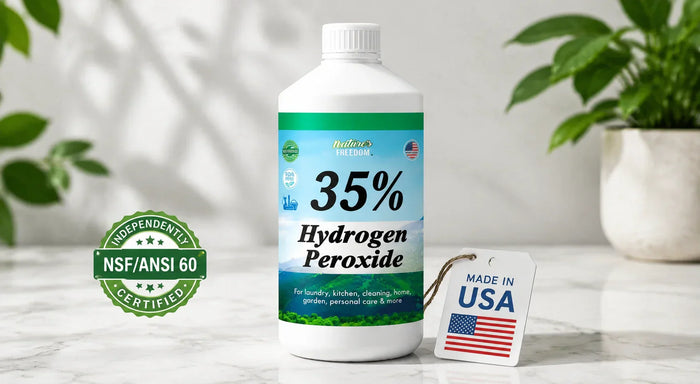

For most household cleaning, disinfection, mold removal, and laundry tasks, food grade hydrogen peroxide is the safer and more versatile choice compared to chlorine bleach. Nature's Freedom 12% and 6% food grade hydrogen peroxide both carry NSF Certified to NSF/ANSI/CAN 60 for drinking water treatment chemicals and NSF/ANSI/CAN 50 for pool, spa, hot tub, and other recreational water treatment chemical use. Bleach carries no equivalent third-party certification and produces chlorine byproducts that irritate airways, degrade surfaces, and persist as residue. Hydrogen peroxide breaks down to water and oxygen after the reaction, leaving no harmful trace.
TL;DR - Key Points
- Nature's Freedom 12% and 6% food grade hydrogen peroxide are both NSF Certified to NSF/ANSI/CAN 60 for drinking water treatment chemicals and NSF/ANSI/CAN 50 for pool, spa, hot tub, and other recreational water treatment chemical use; no bleach product carries equivalent third-party certification
- Hydrogen peroxide is safer for most household uses - no fumes, no residue, no chlorine byproducts, and it breaks down to water and oxygen after the reaction
- Bleach is a faster disinfectant at equivalent concentrations and kills a broader range of pathogens in less time, but the chemical trade-offs make it harder to use safely in homes with children, pets, and people with respiratory sensitivities
- For mold on grout and tile, laundry whitening, produce washing, and everyday surface disinfection, hydrogen peroxide is the better choice
- For heavy-duty commercial disinfection or sewage-contaminated surfaces, bleach may be appropriate with full PPE and proper ventilation
- Never mix hydrogen peroxide and bleach - the combination produces toxic vapors and heat
How Hydrogen Peroxide and Bleach Work
Hydrogen peroxide and bleach are both oxidizing agents that kill pathogens by breaking down cell walls, viral protein coats, and fungal structures. The chemistry differs significantly in what happens after that shared mechanism - and those differences determine which product is appropriate for each application.
How Hydrogen Peroxide Works
Hydrogen peroxide (H2O2) releases oxygen radicals on contact with organic material, which oxidize and destroy bacterial cell walls, viral protein coats, and fungal structures. The only byproducts of the reaction are water and oxygen. Nature's Freedom 12% and 6% food grade hydrogen peroxide are both NSF Certified to NSF/ANSI/CAN 60 for drinking water treatment chemicals and NSF/ANSI/CAN 50 for pool, spa, hot tub, and other recreational water treatment chemical use, an independent third-party verification that no bleach product carries.
According to a PubMed (NIH) review of antimicrobial agents, hydrogen peroxide demonstrates broad-spectrum effectiveness against bacteria, viruses, fungi, and bacterial spores. At working dilutions - 3% for household use, achieved by diluting 12% concentrate approximately 1:3 - nothing harmful remains on the treated surface after the reaction is complete.
How Bleach Works
Chlorine bleach (sodium hypochlorite, NaOCl) releases hypochlorous acid on contact with water, which rapidly disrupts cellular enzymes and proteins in pathogens. It is highly effective at low concentrations and kills most bacteria and viruses within 30 seconds under ideal conditions. However, bleach also reacts with organic matter and nitrogen compounds to produce chloramines and volatile chlorinated byproducts. According to ATSDR toxicology data on chlorine, these byproducts irritate the respiratory system, eyes, and skin at commonly used household concentrations.
Hydrogen Peroxide vs. Bleach: Safety Comparison
The most important comparison is not which product kills more pathogens - it is which one can be used safely in a home with children, pets, and people with respiratory sensitivities.
|
Safety Factor |
Hydrogen Peroxide (Nature's Freedom 12% + 6%) |
Chlorine Bleach |
|
NSF Certification |
NSF Certified to NSF/ANSI/CAN 60 for drinking water treatment chemicals and NSF/ANSI/CAN 50 for pool, spa, hot tub, and other recreational water treatment chemical use |
No NSF certification |
|
Fumes and odor |
None at working concentration (3%). |
Strong chlorine fumes; ventilation required. |
|
Respiratory risk |
Minimal at 3%-6%; use PPE at 12%+ concentrate. |
Chlorine vapors irritate airways even at household concentrations. |
|
Skin contact |
Mild irritant at 3%-6%; follow SDS guidelines at 12%. |
Irritant and corrosive at household concentrations. |
|
Residue after use |
None. Breaks down to water and oxygen. |
Chlorine residue remains until fully rinsed. |
|
Safe around food surfaces |
Yes, food grade H2O2 only, at 3% working dilution. |
Requires thorough rinsing before food contact. |
|
Safe around children and pets after drying |
Yes. No residual toxicity at working concentration. |
Residual chlorine on surfaces; keep away until fully dry. |
|
Mixing hazards |
Never mix with bleach or vinegar (produces peracetic acid). |
Never mix with ammonia, acids, or H2O2. Toxic gases result. |
|
Environmental byproducts |
Water and oxygen only. |
Chlorinated organic compounds in wastewater. |
A study published in PMC (NIH) found that routine domestic bleach use was associated with increased respiratory symptoms and measurable lung function decline in cleaning workers. Per OSHA chemical safety data, hydrogen peroxide at 3% working concentration presents significantly lower inhalation risk than sodium hypochlorite at standard household dilutions.
Which Is More Effective at Disinfecting?
Bleach is faster - a 0.1% sodium hypochlorite solution kills most bacteria and viruses within 30 seconds, which is why it remains the standard for hospital disinfection and sewage remediation. Hydrogen peroxide at a 3% working dilution (made from Nature's Freedom 12% or 6% concentrate) requires 1-10 minutes of contact time for equivalent bacterial kill rates.
For household use, where a treated surface can be left wet for 5-10 minutes before wiping, the contact time difference is not a practical disadvantage. The EPA List N of registered disinfectants lists hydrogen peroxide as an approved active ingredient against a wide range of pathogens including SARS-CoV-2. Coverage includes bacteria, viruses, fungi, and spores across the same pathogen range as bleach.
Hydrogen peroxide has a clear advantage on porous surfaces. Its oxidation reaction penetrates into grout, caulk, and unsealed concrete, killing mold at the root structure. Bleach cannot penetrate porous materials effectively - it whitens the surface appearance without eliminating the mold hyphae beneath, which is why mold returns faster after bleach treatment on bathroom grout.
In-stock now: Nature's Freedom 12% Food Grade Hydrogen Peroxide and 6% Food Grade Hydrogen Peroxide at naturesfreedom.com. Available on-site and on Amazon.
Hydrogen Peroxide vs. Bleach: Which to Use for Each Application
Surface Cleaning and Disinfection
Hydrogen peroxide is the better choice for everyday household surfaces. Dilute Nature's Freedom 12% concentrate approximately 1:3 with water (or use 6% concentrate diluted 1:1) to produce a 3% working solution that disinfects countertops, sinks, tile, and appliances without fumes or residue. Bleach is more appropriate for sewage-contaminated surfaces or outbreak-level contamination where speed of kill is critical and full rinsing is possible afterward.
Verdict: Hydrogen peroxide for everyday household surfaces.
Mold and Mildew Removal
Hydrogen peroxide wins clearly for household mold on tile, grout, and caulk. Apply a 3% working solution, allow 10 minutes of contact time, then scrub and rinse. The oxidation reaction penetrates into the porous surface and destroys mold at the hyphae level, not just the surface appearance. Bleach whitens mold without fully penetrating porous materials, which is why mold regrows faster after bleach treatment on bathroom grout. For mold removal safety guidelines, see the EPA guide to mold and moisture.
Verdict: Hydrogen peroxide for mold on grout, tile, and caulk.
Laundry Whitening
Hydrogen peroxide is safer on fabrics than bleach. Add 1 cup of 3% working solution to the washing machine drum to whiten fabrics, remove organic stains, and sanitize the load without the fiber degradation and color stripping that chlorine causes with repeated use. Nature's Freedom 6% food grade hydrogen peroxide can be diluted 1:1 to produce 3% working solution for laundry use. Bleach is faster but degrades cotton fibers over time and cannot be used on colored garments.
Verdict: Hydrogen peroxide for laundry whitening, especially on colored or delicate fabrics.
Pool and Spa Sanitization
Hydrogen peroxide is the better choice for residential pools and spas where swimmer comfort matters. Chlorine-based systems produce chloramines - the compounds responsible for red eyes, skin irritation, and the characteristic pool smell. Hydrogen peroxide produces none of those byproducts. Nature's Freedom 12% food grade hydrogen peroxide is NSF Certified to NSF/ANSI/CAN 60 for drinking water treatment chemicals and NSF/ANSI/CAN 50 for pool, spa, hot tub, and other recreational water treatment chemical use. It requires more frequent dosing due to UV degradation, but delivers a significantly more pleasant swimming environment. Use the Nature's Freedom hydrogen peroxide pool calculator for volume-based dosing guidance.
Verdict: Hydrogen peroxide for residential pools and spas where swimmer comfort matters.
Produce Washing
Food grade hydrogen peroxide is the only appropriate choice for produce washing. Bleach is not suitable for produce at any concentration - chlorine residue on food is a health concern and taste contamination is significant. Use Nature's Freedom 6% or 12% food grade hydrogen peroxide diluted to a 1-3% working solution. Food grade specifically means no chemical stabilizers are present, unlike standard brown-bottle pharmacy peroxide. Bleach is not appropriate for this application under any circumstances.
Verdict: Hydrogen peroxide (food grade only) for produce. Bleach is not appropriate.
Heavy Commercial Disinfection
Bleach may be appropriate for heavily contaminated environments such as sewage spills, biohazard cleanup, or outbreak response. Its faster kill rate and proven efficacy at very low concentrations make it the professional standard in those contexts. This is the specific situation where bleach's drawbacks are justified by the severity of the contamination - always with full PPE and adequate ventilation.
Verdict: Bleach for heavy commercial or biohazard applications with proper PPE and ventilation.
Which Causes More Surface Damage?
Bleach causes significantly more surface damage with repeated use. Chlorine compounds degrade rubber and silicone seals over time, corrode metal fittings and grout, fade colored surfaces and fabrics, etch natural stone such as marble and granite, and weaken cotton and linen fibers with repeated laundry use.
Nature's Freedom 6% and 12% food grade hydrogen peroxide at a 3% working dilution do not bleach colors, do not degrade rubber or silicone, and do not corrode metal with normal household use. Spot testing on colored or porous surfaces is recommended when using higher concentrations before full application. The surface degradation profile is significantly better than bleach across all household surface types.
Cost Comparison: Hydrogen Peroxide vs. Bleach
A gallon of household bleach appears cheaper at the shelf. The cost-per-use calculation changes significantly when starting from concentrated hydrogen peroxide.
|
Cost Factor |
12% Food Grade H2O2 (Nature's Freedom) |
Household Bleach |
|
Starting concentration |
12%. Dilutes approximately 1:3 to produce 3% working solution. |
3-8% sodium hypochlorite. Used at near-full strength. |
|
Yield per purchase |
One quart of 12% concentrate produces approximately 4 quarts of 3% working solution. |
One bottle produces roughly one bottle of working solution. |
|
Multiple product replacement |
Replaces: disinfectant spray, mold spray, laundry whitener, pool chemical, produce wash. |
Primarily a surface disinfectant. Cannot safely replace produce wash or laundry whitener. |
|
Surface longevity cost |
No surface degradation at 3%. Grout and fixtures last longer. |
Surface degradation over time means earlier replacement of seals, caulk, and fixtures. |
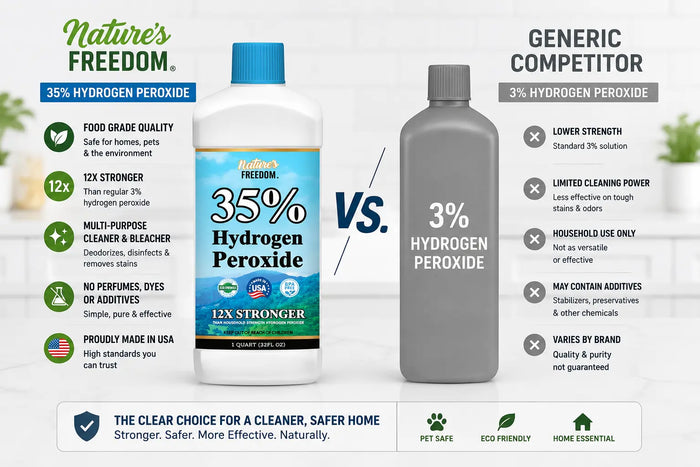
Nature's Freedom 12% food grade hydrogen peroxide produces approximately 4x the working-solution volume of a same-sized bottle of 3% pharmacy peroxide, and replaces multiple cleaning products from a single concentrated formula. Shop the 12% food grade hydrogen peroxide quart, 12% gallon, or 6% food grade hydrogen peroxide gallon for the best cost-per-use value. All sizes available at naturesfreedom.com and on Amazon.
The One Rule That Applies to Both: Never Mix Them
Mixing hydrogen peroxide and bleach produces a rapid oxidation reaction that generates oxygen gas and hypochlorous acid vapor. The reaction is exothermic, can cause containers to rupture, and produces concentrated fumes that cause serious respiratory and eye injury. This is not a precautionary warning - it is a documented chemical reaction with acute hazard potential.
The same applies to mixing bleach with ammonia (produces toxic chloramine gas) and to mixing vinegar with hydrogen peroxide (produces peracetic acid). Each of these cleaners must be used independently. If switching products on the same surface, rinse with water between applications.
Made in the USA. Nature's Freedom 12% and 6% food grade hydrogen peroxide
NSF Certified to NSF/ANSI/CAN 60 for drinking water treatment chemicals and NSF/ANSI/CAN 50 for pool, spa, hot tub, and other recreational water treatment chemical use. COA and SDS with every order. Ships to all 50 US states.
Shop 12% Food Grade Hydrogen Peroxide | Shop 6% Food Grade Hydrogen Peroxide | Browse the full hydrogen peroxide collection
Frequently Asked Questions
1. Is hydrogen peroxide as effective as bleach for killing bacteria?
For household disinfection, yes. Hydrogen peroxide at a 3% working dilution - made by diluting Nature's Freedom 12% concentrate approximately 1:3 - kills the same range of bacteria, viruses, and fungi as household bleach when given adequate contact time of 1-10 minutes. The EPA List N recognizes hydrogen peroxide as an effective antimicrobial active ingredient. Bleach acts faster at lower concentrations, but for household surfaces where extended contact time is practical, hydrogen peroxide is fully effective.
2. What concentration of hydrogen peroxide should I use for cleaning?
The standard working concentration for household disinfection and mold removal is 3%. To produce 3% solution from Nature's Freedom 12% food grade hydrogen peroxide, dilute approximately 1 part concentrate to 3 parts water. To produce 3% from Nature's Freedom 6% food grade hydrogen peroxide, dilute 1 part concentrate to 1 part water. Always read the product SDS for handling guidance at the concentrate stage.
3. Can I use hydrogen peroxide instead of bleach for laundry?
Yes. Add 1 cup of 3% working solution to the washing machine drum with your laundry. It whitens fabrics, removes organic stains, and sanitizes the load without the fiber degradation and color stripping that chlorine bleach causes with repeated use. It is safe on colored garments at 3%, which makes it far more versatile than bleach for mixed laundry loads.
4. Is hydrogen peroxide or bleach better for black mold?
Hydrogen peroxide is more effective for mold on household surfaces such as tile, grout, and caulk. It penetrates into the porous surface material and destroys mold at the hyphae level - not just the surface appearance. Bleach whitens the surface, giving the appearance of cleanliness, but does not penetrate porous materials. Mold returns more quickly after bleach treatment on grout than after hydrogen peroxide treatment.
5. Why does bleach have such a strong smell and is it harmful?
The smell of bleach is chlorine gas off-gassing from sodium hypochlorite in solution. At household concentrations, the vapors cause eye, nose, and throat irritation on direct exposure. Research published in PMC (NIH) found that regular domestic bleach use was associated with measurable respiratory function decline in cleaning workers over time. Adequate ventilation is essential when using bleach, and it is not appropriate for use in enclosed spaces without air movement.
6. Is Nature's Freedom hydrogen peroxide NSF certified?
Yes. Nature's Freedom 12% and 6% food grade hydrogen peroxide are both NSF Certified to NSF/ANSI/CAN 60 for drinking water treatment chemicals and NSF/ANSI/CAN 50 for pool, spa, hot tub, and other recreational water treatment chemical use. NSF certification is issued and verified by an independent third party. No bleach product carries equivalent documentation. A Certificate of Analysis (COA) and Safety Data Sheet (SDS) are included with every order.
Key Takeaways
-
Nature's Freedom 12% and 6% food grade hydrogen peroxide are both NSF Certified to NSF/ANSI/CAN 60 for drinking water treatment chemicals and NSF/ANSI/CAN 50 for pool, spa, hot tub, and other recreational water treatment chemical use - independently verified purity on every batch; no bleach product holds equivalent third-party documentation
-
Hydrogen peroxide is the safer everyday choice for homes with children, pets, and people with respiratory sensitivities - no fumes, no residue, no surface damage, and it breaks down to water and oxygen after the reaction
-
Bleach kills faster at lower concentrations and is appropriate for heavy commercial disinfection or biohazard cleanup, but its chloramine byproducts, surface damage profile, and residue make it harder to use safely in residential settings
-
For mold on grout and caulk, hydrogen peroxide penetrates porous surfaces and destroys mold at the root structure; bleach whitens the surface appearance without fully eliminating the underlying mold
-
Never mix hydrogen peroxide and bleach, never mix bleach with ammonia, and never mix hydrogen peroxide with vinegar - each combination produces toxic compounds; rinse surfaces with water between product changes
-
Shop Nature's Freedom 12% food grade hydrogen peroxide and 6% food grade hydrogen peroxide - available at naturesfreedom.com and on Amazon, with COA and SDS on every order