
Concentrated hydrogen peroxide raises practical questions that diluted drugstore formulas never do: what strength to buy, how to dilute it safely, where to store it, and which applications each concentration actually suits. This page answers the most frequently asked hydrogen peroxide questions about food grade H2O2, from concentration differences and dilution math to pool dosing, produce washing, and outdoor pet odor removal, so first-time buyers and experienced users alike can work with confidence.
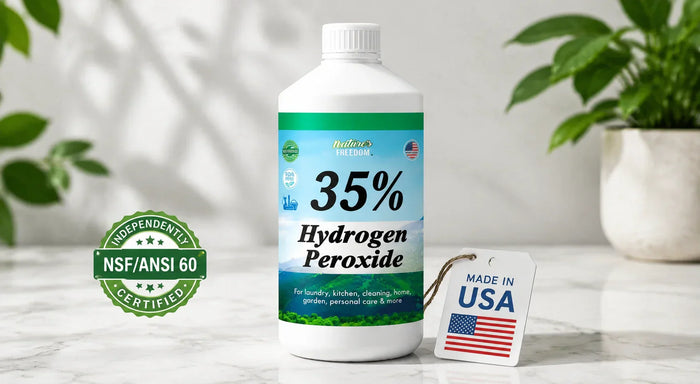
All answers apply specifically to Nature’s Freedom food grade hydrogen peroxide, which is NSF Certified to NSF/ANSI/CAN 60 for drinking water treatment chemicals and NSF/ANSI/CAN 50 for pool, spa, hot tub, and other recreational water treatment chemical use, unless otherwise noted. For any application not covered here, browse the full hydrogen peroxide collection at naturesfreedom.com.
The Basics: What It Is and How It Works
1. What is food grade hydrogen peroxide?
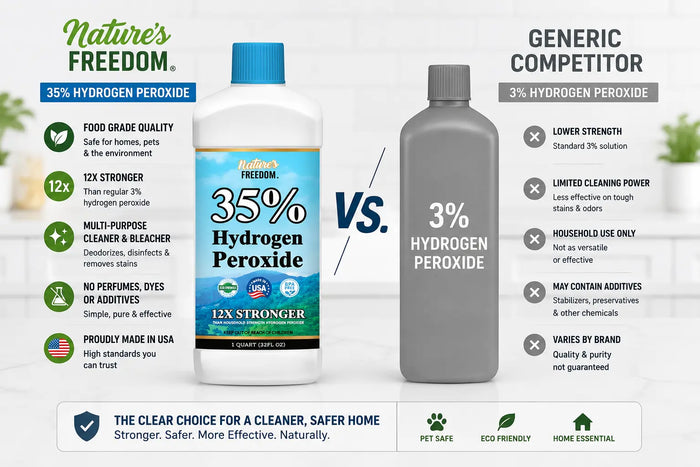
Food grade hydrogen peroxide is a concentrated, stabilizer-free form of H2O2 manufactured without the chemical additives, acetanilide, phenol, and sodium stannate, found in standard drugstore formulas. According to PubChem (NIH), these stabilizers alter the compound’s chemical profile and make standard H2O2 unsuitable for food-contact surface applications and produce washing. Food grade H2O2 is available in 6%, 12%, and 35% concentrations and must always be diluted before use.
Nature’s Freedom food grade hydrogen peroxide is NSF Certified to NSF/ANSI/CAN 60 for drinking water treatment chemicals and NSF/ANSI/CAN 50 for pool, spa, hot tub, and other recreational water treatment chemical use, providing independent third-party verification of purity beyond the food grade classification alone.
Note: The NSF/ANSI/CAN 50 pool and recreational water certification applies to the 35% and 12% H2O2 product lines only. The 6% H2O2 line is NSF Certified to NSF/ANSI/CAN 60 for drinking water treatment chemicals.
2. What is the difference between 3%, 12%, and 35% hydrogen peroxide?
The number refers to the concentration of H2O2 in the solution. Drugstore H2O2 is 3% and sold pre-diluted. Nature’s Freedom offers food grade H2O2 at 6%, 12%, and 35%. The 35% concentration is over 11 times stronger than the 3% formula and dilutes down to any working strength you need from a single bottle. The 12% concentration is a practical mid-point for users who want less dilution work. The 6% is closest to a ready-to-use cleaning strength for most household surfaces.
3. Is hydrogen peroxide safe to use at home?
Yes, when properly diluted to the appropriate working concentration and used with the correct PPE for the concentrate. A 3% diluted solution is safe on most household surfaces, fabrics, and food-contact areas. The undiluted 35% concentrate is a classified strong oxidizer (UN2014) and requires chemical-resistant gloves and eye protection during handling. Per OSHA chemical safety data, PPE is required for concentrations above 8%. At 3% working strength, no special equipment is needed.
4. Is Nature’s Freedom hydrogen peroxide NSF certified?
Yes. Nature’s Freedom hydrogen peroxide is NSF Certified to NSF/ANSI/CAN 60 for drinking water treatment chemicals and NSF/ANSI/CAN 50 for pool, spa, hot tub, and other recreational water treatment chemical use. NSF certification means an independent third party has verified the product’s purity and quality. This goes beyond a Certificate of Analysis, which is issued by the manufacturer. NSF certification is the highest independently verified purity standard available for food grade hydrogen peroxide.
Buying and Storing Hydrogen Peroxide
5. What concentration should I buy for general home use?
35% food grade is the most cost-effective and versatile starting point. It dilutes to 3% at a 1:11 ratio, producing approximately 12 spray bottles of working solution from a single 32 fl oz bottle. The 35% food grade hydrogen peroxide (32 fl oz) is the best starting size for households new to concentrated H2O2. For high-volume users and commercial applications, the 35% hydrogen peroxide gallon (128 fl oz) delivers the lowest cost per ounce.
6. How should I store hydrogen peroxide?
Store the undiluted concentrate in the original vented-cap bottle at 50–75 degrees F, away from heat, direct sunlight, and flammable materials. The vented cap prevents pressure buildup from oxygen off-gassing as the solution slowly decomposes over time. Do not transfer the concentrate to a standard sealed bottle. Stored correctly, undiluted 35% food grade H2O2 remains effective for 1–2 years. Diluted 3% solution stored in a dark bottle should be used within 1–3 months.
7. Does hydrogen peroxide expire?
Yes. Hydrogen peroxide gradually decomposes into water and oxygen over time. The rate of decomposition accelerates with heat, light, and contamination. Undiluted 35% stored correctly degrades approximately 1–2% per year. You can test older diluted solution by pouring a small amount onto a cut potato. If it bubbles vigorously, it is still active. For critical applications such as produce washing or appliance sanitization, always use freshly mixed solution rather than stored stock more than 60 days old.
Browse all available concentrations and sizes in the hydrogen peroxide collection at naturesfreedom.com.
Dilution and Application Questions
8. How do I dilute 35% hydrogen peroxide to 3%?
Mix 1 part 35% H2O2 with 11 parts water. Always add the concentrate to the water, never the reverse. This prevents exothermic splashing. For a standard 32 fl oz spray bottle, add approximately 2.7 fl oz (80 ml) of 35% H2O2 and fill the rest with water. Wear chemical-resistant gloves and eye protection before opening the concentrate. Label the finished bottle with the concentration and the date mixed.
9. Can hydrogen peroxide be used on all surfaces?
At 3%, hydrogen peroxide is safe on sealed hard surfaces: tile, grout, sealed concrete, metal, glass, sealed hardwood, and most plastics. It is not recommended for unsealed natural stone such as marble or travertine, where the oxidation reaction can cause surface etching. At 6% and above, spot-test on colored grout and painted surfaces before full application, as mild lightening can occur on some materials. It is always safe on white grout, sinks, toilet porcelain, and stainless steel at 3%.
10. Can I use hydrogen peroxide to clean my ice machine?
Yes. A 3% food grade hydrogen peroxide solution runs through a full ice machine cleaning cycle, removing scale, bacteria, and biofilm from water lines, trays, and components without leaving chemical taste or residue in the ice. Run the solution through one full cycle, then flush twice with clean water before returning the machine to service. Browse the ice machine cleaners collection at naturesfreedom.com for Nature’s Freedom appliance-specific products.
Pool, Garden, and Outdoor Applications
11. How much hydrogen peroxide do I add to my pool?
The correct dose depends on your pool volume and the current H2O2 level in the water. For maintenance, target 30–50 ppm. To raise a 10,000-gallon pool from zero to 50 ppm requires approximately 1.25 gallons of 35% H2O2. For an exact calculation based on your pool size and current reading, use the hydrogen peroxide pool calculator at naturesfreedom.com. Test every 2–3 days and top up when levels drop below 30 ppm.
12. Is hydrogen peroxide safe for pets and outdoor areas?
Yes, when properly diluted and allowed to dry. At 3% concentration, hydrogen peroxide breaks down completely to water and oxygen after the reaction, leaving no toxic residue on surfaces or in soil once dry. It is used in outdoor areas for odor elimination, surface sanitization, and soil treatment without lasting environmental impact. The outdoor pet urine odor remover is Nature’s Freedom’s dedicated product for outdoor pet areas and yard odor treatment.
Safety Questions
13. What happens if hydrogen peroxide contacts skin or eyes?
Skin contact with diluted 3% solution causes mild, temporary whitening that resolves in minutes. Contact with 35% concentrate causes chemical burns. Flush immediately with large amounts of water for a minimum of 15 minutes and seek medical attention if irritation persists. Eye contact with any concentration above 3% requires immediate flushing with clean water for at least 15 minutes while holding eyelids open. Per CDC NIOSH guidelines, always seek medical advice after any eye contact with concentrated H2O2.
14. Can I mix hydrogen peroxide with bleach or vinegar?
No. Mixing hydrogen peroxide with chlorine bleach produces toxic oxygen gas, heat, and hypochlorous acid vapor that causes serious respiratory and eye irritation. Mixing hydrogen peroxide with vinegar produces peracetic acid, which is corrosive at higher concentrations. Never combine these products in the same container or apply them simultaneously to the same surface. If you want to use both as part of a cleaning routine, apply one product, rinse thoroughly with water, dry the surface, and only then apply the second product.
Made in the USA. NSF Certified. COA and SDS with every order. Ships to all 50 US states.
Start with the 35% food grade hydrogen peroxide (32 fl oz).
Browse the full hydrogen peroxide collection at naturesfreedom.com.
Key Takeaways
• NSF Certified to NSF/ANSI/CAN 60 for drinking water treatment chemicals and NSF/ANSI/CAN 50 for pool, spa, hot tub, and other recreational water treatment chemical use, independently verified purity on every batch; the highest third-party standard available for food grade hydrogen peroxide.
• NSF/ANSI/CAN 50 pool and recreational water certification applies to the 35% and 12% H2O2 lines only; the 6% H2O2 line is certified to NSF/ANSI/CAN 60 for drinking water treatment chemicals.
• Food grade means stabilizer-free, no acetanilide, phenol, or sodium stannate; appropriate for produce washing, food-contact surfaces, and appliances; not the same as drugstore H2O2.
• 35% is the most versatile and cost-effective concentration, dilutes to 3% at 1:11 ratio; one 32 fl oz bottle produces approximately 12 spray bottles of working solution.
• Always add concentrate to water, never the reverse, prevents exothermic splashing; wear gloves and eye protection before opening any concentration above 6%.
• Never mix with bleach or vinegar, produces toxic or corrosive compounds; use each product separately with thorough rinsing between applications.
• Store undiluted concentrate in the original vented-cap bottle at 50–75 degrees F away from heat and light; effective for 1–2 years stored correctly.
• COA and SDS included with every order, made in the USA; ships to all 50 US states with full UN2014 hazmat compliance.