
To dilute 35% hydrogen peroxide to 3% for general cleaning, mix 1 part H2O2 with 10.7 parts water, always adding H2O2 to the water, never the reverse.
The right concentration depends on the task: 0.5%-1% for food surfaces and produce, 3% for general disinfecting, 6% for heavy mildew, and 10% for pool dosing. This guide covers every ratio, dilution chart, step-by-step prep, and safety rules.
Why Does the Correct Dilution Matter for Cleaning?
Getting the dilution right is the difference between hydrogen peroxide that cleans effectively and one that damages surfaces. It works through oxidation - releasing reactive oxygen on contact with organic matter, bacteria, or stains - and the strength of that reaction is directly tied to concentration.
According to PubChem (National Institutes of Health), hydrogen peroxide at high concentrations is a strong oxidizer and corrosive substance - gentle enough at 0.5% for produce rinsing, caustic enough at 35% to cause chemical burns on contact. Proper dilution brings it into the safe range used in food processing, medical, and household cleaning settings worldwide. See what is food grade hydrogen peroxide for a full breakdown of grades and how they are used.
Why Is 35% Food Grade H2O2 the Best Starting Point for Dilution?
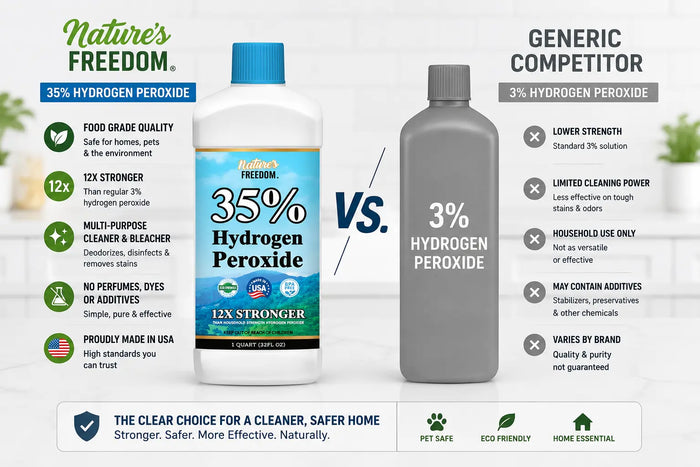
35% food grade H2O2 is the most cost-effective and residue-free starting point for dilution. Drugstore 3% contains stabilizers such as acetanilide and phenol that leave trace residue on cleaned surfaces. Food grade 35% H2O2 contains no stabilizers - only pure H2O2 and water - so no residue carries into your diluted cleaning solutions.
One 32 fl oz bottle of Nature's Freedom 35% H2O2 diluted to 3% produces more than ten spray bottles of cleaning solution. Diluted to 1% for food surfaces, the same bottle yields over 34 spray bottles of solution. Browse the full hydrogen peroxide collection for available sizes.
What Is the Dilution Ratio for Each Cleaning Concentration?
All ratios below are based on diluting 35% H2O2 with water. Always add H2O2 to the water, not water to the concentrate, and use HDPE plastic or stainless steel containers only. Never use glass.
|
Target % |
H2O2 |
Water |
Ratio |
Best Cleaning Uses |
|
0.5% |
1 part |
69 parts |
1:69 |
Produce rinse, baby items, sensitive surfaces |
|
1% |
1 part |
34 parts |
1:34 |
Food contact surfaces, pet bowls, refrigerators |
|
3% |
1 part |
10.7 parts |
1:10.7 |
General disinfecting, bathroom, laundry, odor |
|
6% |
1 part |
4.8 parts |
1:4.8 |
Grout scrubbing, tough mildew, stained tile |
|
10% |
1 part |
2.5 parts |
1:2.5 |
Pool and spa treatment (target 50 ppm) |
For precise volume measurements at the most frequently used concentrations:
|
Target Concentration |
Starting Volume (35%) |
Water to Add |
Final Volume |
|
3% |
1 fl oz (30 ml) |
10.7 fl oz (316 ml) |
11.7 fl oz (346 ml) |
|
3% |
2 fl oz (59 ml) |
21.4 fl oz (633 ml) |
23.4 fl oz (692 ml) |
|
3% |
4 fl oz (118 ml) |
42.8 fl oz (1,267 ml) |
46.8 fl oz (1,385 ml) |
|
1% |
1 fl oz (30 ml) |
34 fl oz (1,006 ml) |
35 fl oz (1,036 ml) |
|
6% |
1 fl oz (30 ml) |
4.8 fl oz (142 ml) |
5.8 fl oz (172 ml) |
How Do You Dilute 35% Hydrogen Peroxide Step by Step?
Follow these steps every time you prepare a diluted H2O2 cleaning solution from 35% concentrate.
-
Put on nitrile gloves and eye protection before opening the bottle. At 35%, H2O2 is a strong oxidizer that causes skin and eye irritation on contact.
-
Measure the water first and pour it into your HDPE spray bottle or mixing container.
-
Measure the H2O2 using a dedicated cup or syringe. Do not estimate.
-
Add H2O2 to the water slowly. Never reverse this order - adding water to the concentrate can cause a rapid exothermic reaction and splashing.
-
Seal and label the container immediately with concentration and date.
-
Store unused diluted solution in a cool, dark location. Diluted H2O2 loses potency faster than the concentrate - prepare only what you need per session.
The most important step is measuring accurately. Estimating the ratio is the most common source of error when diluting hydrogen peroxide for cleaning. See what is food grade hydrogen peroxide for more on concentration grades and their applications.
Which Concentration Should You Use for Each Cleaning Task?
The correct concentration depends on the surface type and the cleaning goal. The five tiers below cover every household application. Learn each hydrogen peroxide uses by application.
0.5% - Sensitive Applications
Use for produce rinsing, baby items, pet bowls, and any surface where even trace chemical contact is a concern. Soak produce in a 0.5% solution for one minute, then rinse with clean water. For baby items, apply, allow to dry fully, and rinse before use.
1% - Food Contact Surfaces
The right concentration for cutting boards, kitchen counters, and refrigerator interiors. Apply, allow 30 seconds of contact time, and wipe clean. No rinsing required - 1% H2O2 decomposes into water and oxygen with no residue.
3% - General Household Disinfecting
The most versatile concentration for household cleaning. Use for bathroom surfaces, toilet bowls, shower tile, laundry whitening, trash bins, doorknobs, and general surface disinfecting. Allow a minimum of 30 seconds contact time for disinfecting, and 5 to 10 minutes for mold-affected grout and caulk.
The EPA Safer Choice program recognizes hydrogen peroxide as an approved active ingredient for safer cleaning formulations. At 3%, it meets the disinfecting standard for the vast majority of household applications.
6% - Tough Stains and Heavy Mildew
Step up to 6% for grout lines with heavy mildew, tile with persistent staining, or outdoor furniture with surface mold. Apply with a brush, allow 5 to 10 minutes of contact time, scrub, then rinse. Spot-test on colored grout or tile before full application at this concentration.
10% - Pool and Spa Treatment
For pool and spa water, the target is 50 ppm H2O2 in the water - not a 10% surface solution. Use 10% as a calculation reference when determining how much 35% H2O2 to add to reach 50 ppm, and verify with an H2O2 test kit before swimming. Browse pool and spa treatment products from Nature's Freedom.
For outdoor pet areas, yards, and kennel surfaces where hydrogen peroxide is impractical to apply at scale, Nature's Freedom offers an Outdoor Pet Odor Eliminator with a hose-end sprayer designed for large surface coverage.
What Safety Rules Apply When Diluting Hydrogen Peroxide?
The CDC NIOSH Pocket Guide recommends appropriate PPE when working with hydrogen peroxide concentrations above 8%. The following rules apply every time you handle 35% H2O2 before dilution.
-
Wear nitrile gloves and eye protection for every dilution session, no exceptions
-
Add H2O2 to water, never water to H2O2
-
Use HDPE plastic or stainless steel containers - glass is not appropriate for H2O2 storage
-
Never mix hydrogen peroxide with bleach - the reaction releases toxic chlorine gas
-
Never mix hydrogen peroxide with vinegar in the same container - the combination creates peracetic acid. For descaling tasks, use Nature's Freedom 45% concentrated vinegar separately, not combined with H2O2.
-
Store 35% H2O2 in its original container in a cool, dark location away from combustible materials
-
Label all diluted solutions with concentration and preparation date
-
On skin or eye contact with undiluted 35% H2O2, flush immediately with large amounts of water for 15 minutes and seek medical attention
Once diluted to 3% or below, hydrogen peroxide requires only standard cleaning precautions. The handling rules above apply specifically to the 35% concentrate before dilution.
How Long Does Diluted Hydrogen Peroxide Stay Effective?
Diluted hydrogen peroxide loses potency faster than the undiluted concentrate, particularly when exposed to light and heat. Store diluted solutions in opaque HDPE bottles in a cool, dark location and use within two to four weeks for best results. Label each bottle with the concentration and preparation date. The 35% concentrate stored in its original container in a cool, dark location maintains potency for up to 12 months.
Why Does NSF Certification Matter When Diluting Hydrogen Peroxide?
NSF certification directly affects dilution accuracy. If the labeled 35% product is actually 32% or 33% due to degradation or inaccurate filling, every solution you mix from it is weaker than intended - and cleaning performance reflects that.
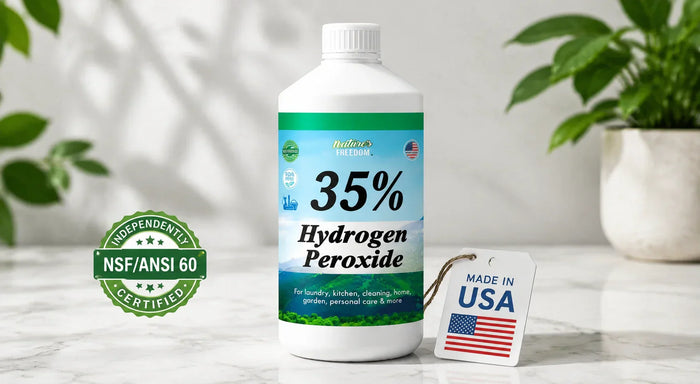
Nature's Freedom 35% hydrogen peroxide carries NSF/ANSI/CAN 60 and NSF/ANSI/CAN 50 certification, meaning an independent third party has verified the actual concentration and confirmed the absence of stabilizers. Learn more about why Nature's Freedom holds these certifications. When you dilute from a certified starting point, your calculated ratios produce accurate results.
What NSF certification means for dilution accuracy:
-
Verified 35% concentration - your dilution math produces accurate results every time
-
No stabilizers - no residue from the base product carries into your diluted cleaning solutions
-
Manufactured in the USA under NSF-audited conditions
-
Safe for food contact surface sanitation at correct dilution
Nature's Freedom 35% hydrogen peroxide is NSF Certified to NSF/ANSI/CAN 60 for drinking water treatment chemicals and NSF/ANSI/CAN 50 for pool, spa, hot tub, and other recreational water treatment chemical use.
For descaling tasks - limescale, mineral deposits, tankless water heaters - pair your H2O2 routine with Nature's Freedom 45% concentrated vinegar, NSF certified to NSF/ANSI/CAN 60 and built for the jobs hydrogen peroxide cannot address. See 45% vinegar vs regular vinegar to understand the concentration difference.
Start with a Verified Concentrate
Every cleaning concentration in this guide starts from a single source: Nature's Freedom 35% NSF/ANSI/CAN 60 and NSF/ANSI/CAN 50 certified hydrogen peroxide. One 32 fl oz bottle prepares months of solutions at any concentration.
Shop concentrated hydrogen peroxide | Browse the full collection | Contact Nature's Freedom
Frequently Asked Questions About Diluting Hydrogen Peroxide
1. How do you dilute 35% hydrogen peroxide to 3% for cleaning?
Mix 1 part 35% H2O2 with 10.7 parts water. For a practical example: add 1 fl oz of 35% H2O2 to 10.7 fl oz of water to produce approximately 11.7 fl oz of 3% solution. Always add the H2O2 to the water, not the other way around. Wear nitrile gloves during preparation.
2. What concentration of hydrogen peroxide is best for general cleaning?
3% is the most versatile concentration for household cleaning - disinfecting surfaces, killing mold, whitening laundry, and eliminating odors with a minimum 30-second contact time. Use 1% or 0.5% for food contact surfaces and produce, 6% for heavy mildew and stubborn grout.
3. Is 3% hydrogen peroxide strong enough to disinfect surfaces?
Yes. At 3% with a minimum 30-second contact time, hydrogen peroxide effectively kills bacteria, viruses, and fungi on hard non-porous surfaces. The EPA Safer Choice program recognizes it as an approved active ingredient for safer disinfecting formulations. Spraying and immediately wiping significantly reduces effectiveness.
4. How much water do you add to hydrogen peroxide to dilute it?
It depends on your target. From 35%: add 10.7 parts water per 1 part H2O2 for 3%, 34 parts for 1%, and 69 parts for 0.5%. The dilution chart above covers every concentration. Shop 35% H2O2 to get started.
5. Can you store diluted hydrogen peroxide, or does it lose potency?
Diluted hydrogen peroxide loses potency faster than the concentrate. Store in opaque HDPE bottles in a cool, dark location, label with concentration and date, and use within two to four weeks. The 35% concentrate stored correctly maintains potency for up to 12 months.
6. Why does NSF certification matter when diluting hydrogen peroxide?
NSF certification independently verifies the stated 35% concentration and the absence of stabilizers, so your calculated dilution ratios produce accurate results. Nature's Freedom NSF-certified H2O2 gives you a verified starting point so your cleaning solutions perform exactly as expected. Learn more about Nature's Freedom certifications.
Key Takeaways
-
To reach 3%, mix 1 part 35% H2O2 with 10.7 parts water. Always add H2O2 to water, never the reverse.
-
Use 0.5%-1% for food surfaces and produce, 3% for general disinfecting, 6% for heavy mildew and grout, 10% as a pool dosing reference.
-
Wear nitrile gloves and eye protection when handling undiluted 35% H2O2. Standard precautions apply once diluted to 3% or below.
-
Never mix hydrogen peroxide with bleach or vinegar in the same container - both create hazardous byproducts. Use vinegar separately for descaling.
-
Nature's Freedom 35% H2O2 is NSF Certified to NSF/ANSI/CAN 60 for drinking water treatment chemicals and NSF/ANSI/CAN 50 for pool, spa, hot tub, and other recreational water treatment chemical use - stabilizer-free, so dilution ratios produce accurate concentrations with no base product residue.
-
Label and date every diluted solution. Store in a cool, dark HDPE bottle and use within two to four weeks.