
|
TL;DR - Key Points • Enzyme cleaners use biological enzymes to break down the organic compounds in pet urine, permanently eliminating odors at their source. • They do not mask smells - they destroy them by converting uric acid, urea, and ammonia into odorless carbon dioxide and water. • Dwell time is essential: allow 10 to 30 minutes before rinsing to let the enzymatic reaction complete. • Nature's Freedom Outdoor Pet Urine Odor Remover uses this enzymatic technology with a hose-end sprayer for large outdoor areas. |
If your yard still smells like dog urine after scrubbing and spraying, you already know the frustrating truth: most cleaning products just mask the problem. You are dealing with a chemical odor that sits deep in soil, grass roots, and porous concrete. Enzyme cleaners work differently. Understanding how enzyme cleaner work helps you choose products that actually fix the problem instead of hiding it temporarily.
This guide explains the science in plain English, covers the right surfaces and use cases, and shows you how to apply enzymatic formulas for results that last.
What Is an Enzyme Cleaner?
An enzyme cleaner is a cleaning product that contains biological enzymes - proteins that accelerate chemical reactions. In the context of pet odor removal, those reactions target the organic compounds that make urine smell: urea, uric acid, and ammonia.
These enzymes act as catalysts. They attach to odor-causing molecules and break them apart into smaller, odorless components - typically carbon dioxide and water. Once those compounds are broken down, there is nothing left to produce a smell.
Most enzyme cleaners also contain beneficial bacteria that produce additional enzymes on contact with organic waste. This dual action makes them significantly more effective on deep-set odors than surface-only cleaners. The EPA Safer Choice Program recognizes cleaning products formulated to minimize environmental and health impact - a standard enzymatic formulas are well-positioned to meet.
The Science Behind Enzymatic Odor Elimination
Pet urine contains several compounds that cause long-lasting outdoor odors:
• Urea - breaks down into ammonia, creating the sharp, eye-watering smell associated with pet urine.
• Uric acid - crystallizes as it dries and reactivates when moisture returns. This is the primary cause of recurring odor after rain.
• Proteins and bacteria - contribute to secondary odor as they decompose over time in the substrate.
Enzyme cleaners contain specific enzyme types matched to these compounds:
|
Enzyme Type |
Target Compound |
Result |
|
Protease |
Protein-based waste |
Breaks protein chains into odorless fragments |
|
Urease |
Urea |
Converts urea into simpler, odorless compounds |
|
Lipase |
Fat-based residue |
Breaks down fatty compounds in organic waste |
When you apply an outdoor pet urine odor remover with enzymatic action, these enzymes get to work immediately on contact. For concentrated formulas applied through a hose-end sprayer, water dilution activates and spreads the enzymes across a wider surface area, penetrating the soil and turf below the surface.
The process takes time - typically 10 to 30 minutes of dwell time on the surface. That is not a flaw; it is the process working as intended. Enzymatic reactions require sustained contact with the target compound to complete the molecular breakdown.
Why Enzyme Cleaners Outperform Chemical Masking Products
Most odor eliminators on store shelves use one of two approaches: fragrance masking or chemical neutralizers. Both have serious limitations outdoors.
Fragrance masking adds a scent on top of the odor. It disappears within hours, and the original odor returns - often stronger once the fragrance fades.
Chemical neutralizers use acids or alkaline compounds to react with odor molecules. They can work on fresh urine on hard surfaces but break down quickly when exposed to sun, rain, and soil conditions.
Enzymatic cleaners eliminate the organic source material. Once the urea and uric acid crystals are broken down at the molecular level, there is no substrate left for bacteria to feed on or for odor to re-emerge from. This distinction matters most outdoors, where odors have multiple routes to linger: soil absorption, root uptake, concrete porosity, and weather reactivation.
What Surfaces Can You Use an Enzyme Cleaner On?
One of the strongest advantages of enzymatic formulas is their surface compatibility. A well-formulated outdoor enzyme cleaner is safe for:
• Natural grass and sod - enzymes and beneficial bacteria are biologically compatible with soil ecosystems and do not harm root systems.
• Artificial turf - formula reaches the infill layer where odors accumulate beneath the surface fibers.
• Concrete and pavers - penetrates porous surfaces and breaks down absorbed urine below the visible surface.
• Patios and decks - safe for treated wood and sealed stone when used as directed.
• Gravel and dog runs - covers large areas efficiently with hose-end application.
• Garden borders - plant-safe formulas do not harm surrounding vegetation or soil chemistry.
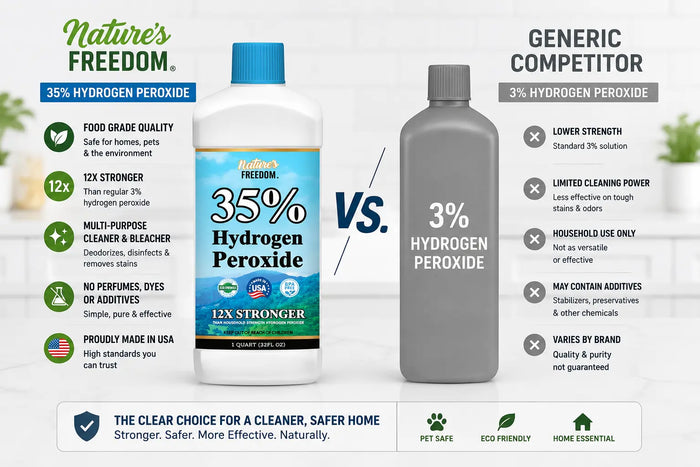
Nature's Freedom Outdoor Pet Urine Odor Remover is formulated specifically for outdoor surfaces and comes with a ready-to-use hose-end sprayer, making it the most practical choice for treating entire yards in a single pass. For multi-surface cleaning beyond pet odors, Nature's Freedom also offers 35% Hydrogen Peroxide for household and commercial use.
How to Apply an Enzyme Cleaner for Best Results
Getting the most out of any enzymatic formula comes down to three things: saturation, dwell time, and timing.
Step 1 - Clear the Area
Remove solid waste and rinse away surface debris. Fresh application on clean surfaces gives enzymes direct contact with the odor source.
Step 2 - Saturate, Do Not Spot Treat
Enzyme cleaners work by contact. Apply enough product to reach the depth of the odor. On grass and soil, that means soaking through to the root zone, not just wetting the surface.
Step 3 - Allow Full Dwell Time
Do not rinse for at least 10 minutes, ideally longer for old or deep-set odors. Enzymatic reactions require time to complete. Rinsing too early stops the process before the compounds are fully broken down.
Step 4 - Repeat for Severe or Old Odors
Uric acid crystals can reactivate in wet weather. A second application after 24 to 48 hours targets any remaining crystals the first pass missed.
Step 5 - Apply Preventively
Regular treatment of high-use areas - dog runs, favorite spots, gate areas - keeps odors from building up over time. Monthly maintenance is significantly more effective than reactive treatment.
For large yards or dog-heavy properties, browse the full Pet Odor Eliminator collection for the right size and application setup.
The Right Formula Makes the Difference
Most outdoor odor products address symptoms. An enzymatic cleaner addresses the cause. If pet urine odors keep returning after rain or warm weather, the uric acid crystals have not been broken down, they have just been covered.
Nature's Freedom Outdoor Pet Urine Odor Remover uses enzymatic technology formulated specifically for outdoor surfaces. Explore the full Pet Odor Eliminator lineup and find the right solution for your space. For other concentrated cleaning needs, browse Nature's Freedom 35% Hydrogen Peroxide - a versatile solution for surfaces and more.
Frequently Asked Questions
1. How long does an enzyme cleaner take to work?
Most enzymatic formulas begin breaking down compounds within minutes of contact. Full odor elimination, particularly for old or deep-set urine, typically takes 10 to 30 minutes of dwell time. For severe cases, a second application after 24 to 48 hours delivers the best results.
2. Is enzyme cleaner safe for grass and pets?
Yes, when formulated correctly. Enzymatic cleaners use biological processes compatible with soil ecosystems. Nature's Freedom Outdoor Pet Urine Odor Remover is pet-safe and plant-safe. Always check product labeling and allow the product to dry before allowing pets back onto the treated area. The ASPCA Animal Poison Control Center is the authoritative reference for substances harmful to pets.
3. What is the difference between an enzyme cleaner and a chemical deodorizer?
Chemical deodorizers react with odor compounds on the surface but do not penetrate porous materials and break down rapidly with sun and rain exposure. Enzyme cleaners break down the organic source material at a molecular level, producing a permanent result rather than temporary odor suppression.
4. Can you use enzyme cleaner on artificial turf?
Yes. Artificial turf is one of the best use cases for enzymatic formulas. Odors accumulate in the infill layer beneath the fibers, which is exactly where enzymes with adequate saturation can reach. A hose-end applicator ensures even coverage across the full turf area.
5. Why does my yard still smell after using an enzyme cleaner?
The most common causes are insufficient saturation, not allowing enough dwell time, or incomplete coverage of the affected area. Uric acid crystals in soil can also reactivate in humid conditions, requiring a second pass. Apply generously, wait at least 15 minutes before rinsing, and treat the full zone rather than just visible spots.
Key Takeaways
• Enzyme cleaners work by deploying biological enzymes that break down the organic compounds in pet urine at a molecular level, permanently eliminating odor.
• Uric acid crystals reactivate in wet weather - standard masking sprays do not address this. Only enzymatic or microbial formulas do.
• Dwell time is essential. Rinsing too early stops the enzymatic reaction before the odor source is fully broken down.
• Outdoor enzyme cleaners are safe for natural grass, artificial turf, concrete, patios, gravel, and plant borders when formulated correctly.
• For large areas, a hose-end sprayer delivers even saturation coverage, making the application process practical at yard scale.
• Regular preventive treatment of high-use dog areas reduces long-term odor buildup and makes each application more effective.