
|
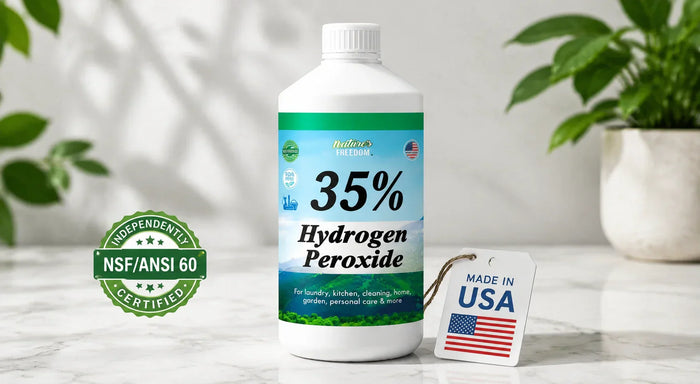
Hydrogen peroxide cleans surfaces by releasing reactive oxygen that breaks down bacteria, mold, and organic stains without leaving chlorine residue. At 3% concentration, it disinfects kitchens, bathrooms, and laundry effectively. Whether you're cleaning a kitchen, treating bathroom mold, or whitening laundry, this guide covers the right dilution, contact time, and safety steps for every room. Nature’s Freedom NSF/ANSI/CAN 60 and NSF/ANSI/CAN 50 certified 35% food grade H2O2 produces more than ten bottles of 3% cleaning solution from a single 32 fl oz bottle, covering every room in the home from one concentrated, additive-free formula. |
Why Does Hydrogen Peroxide Work as a Household Cleaner?
Hydrogen peroxide works by releasing reactive oxygen when it contacts organic matter, bacteria, mold spores, or biofilm. That oxidation reaction breaks down cell walls of microorganisms and decomposes organic stains and odors at the molecular level.
Unlike chlorine bleach, hydrogen peroxide decomposes into water and oxygen with no chlorinated byproducts, no chemical residue, and no sharp fumes after application.
The EPA Safer Choice program recognizes hydrogen peroxide as an approved active ingredient for safer cleaning formulations specifically because of this clean decomposition profile.
According to PubChem (National Institutes of Health), H2O2 demonstrates well-documented antimicrobial activity against bacteria, viruses, and fungi which is what makes it effective across such a wide range of household cleaning tasks.
Why Is 35% H2O2 Better Than the 3% Drugstore Version for Cleaning?
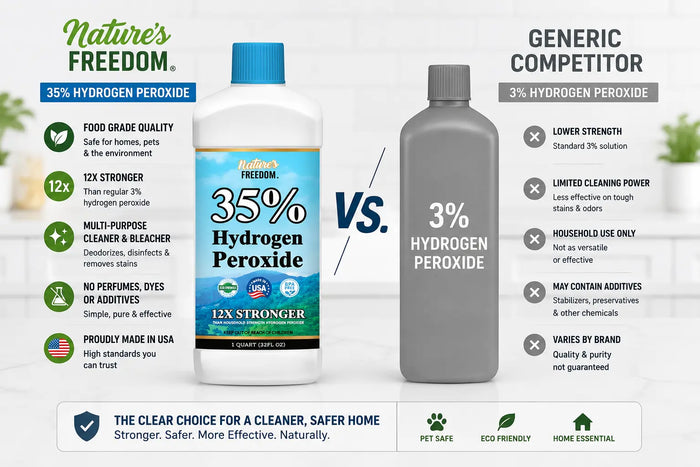
35% food grade hydrogen peroxide is more cost-effective and residue-free compared to standard drugstore peroxide. The standard 3% bottle contains stabilizers such as acetanilide and phenol that extend shelf life but leave trace residues on cleaned surfaces. Nature’s Freedom 35% food grade H2O2 contains no stabilizers only H2O2 and water.
One 32 fl oz bottle diluted to 3% produces more than ten quarts of cleaning solution at a fraction of the cost per use. For food contact surfaces, produce rinsing, and any application where residue matters, stabilizer-free formula is the only appropriate choice.
How Do You Clean Each Room in Your Home with Hydrogen Peroxide?
The correct dilution and contact time vary by surface type and cleaning goal. The breakdown below covers the most common applications by room.
Kitchen
• Countertops and food prep surfaces: spray 3% H2O2, let sit 30 seconds, wipe clean
• Cutting boards: apply 3% H2O2 after washing, let sit 1 minute, rinse with water
• Refrigerator interior: wipe shelves and drawers with 1% solution to eliminate odors and bacteria without chemical smell
• Kitchen sink and faucet bases: spray 3% H2O2, scrub, rinse
• Produce rinse: soak fruit and vegetables in a 1% H2O2 solution for 1 minute, then rinse thoroughly with water
Bathroom
• Toilet bowl: add 1 cup of 3% H2O2, let sit 30 minutes, scrub and flush
• Grout lines: apply 6% H2O2 with a brush, let sit 5 to 10 minutes, scrub and rinse
• Shower tile and caulk: spray 3% H2O2 on mildew-affected areas, leave 10 minutes, wipe away
• Bathroom countertops and sink: spray 3% H2O2, wipe with a clean cloth
• Toothbrush holder and soap dish: soak in 3% H2O2 solution for 5 minutes, rinse
Laundry Room
• Whites and brightening: add 1 cup of 3% H2O2 to the bleach compartment as a direct bleach substitute
• Stain pre-treatment: apply 3% H2O2 directly to sweat, blood, or organic stains and let sit 15 minutes before washing
• Odor elimination: add half a cup of 3% H2O2 to the rinse cycle to neutralize musty smells in towels and athletic wear
Around the House
• Doorknobs, light switches, remote controls: wipe with a cloth dampened in 3% H2O2
• Mirrors and glass: spray 3% H2O2, wipe with a lint-free cloth for streak-free results
• Trash bins: spray inside with 3% H2O2 after emptying, let sit 5 minutes, wipe dry
• Pet bowls and feeding areas: clean with 1% H2O2 solution, rinse thoroughly before refilling
For outdoor pet odor issues in yards and kennel areas, Nature’s Freedom offers a dedicated Outdoor Pet Odor Eliminator with an enzyme-based formula and hose-end sprayer.
How Long Should You Leave Hydrogen Peroxide on a Surface?
Contact time is the most commonly overlooked factor in effective cleaning with hydrogen peroxide. Spraying and immediately wiping removes surface soil but significantly limits disinfecting action.
|
Application |
Minimum Contact Time |
Notes |
|
General surface disinfecting |
30 seconds |
Wipe dry after |
|
Mold and mildew on grout |
5 to 10 minutes |
Scrub before rinsing |
|
Toilet bowl |
30 minutes |
Scrub then flush |
|
Laundry stain pre-treatment |
15 minutes |
Wash immediately after |
|
Produce rinse |
1 minute |
Rinse with water after |
|
Cutting board sanitizing |
1 minute |
Rinse with water after |
Hydrogen peroxide is light-sensitive. For longer contact times such as mold treatment, cover the treated area loosely with a cloth to slow decomposition and allow the oxidizing action to complete.
How Do You Dilute 35% Hydrogen Peroxide for Cleaning?
Always add hydrogen peroxide to water not water to hydrogen peroxide to control the reaction and minimize splashing. Use HDPE plastic or stainless steel containers only; never use glass.
|
Target Concentration |
Mix Ratio (H2O2 : Water) |
Cleaning Use |
|
0.5% |
1 part H2O2 + 69 parts water |
Baby items, sensitive surfaces |
|
1% |
1 part H2O2 + 34 parts water |
Food contact surfaces, produce rinse |
|
3% |
1 part H2O2 + 10.7 parts water |
General surface cleaning, bathroom disinfecting, mold treatment |
|
6% |
1 part H2O2 + 4.8 parts water |
Grout scrubbing, tough mildew on tile |
One 32 fl oz bottle of Nature’s Freedom 35% H2O2 diluted to 3% produces approximately 373 fl oz of cleaning solution, the equivalent of more than eleven standard spray bottles of 3% peroxide.
What Does NSF/ANSI/CAN 60 and NSF/ANSI/CAN 50 certification Mean for a Hydrogen Peroxide Cleaner?
NSF60/NSF50/ANSI 60 certification is independent third-party verification that a product’s purity, concentration, and manufacturing process meet defined standards. Most hydrogen peroxide products available online carry no NSF/ANSI/CAN 60 and NSF/ANSI/CAN 50 certification; their purity and concentration are self-reported by the manufacturer with no external validation.
For cleaning applications on food preparation surfaces, produce, or any area where residue matters, NSF/ANSI/CAN 60 and NSF/ANSI/CAN 50 certification is the only objective confirmation that the product contains no stabilizers and meets its stated concentration.
What NSF/ANSI/CAN 60 and NSF/ANSI/CAN 50 certification means for Nature’s Freedom 35% and 12% H2O2:
-
Independently verified purity and concentration accuracy
-
No stabilizers confirmed through third-party testing
-
Manufactured under NSF-audited conditions
-
Safe for food contact surface sanitation at correct dilution
-
Certification verifiable through the NSF60/NSF50 public product database
-
Nature's Freedom 35% hydrogen peroxide is NSF Certified to NSF/ANSI/CAN 60 for drinking water treatment chemicals and NSF/ANSI/CAN 50 for pool, spa, hot tub, and other recreational water treatment chemical use.
How Does Nature’s Freedom Compare to Other Hydrogen Peroxide Cleaners?
Nature’s Freedom is the only NSF/ANSI/CAN 60 and NSF/ANSI/CAN 50 certified option in this comparison, the only brand providing independent verification that no stabilizers are present and that the stated 35% concentration is accurate.
|
Feature |
Nature's Freedom |
Lab Alley |
Alliance Chemical |
Essential Depot |
|
NSF/ANSI/CAN 60 and NSF/ANSI/CAN 50 certified |
Yes ✓ |
No |
No |
No |
|
Food Grade (No Stabilizers) |
Yes |
Not Stated |
Not Stated |
Not Stated |
|
35% and 12% Concentration |
Yes |
Yes |
Yes |
Yes |
|
Made in USA |
Yes |
Yes |
Yes |
Not Stated |
|
Consumer Size Available |
Yes (32 fl oz) |
Limited |
Primarily Bulk |
Yes |
Nature’s Freedom also produces a 45% concentrated vinegar that is NSF/ANSI/CAN 60 certified and pairs with hydrogen peroxide for descaling, cleaning, and weed control.
What Are the Safety Rules for Cleaning with Hydrogen Peroxide?
At 3% concentration, hydrogen peroxide is safe for regular household use. When handling and diluting the 35% concentrate, these rules apply without exception.
1. Wear nitrile gloves and eye protection when measuring and diluting 35% H2O2
2. Always add H2O2 to water pouring water into concentrated H2O2 risks splashing
3. Never mix hydrogen peroxide with vinegar in the same container the combination creates peracetic acid, a more aggressive irritant
4. Never mix hydrogen peroxide with bleach the combination releases chlorine gas
5. Store 35% H2O2 in its original container in a cool, dark location, away from combustible materials
6. Keep the concentrated product out of reach of children and pets before dilution
7. On skin or eye contact with undiluted 35% H2O2, flush with large amounts of water for 15 minutes and seek medical attention
The CDC NIOSH recommends appropriate PPE when working with hydrogen peroxide concentrations above 8%.
What Surfaces Should Not Be Cleaned with Hydrogen Peroxide?
Avoid using hydrogen peroxide on unsealed natural stone marble, granite, and travertine where the oxidizing action can etch or discolor the surface. Solid brass and copper fixtures can also experience surface discoloration with repeated use. Always test a small hidden area first on any surface you are uncertain about, particularly at concentrations above 3%.
Ready to Clean Smarter?
Nature’s Freedom 35% hydrogen peroxide is NSF/ANSI/CAN 60 and NSF/ANSI/CAN 50 certified, stabilizer-free, and made in the USA. One bottle gives you a full cleaning system for every room in the home. Shop concentrated hydrogen peroxide and replace the single-use spray bottles for good. Questions? Contact Nature’s Freedom.
Frequently Asked Questions About Cleaning with Hydrogen Peroxide
1. How do you use hydrogen peroxide for cleaning surfaces?
Dilute 35% H2O2 to 3% by mixing 1 part H2O2 with 10.7 parts water. Apply to the surface, allow a minimum of 30 seconds of contact time, then wipe clean. For mold on grout or tile, extend contact time to 5 to 10 minutes and scrub before rinsing.
2. What household surfaces can hydrogen peroxide clean?
Hydrogen peroxide is safe and effective on tile, sealed stone, glass, stainless steel, plastic, cutting boards, and porcelain. Avoid unsealed marble, granite, and travertine, and solid brass or copper fixtures where repeated use causes surface discoloration. Always test an inconspicuous area first on unfamiliar surfaces.
3. Is hydrogen peroxide better than bleach for home cleaning?
For most household applications, hydrogen peroxide is preferable. It disinfects, whitens, and deodorizes without chlorinated byproducts, sharp chemical smell, or residue on food contact surfaces. It is not a hospital-grade disinfectant substitute in all formulations, but for kitchen, bathroom, and laundry applications it covers the same ground as bleach with a significantly cleaner decomposition profile.
4. Why does NSF/ANSI/CAN 60 and NSF/ANSI/CAN 50 certification matter when buying hydrogen peroxide for cleaning?
NSF/ANSI/CAN 60 and NSF/ANSI/CAN 50 certification is independent third-party verification of purity, concentration accuracy, and manufacturing standards. A food grade label is a manufacturer’s self-reported claim with no external validation. For cleaning on food contact surfaces or anywhere residue matters, NSF/ANSI/CAN 60 and NSF/ANSI/CAN 50 certification is the only objective confirmation the product contains no stabilizers and meets its stated concentration.
5. Can hydrogen peroxide clean mold?
Yes. Apply 3% to 6% H2O2 to affected grout, tile, caulk, or hard surfaces, allow 5 to 10 minutes of contact time, then scrub and rinse. Hydrogen peroxide kills mold at the root rather than simply bleaching the visible surface. For porous surfaces such as drywall or wood, professional remediation is the appropriate course of action.
6. How much cleaning solution does one bottle of 35% H2O2 make?
One 32 fl oz bottle of 35% H2O2 diluted to 3% produces approximately 373 fl oz of cleaning solution, roughly eleven standard 32 fl oz spray bottles of 3% peroxide. The cost per application is substantially lower than purchasing pre-diluted 3% peroxide.
Key Takeaways
• Hydrogen peroxide for cleaning is effective across kitchen, bathroom, laundry, and general household surfaces when diluted to 3% for most applications.
• Contact time is essential: allow at least 30 seconds for general disinfecting and 5 to 10 minutes for mold treatment before wiping.
• Nature’s Freedom 35% H2O2 is NSF/ANSI/CAN 60 and NSF/ANSI/CAN 50 certified purity and concentration are independently verified, a standard not met by Lab Alley, Alliance Chemical, or Essential Depot.
• Never mix hydrogen peroxide with bleach or vinegar in the same container. Apply each separately with drying time between applications.
• One 32 fl oz bottle of 35% H2O2 dilutes into more than eleven spray bottles of 3% cleaning solution significantly more cost-effective than pre-diluted alternatives.
• Always wear nitrile gloves and eye protection when diluting the 35% concentrate; once diluted to 3%, standard handling precautions apply.
• Hydrogen peroxide decomposes into water and oxygen with no chlorinated byproducts, no persistent residue making it one of the cleanest disinfecting options available for household use. Visit this page for full guide on what is hydrogen peroxide used for.