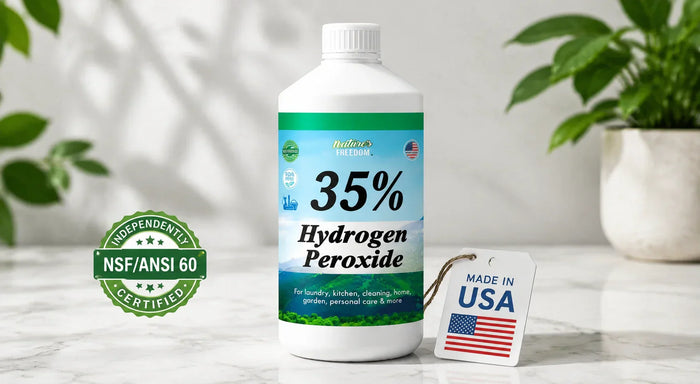

Food grade hydrogen peroxide is H2O2 produced without stabilizers, making it appropriate for food contact surfaces, produce washing, edible plant care, and any application where residue is a concern. The FDA recognizes hydrogen peroxide as Generally Recognized As Safe (GRAS) under 21 CFR 184.1366 for specified food contact applications. The defining difference from drugstore 3% peroxide is not the chemistry - it is the absence of stabilizers and, for certified products, independent verification of both.
What Is Food Grade Hydrogen Peroxide?
Food grade hydrogen peroxide is a formulation of H2O2 that meets the purity standards required for food contact applications - specifically, it contains no stabilizers.
The FDA Code of Federal Regulations 21 CFR 184.1366 recognizes hydrogen peroxide as Generally Recognized As Safe (GRAS) as a direct and indirect food additive for specific applications including bleaching, oxidizing, and antimicrobial functions in food processing. This regulatory designation applies to food grade formulations, not to stabilizer-containing drugstore varieties.
The defining characteristic of food grade H2O2 is what it does not contain. Standard hydrogen peroxide sold in pharmacies contains one or more stabilizing additives - compounds such as acetanilide, phenol, and sodium stannate - that extend shelf life but leave trace residues on any surface the product contacts. Food grade hydrogen peroxide contains only H2O2 and purified water.
According to PubChem (National Institutes of Health), hydrogen peroxide decomposes into water and oxygen. For food grade formulations without stabilizers, the only byproducts of the oxidation reaction are water and oxygen - a clean decomposition profile that makes it suitable for food-adjacent applications.
Common concentrations:
Food grade hydrogen peroxide is available at 3%, 6%, 12%, and 35% for consumer use. The 35% concentration is the most cost-effective because significant dilution is required before any application - one bottle produces a large volume of working solution at any target concentration.
! 35% Food Grade H2O2 Must Always Be Diluted
35% food grade hydrogen peroxide is not safe to use undiluted. At full concentration, it is a strong oxidizer that causes chemical burns on contact with skin, eyes, or tissue.
All consumer applications require dilution to the appropriate working concentration before use.
How Does Food Grade Hydrogen Peroxide Differ from Regular?
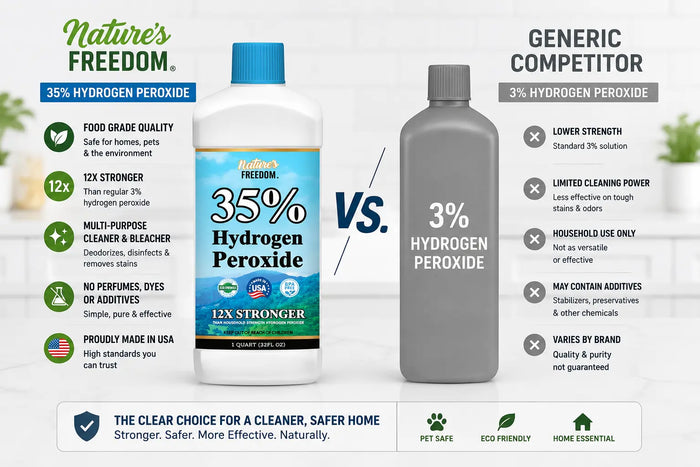
The distinction between food grade and regular hydrogen peroxide comes down to two factors: the presence or absence of stabilizers, and the concentration available.
|
Property |
Food Grade H2O2 |
Drugstore 3% H2O2 |
|
Common concentration |
35%, 3%, 6%, 12% |
3% |
|
Stabilizers |
None - H2O2 and water only |
Yes: acetanilide, phenol, sodium stannate |
|
Intended use |
Food processing, sanitization, cleaning |
First aid, wound care |
|
NSF certification available |
Yes (e.g., Nature's Freedom) |
No |
|
FDA GRAS status |
Yes, 21 CFR 184.1366 |
Not evaluated for food use |
|
Residue on surfaces |
None after decomposition |
Stabilizer residue may remain |
|
Cost per gallon of 3% solution |
Significantly lower (concentrated) |
Higher (pre-diluted) |
|
Safe for food contact surfaces |
Yes at correct dilution |
Not recommended due to stabilizers |
The practical implication of the stabilizer difference is most significant for food contact applications and repeated plant use. Stabilizer residues deposited on cutting boards, food preparation surfaces, and edible plant root zones accumulate over time. For anyone using hydrogen peroxide on food-contacting surfaces or in growing systems producing edible plants, food grade is the appropriate choice.
What Is Food Grade Hydrogen Peroxide Used For?
Food grade hydrogen peroxide applications fall into four main categories: food and food contact surface sanitation, household cleaning, plant care, and pool and spa treatment.
|
Application Category |
Concentration |
Specific Uses |
|
Food contact surfaces |
1% to 3% |
Cutting boards, countertops, refrigerator interiors, food prep equipment |
|
Produce washing |
0.5% to 1% |
Fruit and vegetable rinse to reduce bacteria and pesticide residue |
|
General cleaning and disinfecting |
3% |
Bathroom, kitchen surfaces, mold treatment, laundry |
|
Pool and spa sanitation |
3% to 10% (50 ppm) |
Non-chlorine pool shock and ongoing sanitation |
|
Plant care and gardening |
0.5% to 3% |
Root rot treatment, soil oxygenation, seed germination, pest control |
|
Laundry |
3% |
Bleach substitute, stain removal, odor elimination |
|
Wound care and first aid |
3% |
Surface disinfection - consult a healthcare provider for wound treatment |
|
Commercial food processing |
Varies |
Equipment sterilization, packaging sanitation, aseptic processing |
! Do Not Ingest Hydrogen Peroxide at Any Concentration
Some online sources suggest food grade hydrogen peroxide can be consumed internally for health benefits. The FDA has issued clear warnings against this practice.
Ingesting hydrogen peroxide at any concentration is dangerous and has caused serious injuries and deaths.
The term food grade refers to the absence of stabilizers and the appropriateness for food contact surface applications - it does not mean the product is safe to drink.
Nature's Freedom does not make any health claims for internal use, and this guide does not recommend or support any such application.
For outdoor yard and pet area applications, Nature's Freedom also offers an Outdoor Pet Odor Eliminator designed for large-scale outdoor surface treatment. Learn other hydrogen peroxide uses.
Is Food Grade Hydrogen Peroxide Safe?
At the correct dilution and with appropriate handling, yes. At 35% concentration before dilution, it requires careful handling with PPE. The safety profile depends entirely on concentration and application.
Safety at working concentrations:
Diluted to 3% or below for household and food contact applications, food grade H2O2 is safe for regular use. At these concentrations, the oxidizing action is sufficient to disinfect and clean but not strong enough to cause chemical burns on brief contact with skin. Sensitive skin may experience mild irritation from prolonged contact - rinse with water if irritation occurs.
Handling 35% concentrate:
The CDC NIOSH Pocket Guide recommends appropriate PPE when working with hydrogen peroxide concentrations above 8%. For 35% H2O2: wear nitrile gloves and eye protection during every dilution session. Add H2O2 to water - never add water to concentrated H2O2 - and use HDPE plastic or stainless steel containers. Store in a cool, dark location in the original container, away from combustible materials. In case of skin or eye contact with undiluted 35% H2O2, flush with large amounts of water for 15 minutes and seek medical attention.
The FDA GRAS designation:
The FDA GRAS designation for hydrogen peroxide under 21 CFR 184.1366 covers specific food processing applications including its use as a bleaching agent, oxidizing agent, and antimicrobial agent. This regulatory status confirms the established safety record of food grade H2O2 in food contact applications when used at specified concentrations.
How Do You Dilute Food Grade Hydrogen Peroxide?
All concentrations below are achieved by mixing 35% food grade H2O2 with water. Always add H2O2 to water and use HDPE plastic or stainless steel containers. Never use glass for storage.
|
Target % |
H2O2 : Water Ratio |
Practical Example |
Use Cases |
|
0.5% |
1 : 69 |
1 fl oz H2O2 + 69 fl oz water |
Produce rinse, seedlings, sensitive surfaces |
|
1% |
1 : 34 |
1 fl oz H2O2 + 34 fl oz water |
Food contact surfaces, plant watering |
|
3% |
1 : 10.7 |
1 fl oz H2O2 + 10.7 fl oz water |
General cleaning, mold, laundry, pest control |
|
6% |
1 : 4.8 |
1 fl oz H2O2 + 4.8 fl oz water |
Grout, heavy mildew, tool disinfecting |
|
10% |
1 : 2.5 |
1 fl oz H2O2 + 2.5 fl oz water |
Pool and spa dosing reference |
The EPA Safer Choice program recognizes hydrogen peroxide as an approved active ingredient for safer cleaning formulations, supporting its use across household, food service, and commercial applications at appropriate concentrations.
Why Does NSF Certification Matter for Food Grade Hydrogen Peroxide?
NSF certification converts a self-reported food grade claim into an independently verified fact - and the difference matters for applications where residue and concentration accuracy are not negotiable.
The term food grade on a hydrogen peroxide label is a manufacturer's self-declaration. There is no legal requirement for a manufacturer to obtain third-party testing or certification before labeling a product as food grade. The label alone confirms nothing about the actual stabilizer content, concentration accuracy, or manufacturing process quality.
NSF/ANSI/CAN 60 certification requires independent third-party testing and ongoing manufacturing audits by NSF International. For hydrogen peroxide, NSF certification confirms the stated concentration is accurate, no stabilizers are present, and the manufacturing process meets the standards required for food contact applications.
Why this matters for consumers:
• Verified concentration accuracy means dilution calculations produce accurate working solutions
• Confirmed stabilizer-free status means no residue on food contact surfaces after decomposition
• NSF audit trail provides accountability that a self-reported label cannot offer
• Certification is verifiable - the NSF public database allows consumers to confirm certification status independently
For applications involving edible plants, produce, food preparation surfaces, and any use where stabilizer accumulation over repeated treatments is a concern, NSF certification is the only objective quality standard available.
• Nature's Freedom 35% hydrogen peroxide is NSF Certified to NSF/ANSI/CAN 60 for drinking water treatment chemicals and NSF/ANSI/CAN 50 for pool, spa, hot tub, and other recreational water treatment chemical use.
Product Specifications and Competitor Comparison
Nature's Freedom 35% Food Grade Hydrogen Peroxide
|
Specification |
Detail |
|
Product |
Nature's Freedom 35% Hydrogen Peroxide |
|
Grade |
Food Grade |
|
Concentration |
35% H2O2 |
|
NSF Certification |
NSF/ANSI/CAN 60 and NSF/ANSI/CAN 50 Certified |
|
FDA GRAS Status |
Hydrogen peroxide listed as GRAS under 21 CFR 184.1366 |
|
Stabilizers |
None - H2O2 and water only |
|
Made In |
USA |
|
Available Size |
32 fl oz |
|
Typical Household Dilution |
3% for general use (1 part H2O2 + 10.7 parts water) |
|
Feature |
Nature's Freedom |
Lab Alley |
Alliance Chemical |
Essential Depot |
|
NSF/ANSI/CAN 60 + NSF/ANSI/CAN 50 Certified |
Yes v |
No |
No |
No |
|
No Stabilizers |
Yes |
Not Stated |
Not Stated |
Not Stated |
|
35% Concentration |
Yes |
Yes |
Yes |
Yes |
|
Made in USA |
Yes |
Yes |
Yes |
Not Stated |
|
Consumer Size (32 fl oz) |
Yes |
Limited |
Primarily Bulk |
Yes |
|
Third-Party Verified Purity |
Yes (NSF) |
No |
COA only |
No |
The critical differentiator is NSF certification. Lab Alley and Alliance Chemical are reputable chemical suppliers with COA documentation for each lot, but neither carries NSF certification. Essential Depot sells food grade-labeled product without third-party verification. Nature's Freedom is the only NSF-certified option in this comparison.
Nature's Freedom also produces 45% concentrated vinegar, NSF certified, the natural companion product for descaling, weed control, and household cleaning applications where hydrogen peroxide is not the right tool.
The Only NSF-Certified Food Grade H2O2 in This Category
Nature's Freedom 35% hydrogen peroxide is NSF/ANSI/CAN 60 and NSF/ANSI/CAN 50 certified, stabilizer-free, and made in the USA. One 32 fl oz bottle covers food contact surface sanitation, produce washing, laundry, plant care, and cleaning from a single independently verified source.
Shop concentrated hydrogen peroxide | Browse the full collection | Contact Nature's Freedom
Frequently Asked Questions About Food Grade Hydrogen Peroxide
1. What is food grade hydrogen peroxide?
Food grade hydrogen peroxide is H2O2 produced without stabilizers, making it suitable for food contact applications, produce washing, and any use where residue is a concern. The FDA recognizes hydrogen peroxide as GRAS under 21 CFR 184.1366 for specific food contact applications. It is most commonly sold at 35% concentration for consumer use and must always be diluted before application.
2. What is the difference between food grade and regular hydrogen peroxide?
The key difference is stabilizers. Drugstore 3% hydrogen peroxide contains stabilizing additives - acetanilide, phenol, and sodium stannate - that extend shelf life but leave trace residue on surfaces. Food grade hydrogen peroxide contains only H2O2 and water. No stabilizers means no residue after decomposition, which is why food grade is the appropriate choice for food contact surfaces, produce, and edible plants. Food grade is also typically available at higher concentrations, most commonly 35%.
3. Is food grade hydrogen peroxide safe to use at home?
Yes, at correct working concentrations. At 3% or below, food grade H2O2 is safe for food contact surfaces, produce washing, cleaning, laundry, and plant care. At 35% concentrate, proper PPE is required during dilution. Never use 35% food grade H2O2 undiluted on any surface, skin, or in or around the mouth.
4. Can you drink food grade hydrogen peroxide?
No. The FDA has issued clear warnings against ingesting hydrogen peroxide at any concentration. Drinking hydrogen peroxide at any percentage is dangerous and has caused serious injuries and deaths. The food grade designation refers to suitability for food contact surface applications, not internal consumption. Nature's Freedom does not make health claims for internal use and does not recommend or support this practice under any circumstances.
5. What concentration of food grade hydrogen peroxide should you buy?
35% is the most cost-effective option for household use. One 32 fl oz bottle diluted to 3% yields more than ten spray bottles of working solution, covering cleaning, plant care, laundry, and pool treatment from a single source. Food grade 3% or 6% versions are available if you prefer less dilution math, but at significantly higher cost per unit of active ingredient.
6. Why is NSF-certified food grade hydrogen peroxide better than self-declared food grade?
NSF certification provides independent third-party verification that the product contains no stabilizers and meets its stated concentration - two facts that a food grade label alone cannot confirm. Without certification, both claims are based entirely on the manufacturer's word. For applications involving food preparation surfaces and edible plants where stabilizer residue matters, NSF certification is the only objective standard that confirms what is actually in the bottle.
7. Where can you buy NSF-certified food grade hydrogen peroxide?
Nature's Freedom 35% hydrogen peroxide is available at naturesfreedom.com and on Amazon. It is the only NSF/ANSI/CAN 60 certified consumer food grade H2O2 product in the comparison covered in this guide. One 32 fl oz bottle provides enough concentrate for months of household use across every application category described here.
Key Takeaways
• Food grade hydrogen peroxide is H2O2 produced without stabilizers, appropriate for food contact surfaces, produce washing, edible plant care, and any application where residue is a concern.
• The FDA recognizes hydrogen peroxide as GRAS under 21 CFR 184.1366 for specified food contact and processing applications - this designation applies to food grade, stabilizer-free formulations.
• 35% is the most cost-effective concentration for consumer use - one bottle diluted to 3% produces more than ten spray bottles of working solution.
• Never use 35% food grade H2O2 undiluted. Always dilute before application and wear nitrile gloves and eye protection during the dilution process.
• Nature's Freedom 35% H2O2 is NSF Certified to NSF/ANSI/CAN 60 for drinking water treatment chemicals and NSF/ANSI/CAN 50 for pool, spa, hot tub, and other recreational water treatment chemical use, independently verified for purity and stabilizer-free status - which a self-reported food grade label alone cannot confirm.
• Do not ingest hydrogen peroxide at any concentration. The food grade designation refers to food contact surface suitability, not safety for internal use.