
Does white vinegar kill weeds? Yes - but only on very young seedlings under ideal conditions. At 5% acetic acid, household white vinegar causes surface burn but leaves root systems intact, allowing most established weeds to regrow within one to two weeks. 45% concentrated vinegar is nine times stronger and delivers the results most people are actually looking for. The gap between 5% and 45% is not a small upgrade - it is the difference between surface cosmetic burn and genuine tissue destruction. For a full breakdown of application and dilution, see the Vinegar Weed Killer guide.
What Is White Vinegar and Why Does Concentration Matter?
White vinegar is a dilute solution of acetic acid in water. The 5% concentration sold in grocery stores is the minimum the U.S. Food and Drug Administration (FDA) requires for a product to be labeled as vinegar.
According to PubChem (National Institutes of Health) - Acetic Acid, acetic acid kills plant tissue by acidifying the surface on contact, disrupting cell membranes and causing rapid moisture loss. The higher the concentration, the deeper the tissue damage goes and the faster the plant dies.
At 5%, the acid causes surface-level burn on young, tender plant tissue. At 45%, the same acid penetrates far deeper, damages the crown, and kills annual weeds reliably from root to tip in a single application. Switching from 5% to 45% changes the mechanism from a product that sometimes looks like it is working to one that consistently delivers results.
The EPA minimum-risk pesticide program under 40 CFR Part 152 recognizes acetic acid as an approved herbicide active ingredient, supporting its use in certified organic agriculture as an alternative to synthetic weed control.
How Does White Vinegar Compare to Concentrated Vinegar for Weeds?
The comparison below shows exactly why concentration is the deciding variable for outdoor weed control.
|
Factor |
White Vinegar (5%) |
Concentrated Vinegar (45%) |
|
Acetic Acid Concentration |
5% |
45% |
|
Times Stronger |
Baseline |
9x stronger |
|
Kill rate on young annual weeds |
Moderate - surface burn, may regrow |
High - reliable single-application kill |
|
Kill rate on established weeds |
Low - surface damage only |
Moderate to high - crown and tissue damage |
|
Kill rate on moss |
Minimal |
High - results within 24 hours |
|
Time to visible results |
12 to 48 hours |
2 to 6 hours |
|
NSF certified option available |
No |
Yes (Nature's Freedom - NSF/ANSI/CAN 60) |
For a deeper look at these differences, see 45% vinegar vs. regular vinegar.
When Can White Vinegar Work on Weeds?
White vinegar produces acceptable results in three narrow situations. Outside of these, it consistently underperforms.
• Very young seedlings within the first week of germination: A newly sprouted weed with only a cotyledon or two and no developed root system can be killed by 5% vinegar. The plant has almost no structural defenses and minimal root energy to draw on for recovery.
• Moss and algae on outdoor surfaces in warm conditions: Moss is structureless compared to rooted plants. Even 5% vinegar can damage thin moss growth on patios and stone, though results are slower and less complete than with concentrated vinegar.
• Spot treatment on tiny annual seedlings in vegetable beds: When precision is needed near desirable plants and the intensity of 45% vinegar poses a risk, household-strength vinegar applied carefully with a brush is a low-risk option for week-old weed seedlings only.
Outside of these narrow situations, white vinegar consistently produces surface burn, apparent death, and regrowth from the undamaged root within one to two weeks.
Why Do Most Outdoor Weed Jobs Require 45% Concentrated Vinegar?
The weeds most people are actually dealing with are not week-old seedlings. They are established dandelions, persistent grass through patio joints, creeping clover along fence lines, and moss colonizing stepping stones. For the full explanation of how concentration determines results, see the Vinegar Weed Killer guide.
These plants have developed root systems, stored energy reserves, and enough structural mass that 5% acetic acid simply cannot deliver sufficient damage for a complete kill. 45% concentrated vinegar causes deep enough tissue damage that annual weeds are killed completely in a single application. Established perennials are suppressed significantly, often requiring only two or three repeat applications to exhaust the root system.
If you have been using white vinegar and been disappointed, the concentration is the problem, not the method. Switching to 45% concentrated vinegar on the same weeds, with the same application technique, produces dramatically different results.
Why Does NSF Certification Matter When Choosing Concentrated Vinegar?
If you are switching from white vinegar to a concentrated product, the concentration on the label is only reliable if an independent party has verified it - and most brands in this category are self-certified. Nature's Freedom 45% Concentrated Vinegar is NSF Certified to NSF/ANSI/CAN 60 for drinking water treatment chemicals, with independent third-party verification that its 45% acidity claim is accurate. See our 45% concentrated vinegar guide.
|
Brand |
NSF Certified |
Concentration |
Made in USA |
|
Nature's Freedom |
Yes - NSF/ANSI/CAN 60 |
45% |
Yes |
|
Calyptus |
No |
45% |
Yes |
|
Belle Chemical |
No |
45% |
Unknown |
|
Natural Armor |
No |
45% |
Unknown |
How Do You Transition from White Vinegar to Concentrated Vinegar?
Four practical differences to keep in mind when making the switch. For the full step-by-step application process, see How to Kill Weeds With Vinegar.
• Dilute before use: Unlike 5% white vinegar, 45% concentrated vinegar must be diluted for most applications. A 1:2 or 1:3 ratio (vinegar to water) creates a 10-15% working solution for most annual weed control. Undiluted or 1:1 application is reserved for established perennials and moss on hard surfaces.
• Use protective equipment: White vinegar is safe to handle without protection. 45% acetic acid is corrosive and requires chemical-resistant gloves and eye protection during handling and application.
• Expect faster and more complete results: If you are used to partial browning the next morning, switching to 45% will change that expectation. Results are typically visible within 2 to 6 hours on a warm day.
• Use less product per application: Because 45% vinegar is diluted before use, a single gallon yields multiple gallons of working solution. The upfront cost is higher than grocery store white vinegar, but cost per treated area is significantly lower over time.
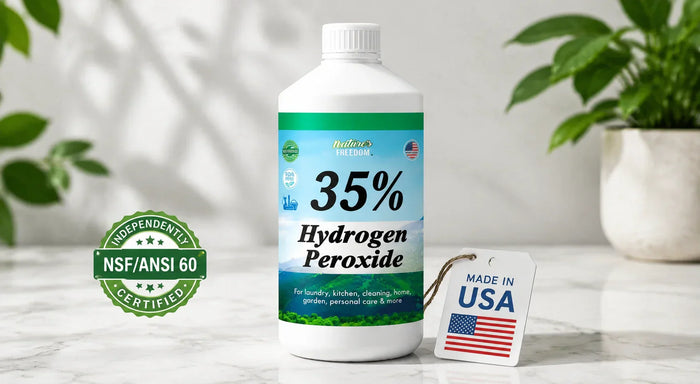
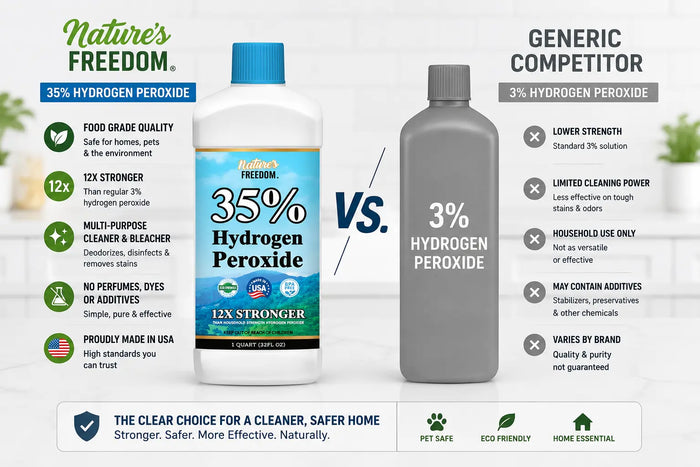
For all-around outdoor maintenance, Nature's Freedom also produces 35% hydrogen peroxide for surface disinfection and appliance descaling, alongside an Outdoor Pet Odor Eliminator for enzyme-based yard odor control.
If White Vinegar Has Let You Down, the Fix Is the Right Vinegar
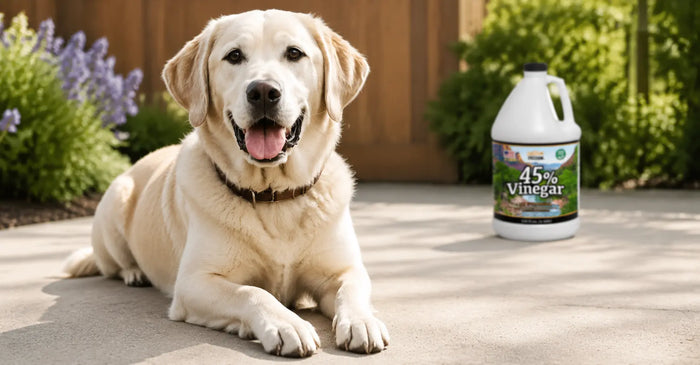
If white vinegar has not killed your weeds, concentration is why. Nature's Freedom Concentrated Vinegar at 45% acetic acid is NSF Certified to NSF/ANSI/CAN 60 for drinking water treatment chemicals, made in the USA, and nine times stronger than anything in your pantry. Order the 45% Concentrated Vinegar - 1 Gallon. Browse the full concentrated vinegar collection, or contact the Nature's Freedom team with questions.
Frequently Asked Questions About White Vinegar and Weeds
1. Does white vinegar kill weeds permanently?
Standard 5% white vinegar does not kill most established weeds permanently. It causes surface burn on foliage, but the root system typically survives and sends up new growth within one to two weeks. 45% concentrated vinegar gives meaningfully better permanence results on annual weeds.
2. How much white vinegar do you need to kill weeds?
Using more white vinegar does not compensate for low concentration. Applying twice as much 5% vinegar still only delivers 5% acetic acid. The only way to get better results is to use a higher concentration product, not a larger volume of the same weak solution.
3. Is it safe to spray white vinegar on weeds near a lawn?
Vinegar is non-selective - it damages any green plant it contacts, whether weed or lawn grass. This applies equally to 5% and 45% vinegar. The difference is that 5% causes less severe damage, so spray drift may produce temporary bleaching rather than a kill on nearby turf. Precision application is critical when working near turf you want to preserve.
4. Can you add salt to white vinegar to make it stronger?
Adding salt increases the herbicidal effect somewhat by drawing additional moisture from plant tissue, but it does not increase the acetic acid concentration. Salt also accumulates in soil and can prevent anything from growing in treated areas for extended periods. Switching to 45% concentrated vinegar is a cleaner, more controllable solution.
5. Will boiling white vinegar make it kill weeds better?
Boiling vinegar causes acetic acid to evaporate faster than the water, which reduces concentration over time rather than increasing it. Boiled vinegar poured hot onto weeds may cause some additional thermal damage to foliage, but the acid content is not increased by heating. Use concentrated vinegar at the right percentage rather than attempting to modify household vinegar.
6. What is the difference between cleaning vinegar and weed killer vinegar?
Cleaning vinegar sold in stores is typically 6% acetic acid - slightly stronger than standard 5% white vinegar but still far below the 45% needed for reliable outdoor weed control. Horticultural or concentrated vinegar at 45% acetic acid is the correct product. Nature's Freedom 45% Concentrated Vinegar is NSF Certified to NSF/ANSI/CAN 60 for drinking water treatment chemicals, specifically formulated for this use case.
Key Takeaways
• Does white vinegar kill weeds? Yes - on very young seedlings under ideal conditions, but it is not strong enough for reliable outdoor weed control on established plants.
• 45% concentrated vinegar is nine times stronger than white vinegar and delivers reliable kill rates on annual weeds, moss, and grass in hard surface areas in a single application.
• The reason most vinegar weed killer attempts fail is using the wrong concentration. Switching from 5% to 45% on the same weeds with the same application technique produces dramatically different results.
• Nature's Freedom is the only concentrated vinegar brand certified to NSF/ANSI/CAN 60 for drinking water treatment chemicals, providing independent verification of concentration accuracy that Calyptus, Belle Chemical, and Natural Armor do not offer.
• 45% concentrated vinegar requires dilution for most applications and protective equipment during handling, unlike ready-to-use household white vinegar.
• Adding salt, boiling, or increasing volume does not improve the performance of 5% white vinegar. Only increasing the acetic acid concentration produces meaningfully better weed control results.