
Does vinegar kill weeds? Yes - but whether it kills them well, quickly, and for good depends almost entirely on one number: the percentage of acetic acid in the bottle. Household 5% vinegar burns weed surfaces while roots survive and regrow. Concentrated 45% vinegar delivers nine times the acidity, producing reliable kills on annual weeds and meaningful suppression of established perennials. For a full breakdown of application methods and dilution ratios, see the Vinegar Weed Killer guide.
How Does Vinegar Kill Weeds?
Vinegar kills weeds through desiccation - acetic acid disrupts plant cell membranes on contact, causing rapid moisture loss and death of leaf and stem tissue.
According to PubChem (National Institutes of Health) - Acetic Acid, acetic acid lowers the pH on contact with plant tissue, disrupting the cell membrane and causing rapid moisture loss. On a warm, sunny day, wilting and browning are visible within two to six hours.
The EPA minimum-risk pesticide program under 40 CFR Part 152 classifies acetic acid as an approved active ingredient for herbicide use. It is recognized as an effective weed control method in certified organic agriculture.
The critical limitation: vinegar is a contact herbicide. It kills what it touches. Roots below ground are unaffected unless the acid physically reaches them - this drives most of the disappointment people experience when using the wrong concentration.
Does 5% White Vinegar Kill Weeds?
Yes - technically. But 5% white vinegar is rarely strong enough for reliable results on anything beyond very young seedlings.
Standard household white vinegar is 5% acetic acid. At that concentration, the acid can burn the surface of young, shallow-rooted weeds. For anything with more than a few weeks of root growth, the result is cosmetic - the visible plant dies back, the root system sends up fresh growth within one to two weeks, and you end up retreating the same weed repeatedly without solving the problem.
The honest answer: 5% vinegar is better suited for kitchen counter cleaning than driveway weed control. See the full comparison in 45% vinegar vs. regular vinegar.
Why Does 45% Concentrated Vinegar Work Better?
45% concentrated vinegar is nine times stronger than grocery store vinegar - and that difference is not subtle in practice.
At 45% acetic acid, the higher concentration delivers enough acid to penetrate beyond the leaf surface and cause deep tissue damage in annual weeds. For established perennials, the crown and upper root zone can be affected, significantly slowing or preventing regrowth. Annual weeds in driveway cracks, sidewalk joints, and gravel paths show reliable kill rates with a single application at the right dilution.
Nature's Freedom 45% Concentrated Vinegar is NSF Certified to NSF/ANSI/CAN 60 for drinking water treatment chemicals - independently verified by a third party for formulation and purity, not just a label claim.
|
Brand |
NSF Certified |
Concentration |
Made in USA |
|
Nature's Freedom |
Yes - NSF/ANSI/CAN 60 |
45% |
Yes |
|
Calyptus |
No |
45% |
Yes |
|
Belle Chemical |
No |
45% |
Unknown |
|
Natural Armor |
No |
45% |
Unknown |
Which Weeds Does Vinegar Kill Best?
The type of weed matters as much as the product you use.
• Annual weeds - best results. Crabgrass, chickweed, spurge, annual bluegrass, and lamb's quarters die reliably with one or two applications of 45% vinegar because their root systems are shallow.
• Moss and algae - excellent results. Concentrated vinegar is one of the fastest-acting moss killers for patios, driveways, and retaining walls. Results are visible within 24 hours.
• Young perennial weeds - good results in the first season before root systems fully establish. Young dandelions, clover, and creeping Charlie respond well when caught early.
• Established perennial weeds - moderate results. Surface dieback is reliable, but deep taproots survive and may regrow. Multiple applications spaced several days apart are needed for meaningful suppression.
• Deep-rooted grasses like Bermuda - limited results. Rhizomatous root systems extend below the reach of surface acid. Vinegar alone will not eradicate these reliably.
Is Vinegar Weed Killer Safe Around Pets and Children?
Yes - once dry. Acetic acid does not persist on surfaces or in soil after it dries. The EPA Safer Choice program recognizes acetic acid's favorable safety profile compared to conventional herbicide alternatives. Once treated areas are fully dry - typically within one to three hours - there is no toxic residue.
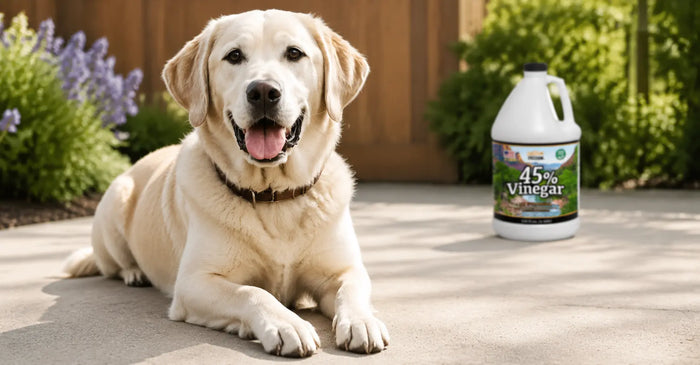
During and immediately after application, keep pets and children away. Concentrated vinegar is corrosive to mucous membranes. A pet walking through fresh undiluted application may experience paw irritation.
For households managing both outdoor weed control and yard odor from pet use, Nature's Freedom offers a dedicated Outdoor Pet Odor Eliminator that pairs naturally with concentrated vinegar for complete yard maintenance.
How Do You Apply Vinegar as a Weed Killer?
Correct application conditions are as important as choosing the right concentration. For formula-specific recipes, see the vinegar weed killer recipe guide.
1. Dilute appropriately. For annual weeds in cracks and gravel, mix one part 45% vinegar with two to three parts water. For established perennials or moss, apply undiluted or at a 1:1 ratio.
2. Choose a warm, sunny day. Apply with no rain forecast for at least 24 hours. Sunlight and heat accelerate the desiccation process significantly.
3. Saturate leaves and stems. Fill a pump sprayer or spray bottle. Direct foliage contact is essential - soil-only application is far less effective.
4. Wear gloves and eye protection. A 45% acetic acid solution is corrosive. Protective equipment is required for any handling of undiluted product.
5. Check results after 24 to 48 hours. Annual weeds will show browning and collapse. Perennials may need a second application after three to five days.
6. Clear dead plant material. Remove wilted weeds before they dry and drop seeds - this prevents the next generation from establishing in the same spot.
Read the complete 45% concentrated vinegar guide.
Vinegar Kills Weeds When You Give It the Concentration It Needs
Nature's Freedom Concentrated Vinegar at 45% acetic acid is NSF Certified to NSF/ANSI/CAN 60 for drinking water treatment chemicals, made in the USA, and built to outperform everything sitting in your grocery store aisle. Order the 45% Concentrated Vinegar - 1 Gallon and see the difference concentration makes. Browse the full concentrated vinegar collection or contact the Nature's Freedom team with questions.
Frequently Asked Questions: Does Vinegar Kill Weeds?
1. Does vinegar kill weeds to the root?
Vinegar acts on contact only. For annual weeds with shallow root systems, the kill is often complete including the root. For established perennials with deep taproots, the root typically survives and the plant regrows. Repeat applications are necessary for meaningful suppression of deep-rooted perennials.
2. How long does it take for vinegar to kill weeds?
On a warm, sunny day, wilting and browning typically begin within two to six hours. Full collapse of annual weeds usually occurs within 24 hours. Established perennials may take 48 to 72 hours to show complete surface dieback, with regrowth from roots possible within one to two weeks.
3. What type of vinegar kills weeds best?
45% horticultural or concentrated vinegar delivers the most reliable results. Standard 5% household white vinegar is not strong enough for consistent outdoor weed control. Nature's Freedom 45% Concentrated Vinegar is NSF Certified to NSF/ANSI/CAN 60 for drinking water treatment chemicals and formulated specifically for outdoor herbicide applications.
4. Will vinegar kill weeds in a vegetable garden?
Vinegar is non-selective - it damages any green plant it contacts, including vegetables, flowers, and lawn grass. Do not spray in or near vegetable beds. For precision application near garden edges, use a paintbrush to apply concentrated vinegar directly to the target weed without contacting surrounding plants.
5. Is vinegar weed killer safe for the environment?
Acetic acid dissipates rapidly in soil and does not persist in groundwater. The EPA classifies it as a minimum-risk pesticide ingredient. It is widely used in certified organic production as an alternative to synthetic herbicides. When used at appropriate dilutions, it poses no long-term environmental risk to treated areas.
6. Does vinegar work better than Roundup?
For annual weeds on hard surfaces and moss removal, 45% concentrated vinegar is equally fast and more environmentally benign. For established deep-rooted perennials, glyphosate-based products have a higher single-application success rate because they translocate to the root. The trade-off is soil persistence and ongoing regulatory scrutiny around glyphosate that concentrated vinegar does not carry.
Key Takeaways
• Does vinegar kill weeds? Yes - through acetic acid desiccation, but the 5% version in grocery stores is rarely strong enough for outdoor weed control on anything beyond very young seedlings.
• 45% concentrated vinegar is nine times stronger than household vinegar and produces reliable kill rates on annual weeds, moss, and algae with proper application.
• Vinegar is a contact herbicide - it kills what it touches. Deep-rooted perennial weeds require multiple applications because the root system survives initial treatment.
• Nature's Freedom is the only NSF Certified to NSF/ANSI/CAN 60 option among major concentrated vinegar brands, with independent verification of its 45% acidity claim.
• The product is pet safe once dry, non-persistent in soil, and compatible with organic certification standards.
• Application conditions - sunny weather, dry forecast, and direct foliage contact - are as important as choosing the right concentration.