
|
Yes. 12% hydrogen peroxide removes algae, mildew, biofilm, and organic staining from outdoor hard surfaces by releasing oxygen that breaks down organic matter. It is more effective than 3% drugstore peroxide for tough exterior cleaning jobs. Nature's Freedom 12% Hydrogen Peroxide is NSF Certified to NSF/ANSI/CAN 60 for drinking water treatment chemicals and NSF/ANSI/CAN 50 for pool, spa, hot tub, and other recreational water treatment chemical use. |
How Is 12% Hydrogen Peroxide Being Used in Major Public Maintenance?
Hydrogen peroxide's role has expanded beyond medicine cabinets into serious infrastructure maintenance. According to published reports, the National Park Service deployed hydrogen peroxide alongside ozone nanobubble technology to combat visible algae growth in the Lincoln Memorial Reflecting Pool in Washington, D.C. following a major renovation. The choice is significant: preservation teams responsible for one of the most visited landmarks in the United States selected hydrogen peroxide over harsher chemical treatments.
This mirrors a broader shift happening in facility management, pool maintenance, and property care - choosing oxidizing chemistry that decomposes into water and oxygen rather than leaving residual chemical buildup.
Why Does Hydrogen Peroxide Work Against Algae and Organic Growth?
Hydrogen peroxide eliminates algae through oxidation. When applied to organic growth such as algae, mildew, mold, or biofilm, H2O2 releases reactive oxygen that disrupts cellular structure and breaks down organic compounds. The reaction produces only water (H2O) and oxygen (O2) as byproducts.
This mechanism makes it effective across a wide range of outdoor surfaces including concrete, stone, brick, pavers, tile, and masonry. Unlike sodium hypochlorite (bleach), hydrogen peroxide does not leave chlorine residue, does not produce chlorine gas when mixed with organic matter, and does not bleach surrounding vegetation to the same degree.
You can check Nature's Freedom 35% Hydrogen Peroxide for stronger concentration.
What Is the Difference Between 3% and 12% Hydrogen Peroxide for Cleaning?
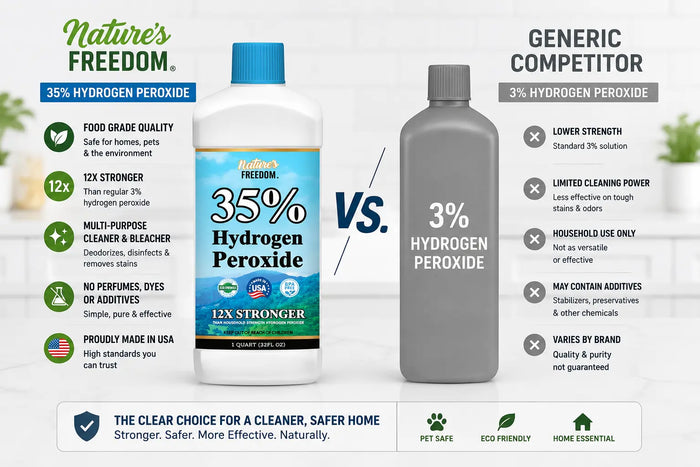
The concentration of hydrogen peroxide directly determines its cleaning strength. Standard 3% hydrogen peroxide sold in drugstores is formulated for minor antiseptic use - not heavy-duty surface cleaning. At 3%, it lacks the oxidation capacity to penetrate established algae colonies, embedded mildew, or deep organic staining on porous outdoor surfaces.
Nature's Freedom 12% Hydrogen Peroxide delivers four times the active concentration. This makes it suitable for professional-grade exterior cleaning applications where 3% would require multiple applications or produce no visible result. View Nature's Freedom 12% Hydrogen Peroxide.
What Surfaces Can 12% Hydrogen Peroxide Clean?
Nature's Freedom 12% Hydrogen Peroxide is effective on a wide range of hard surfaces:
• Concrete patios, driveways, and walkways with green algae or black mildew buildup
• Natural stone, brick, and pavers with organic staining
• Tile and grout in outdoor pool surrounds or deck areas
• Drainage channels and gutters with biofilm accumulation
• Fountain basins and decorative water features
For heavily infested surfaces, a direct application followed by a dwell time of 10 to 15 minutes and a pressure rinse is a standard approach used in commercial property maintenance.
Is Nature's Freedom 12% Hydrogen Peroxide NSF Certified?
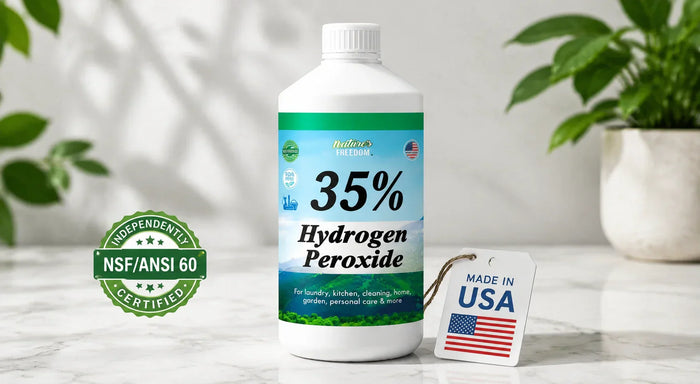
Yes. Nature's Freedom 12% Hydrogen Peroxide is NSF Certified to NSF/ANSI/CAN 60 for drinking water treatment chemicals and NSF/ANSI/CAN 50 for pool, spa, hot tub, and other recreational water treatment chemical use. This dual NSF certification means the product has been independently verified to meet safety and performance standards for both drinking water system applications and recreational water environments.
NSF International is an independent organization that develops public health standards and certifications. The NSF/ANSI/CAN 60 and NSF/ANSI/CAN 50 standards are among the most recognized in the water treatment and pool maintenance industries.
Competitors in the professional hydrogen peroxide space typically do not carry both certifications. The dual NSF certification is a primary trust differentiator for Nature's Freedom.
NSF Certification Comparison
|
FEATURE |
NATURE'S FREEDOM 12% H2O2 |
TYPICAL COMPETITOR |
|
NSF/ANSI/CAN 60 |
Yes |
No |
|
NSF/ANSI/CAN 50 |
Yes |
No |
|
Concentration |
12% |
Varies |
|
Residue after use |
Water + Oxygen only |
May leave chemical residue |
|
Bleach-free |
Yes |
Check label |
Who Should Use 12% Hydrogen Peroxide for Outdoor Cleaning?
12% hydrogen peroxide is appropriate for homeowners, property managers, facility maintenance teams, pool-area operators, and cleaning contractors who need a stronger, residue-free alternative to bleach-based cleaners. It is particularly well-suited for:
• Residential patio and deck maintenance with recurring algae growth
• Commercial property exteriors with persistent organic staining
• Pool surrounds, spa decks, and outdoor tile requiring non-chlorine oxidation
• Historic masonry or natural stone where bleach would cause surface damage
• Any application where chemical residue is a concern after treatment
Frequently Asked Questions on 12% Hydrogen Peroxide
1. Can 12% hydrogen peroxide be used directly on algae without dilution?
Yes, 12% hydrogen peroxide can be applied directly to algae-affected hard surfaces. For most outdoor applications, direct application followed by a 10 to 15 minute dwell period and a rinse is effective. For more delicate or porous surfaces, diluting to 6% is common practice.
2. How does 12% hydrogen peroxide compare to bleach for algae removal?
Both bleach (sodium hypochlorite) and hydrogen peroxide are oxidizing agents effective against algae. Hydrogen peroxide decomposes into water and oxygen only, whereas bleach leaves chlorine residue and can damage surrounding vegetation, discolor surfaces, and produce hazardous gases if mixed with other cleaning agents. For surfaces where residue is a concern, hydrogen peroxide is generally preferred.
3. Is 12% hydrogen peroxide safe for use around outdoor plants and landscaping?
Diluted hydrogen peroxide is generally considered less damaging to surrounding plant life than chlorine bleach. However, direct, undiluted application to plant roots or foliage can cause oxidative damage. When treating surfaces near landscaping, rinsing thoroughly after treatment is recommended.
4. Why does Nature's Freedom 12% Hydrogen Peroxide carry NSF certification?
NSF/ANSI/CAN 60 and NSF/ANSI/CAN 50 certifications confirm that the product meets independently verified standards for safety and performance in drinking water treatment and recreational water applications respectively. For facility managers, pool operators, and contractors, NSF certification provides third-party verification that the product performs as labeled and meets public health benchmarks.
5. Where can I purchase Nature's Freedom 12% Hydrogen Peroxide?
Nature's Freedom 12% Hydrogen Peroxide is available at naturesfreedom.com.
Key Takeaways
• 12% hydrogen peroxide removes algae, mildew, mold, and biofilm through oxidation, leaving only water and oxygen as byproducts.
• It delivers four times the active concentration of standard 3% drugstore hydrogen peroxide, making it effective for professional exterior cleaning.
• The National Park Service used hydrogen peroxide to treat algae at the Lincoln Memorial Reflecting Pool - a documented real-world application at a national landmark.
• Nature's Freedom 12% Hydrogen Peroxide holds dual NSF certification: NSF/ANSI/CAN 60 (drinking water treatment chemicals) and NSF/ANSI/CAN 50 (pool, spa, hot tub, and recreational water use).
• Effective on concrete, stone, brick, pavers, tile, pool surrounds, and outdoor masonry without chlorine residue.
• Suitable for homeowners, property managers, pool operators, and cleaning contractors.