
No. Mixing bleach and hydrogen peroxide is dangerous and must never be done.
The reaction produces chlorine gas and releases concentrated oxygen, creating toxic fumes that cause serious respiratory harm even in small, enclosed spaces.
Hydrogen peroxide cleans, disinfects, and whitens effectively on its own, no bleach required, and no toxic reaction possible.
⚠ SAFETY WARNING
Never mix bleach and hydrogen peroxide. The reaction produces toxic chlorine gas immediately.
If accidental mixing occurs: leave the area, open windows and doors, and call Poison Control at 1-800-222-1222.
What Happens When You Mix Bleach and Hydrogen Peroxide?
When household bleach (sodium hypochlorite, NaOCl) contacts hydrogen peroxide (H2O2), a rapid oxidation-reduction reaction occurs that releases chlorine gas (Cl2) and oxygen gas as byproducts. The hydrogen peroxide acts as a reducing agent toward the hypochlorite, the two compounds do not amplify each other, they react to produce something far more dangerous than either alone.
According to PubChem (National Institutes of Health), chlorine gas causes severe irritation to the eyes, nose, throat, and lungs. Even brief exposure at low concentrations produces coughing, choking, and a burning sensation in the airways. Higher concentrations or prolonged exposure can cause pulmonary edema, a dangerous accumulation of fluid in the lungs.
The reaction happens almost immediately on contact. There is no safe ratio or controlled method for combining these two products in a household setting.
What the Reaction Looks Like
Mixing bleach and hydrogen peroxide produces visible bubbling and fizzing as oxygen is rapidly released, followed by a sharp chlorine smell almost immediately. If this happens accidentally, leave the area right away, open windows and doors to ventilate, and contact Poison Control at 1-800-222-1222 if any symptoms of exposure appear.
Why Is Mixing Bleach and Hydrogen Peroxide Dangerous?
The danger is chemical, not theoretical. Chlorine gas was used as a chemical weapon in World War I because of its effectiveness at causing respiratory damage even at low concentrations. In a home setting, releasing chlorine gas in an enclosed space such as a bathroom or kitchen creates a hazardous environment within seconds.
The CDC NIOSH Pocket Guide identifies chlorine as a severe respiratory hazard, with exposure symptoms including burning eyes and throat, coughing, shortness of breath, and in serious cases, fluid in the lungs requiring emergency medical treatment.
Bathrooms and kitchens, the most common rooms where cleaning products are used, have limited ventilation, which concentrates released gas rapidly and increases the likelihood that accidental exposure reaches harmful levels.
What Other Cleaning Combinations Should You Never Mix?
Bleach and hydrogen peroxide is one of several hazardous cleaning product combinations found in the average household. Each of the pairings below produces a dangerous reaction from individually safe products.
|
Combination |
Reaction Product |
Risk |
|
Bleach + Hydrogen Peroxide |
Chlorine gas, oxygen gas |
Toxic fumes, respiratory damage |
|
Bleach + Ammonia |
Chloramine gas |
Severe respiratory irritation, potentially fatal |
|
Bleach + Vinegar |
Chlorine gas |
Eye and lung irritation |
|
Bleach + Rubbing Alcohol |
Chloroform and other toxic compounds |
Dizziness, nausea, organ damage |
|
Hydrogen Peroxide + Vinegar (same container) |
Peracetic acid |
Skin, eye, and airway irritation |
The OSHA Hazard Communication guidelines emphasize that chemical incompatibility is one of the most underappreciated hazards in non-industrial settings. Most accidental household exposures involve products that are safe individually but reactive when combined.
Can You Use Hydrogen Peroxide and Vinegar Together?
Hydrogen peroxide and vinegar are safe when used separately, but mixing them in the same container creates peracetic acid, a more aggressive compound that irritates skin, eyes, and airways. The safe method is to apply one, allow the surface to dry fully, then apply the other. Alternating them this way is more effective than combining them and eliminates peracetic acid formation entirely.
Can Hydrogen Peroxide Replace Bleach for Household Cleaning?
Yes. For the vast majority of household cleaning applications, hydrogen peroxide replaces bleach effectively, disinfecting, whitening, deodorizing, and removing organic stains without producing chlorinated byproducts, without leaving chemical residue on surfaces, and without the sharp fumes that make bleach unpleasant to work with. Read our full hydrogen peroxide cleaning guide.
|
Property |
Hydrogen Peroxide |
Bleach (Sodium Hypochlorite) |
|
Active ingredient |
H2O2 |
NaOCl |
|
Decomposition products |
Water and oxygen |
Chlorinated byproducts |
|
Residue after use |
None |
Chemical residue on surfaces |
|
Safe for food surfaces |
Yes (at correct dilution) |
Requires thorough rinsing |
|
Fumes during use |
Minimal |
Strong chlorine fumes |
|
Fabric safe |
Yes (most fabrics at 3%) |
Can strip color and weaken fibers |
|
NSF certified option |
Yes, Nature's Freedom |
N/A |
|
EPA Safer Choice approved |
Yes |
No |
The EPA Safer Choice program recognizes hydrogen peroxide as an approved active ingredient for safer cleaning formulations. Bleach does not appear on the Safer Choice approved ingredients list.
How Do You Clean Safely Without Bleach?
Switching from bleach to hydrogen peroxide requires only a change in concentration and contact time. The four applications below cover the tasks bleach is most commonly used for.
Disinfecting Hard Surfaces
Apply 3% hydrogen peroxide to countertops, tile, appliance surfaces, and bathroom fixtures. Allow 30 seconds of contact time for general disinfecting. For areas with heavier contamination, extend contact time to 2 to 3 minutes before wiping.
Mold and Mildew Removal
Spray 3% to 6% H2O2 directly on mold-affected grout, caulk, or tile. Allow 5 to 10 minutes of contact time, scrub with a brush, then rinse. Unlike bleach, hydrogen peroxide kills mold at the root rather than simply bleaching the visible surface discoloration.
Laundry Whitening
Add one cup of 3% hydrogen peroxide to the bleach compartment of a standard washing machine as a direct substitute for chlorine bleach. It whitens fabrics and eliminates odors without weakening fibers or stripping color from non-white items.
Toilet and Bathroom Sanitizing
Pour one cup of 3% H2O2 into the toilet bowl, let sit for 30 minutes, scrub, and flush. For toilet exteriors and bathroom surfaces, spray and wipe with a 3% solution. No rinsing is required, hydrogen peroxide decomposes into water and oxygen with no residue.
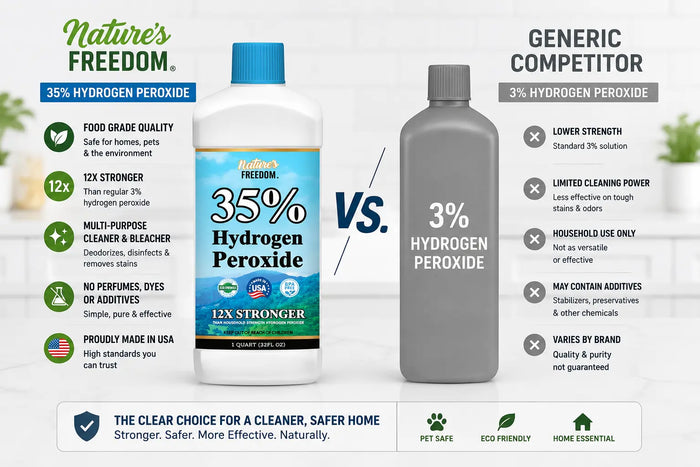
Nature's Freedom 35% concentrated H2O2 dilutes into more than ten bottles of 3% cleaning solution from a single 32 fl oz bottle. Browse the full hydrogen peroxide collection.
Why Is NSF-Certified Hydrogen Peroxide the Better Choice Over Bleach?
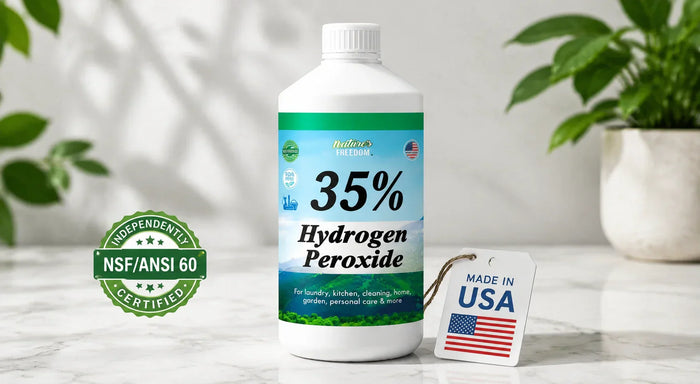
NSF-certified 35% hydrogen peroxide is the superior alternative to bleach because it is independently verified to contain no stabilizers, no chemical residue, and no toxic reaction potential. Standard drugstore 3% H2O2 contains stabilizers such as acetanilide and phenol that leave trace residue on cleaned surfaces. Nature's Freedom 35% H2O2 carries NSF/ANSI/CAN 60 and NSF/ANSI/CAN 50 certification, independently verified by a third party for purity, concentration accuracy, and absence of stabilizers.
What NSF certification means in practice:
• No stabilizer residue on cleaned surfaces
• Independently verified 35% concentration, not a manufacturer estimate
• Safe for food contact surface sanitation at correct dilution
• Manufactured under NSF-audited conditions in the USA
• Nature's Freedom 35% hydrogen peroxide is NSF Certified to NSF/ANSI/CAN 60 for drinking water treatment chemicals and NSF/ANSI/CAN 50 for pool, spa, hot tub, and other recreational water treatment chemical use.
Nature's Freedom also produces 45% concentrated vinegar, NSF certified and effective for descaling, weed control, and surface cleaning when used separately from hydrogen peroxide.
Clean Without the Risk
Nature's Freedom 35% hydrogen peroxide is NSF/ANSI/CAN 60 and NSF/ANSI/CAN 50 certified, stabilizer-free, and made in the USA. It handles every job bleach is typically used for, with no toxic reactions, no chlorinated residue, and no fumes.
Shop concentrated hydrogen peroxide | Contact Nature's Freedom
Frequently Asked Questions About Mixing Bleach and Hydrogen Peroxide
1. Can you mix bleach and hydrogen peroxide for cleaning?
No. Mixing bleach and hydrogen peroxide produces chlorine gas and releases oxygen rapidly, creating toxic fumes that are dangerous to inhale even in small amounts. Never combine these two products. Hydrogen peroxide disinfects effectively on its own, with no need for bleach.
2. What should you do if you accidentally mix bleach and hydrogen peroxide?
The mixture will fizz visibly and release a sharp chlorine smell almost immediately. Leave the area right away and ventilate the space by opening windows and doors. If you experience coughing, burning eyes or throat, or difficulty breathing, contact Poison Control at 1-800-222-1222 or seek emergency medical attention. Do not attempt to clean up the mixture without proper ventilation and gloves.
3. Is hydrogen peroxide as effective as bleach for disinfecting?
Yes, for household surfaces. Hydrogen peroxide kills bacteria, viruses, and fungi through oxidation. It is not registered as a hospital-grade disinfectant in all formulations, but for standard kitchen, bathroom, and laundry applications it matches bleach performance. The EPA Safer Choice program recognizes hydrogen peroxide as an approved disinfecting ingredient. Bleach is not on the Safer Choice list.
4. Can you use hydrogen peroxide and vinegar together for cleaning?
Not in the same container. Mixing them creates peracetic acid, which irritates skin, eyes, and airways. The safe method is to apply one product, let the surface dry fully, then apply the other. Alternating them is more effective than combining them and eliminates the peracetic acid risk entirely.
5. Why is NSF-certified hydrogen peroxide better for replacing bleach?
NSF certification provides independent third-party verification that the product contains no stabilizers and meets its stated concentration. Drugstore hydrogen peroxide contains stabilizers that leave trace residue on surfaces. Nature's Freedom NSF-certified 35% H2O2 is stabilizer-free, surfaces cleaned with it are left with nothing but water and oxygen after the H2O2 decomposes. For food contact surfaces and areas where residue matters, this distinction is significant.
Key Takeaways
• Never mix bleach and hydrogen peroxide, the reaction produces toxic chlorine gas that is dangerous to inhale even in small amounts in an enclosed space.
• If accidental mixing occurs, leave the area immediately, ventilate the space, and contact Poison Control (1-800-222-1222) if any symptoms appear.
• Hydrogen peroxide replaces bleach effectively for disinfecting, mold removal, laundry whitening, and bathroom sanitizing, without chlorinated byproducts or surface residue.
• Hydrogen peroxide and vinegar are safe when used separately on surfaces, but mixing them in the same container creates peracetic acid, which irritates skin and airways.
• Nature's Freedom 35% H2O2 is NSF Certified to NSF/ANSI/CAN 60 for drinking water treatment chemicals and NSF/ANSI/CAN 50 for pool, spa, hot tub, and other recreational water treatment chemical use, and stabilizer-free. One 32 fl oz bottle dilutes into more than ten bottles of 3% cleaning solution.
• The EPA Safer Choice program approves hydrogen peroxide as a cleaning ingredient. Bleach does not appear on the Safer Choice approved list.