
|
Yes. Hydrogen peroxide cleans shoes by breaking down organic stains through oxidation, killing odor-causing bacteria on contact, and reversing yellowing on white rubber and canvas. It works on canvas, mesh, and rubber soles. At 3% concentration, diluted from Nature’s Freedom NSF-certified 35% H2O2, it is safe and effective for most footwear materials, with the exception of genuine leather, suede, and nubuck. |
What Does Hydrogen Peroxide Do to Shoes?
Hydrogen peroxide works on shoes through three distinct mechanisms, each targeting a different cleaning problem. Read our complete guide to hydrogen peroxide uses.
Stain Removal
The oxidizing reaction breaks apart chemical bonds in organic stains, grass, mud, food, and the grayish film that builds up on canvas over time. On white fabric and canvas, this produces a visible brightening effect that most cleaners cannot achieve without the risk of color stripping.
Disinfecting and Odor Elimination
Shoe odor comes primarily from bacteria that thrive in the warm, moist environment inside footwear. Hydrogen peroxide kills those bacteria on contact.
According to PubChem (National Institutes of Health), H2O2 demonstrates well-documented antimicrobial activity against bacteria, viruses, and fungi. Applied to shoe liners and interior fabric, it eliminates odor at its source rather than masking it with fragrance.
Yellowing Reversal on White Shoes
White rubber and canvas yellow over time from oxidation, UV exposure, and residue left by bleach-based cleaners. Hydrogen peroxide reverses this by breaking up the yellowed compounds and restoring the original white color, making it one of the most effective solutions for white sneakers.
How Do You Clean Shoes with Hydrogen Peroxide Step by Step?
The method below works for canvas sneakers, mesh uppers, rubber soles, and fabric shoe liners. For other materials, check the compatibility table in this guide before starting.
What You Need:
• Nature’s Freedom 35% hydrogen peroxide, diluted to 3% before use
• Small bowl or spray bottle
• Soft-bristle brush or old toothbrush
• Clean cloth or paper towels
• Nitrile gloves
Step-by-Step Method:
1. Remove laces and insoles.
2. Mix 1 part 35% H2O2 with 10.7 parts water to reach 3%. Pour into a spray bottle or bowl.
3. Brush off loose dirt before applying any liquid.
4. Apply the solution to uppers, sole edges, and stained areas.
5. Let sit for 5 to 10 minutes before wiping.
6. Scrub gently with a soft-bristle brush.
7. Wipe clean with a damp cloth. Repeat for stubborn stains.
8. Air dry fully in a ventilated area away from direct sunlight.
For severely yellowed soles, a second application after the first dries typically produces noticeably better results.
How Do You Remove Yellow Stains from White Shoes with Hydrogen Peroxide?
Apply 3% H2O2 directly to yellowed soles, let sit for 10 minutes, then scrub with a soft brush. For severe yellowing, use the baking soda paste method below, which activates H2O2 through sunlight exposure for stronger results.
The Baking Soda Paste Method for Heavy Yellowing
1. Mix 1 tablespoon of baking soda with 1.5 tablespoons of 3% H2O2 into a thick paste.
2. Apply to yellowed soles and fabric with an old toothbrush.
3. Place in direct sunlight for 3 to 4 hours.
4. Brush off the dried paste and wipe clean with a damp cloth.
5. Repeat once for severe yellowing.
This method is safe for canvas, mesh, and rubber sole materials. Avoid on synthetic leather or colored panels, the combination can affect dye in some fabrics. Always spot-test a hidden area first.
How Do You Use Hydrogen Peroxide to Eliminate Shoe Odor?
Shoe odor treatment is one of the fastest applications because hydrogen peroxide works directly on the bacteria responsible for the smell.
1. Remove insoles if possible.
2. Spray the interior of each shoe with 3% H2O2 solution until the lining is lightly dampened, not soaked.
3. Leave shoes open in a well-ventilated area for at least 30 minutes. H2O2 needs contact time with the bacteria-laden fabric.
4. Allow to air dry fully before wearing. H2O2 decomposes into water and oxygen, leaving no residue once dry.
For insoles, spray directly and allow to dry flat before reinserting. For persistent odor in athletic shoes used frequently, repeat the treatment weekly.
The CDC NIOSH confirms hydrogen peroxide’s established antimicrobial properties against the bacterial species most commonly associated with foot odor, including Staphylococcus and Brevibacterium.
Which Shoe Materials Are Safe to Clean with Hydrogen Peroxide?
Not all shoe materials respond the same way to hydrogen peroxide. The table below outlines compatibility for the most common types.
|
Shoe Material |
Safe to Use H2O2? |
Notes |
|
Canvas (e.g., Converse) |
Yes |
Excellent results on stains and yellowing |
|
Mesh (e.g., running shoes) |
Yes |
Use 3% solution, let dry fully |
|
Rubber soles |
Yes |
Restores whiteness, removes scuffs |
|
Synthetic leather |
Test first |
Spot-test a hidden area before full application |
|
Genuine leather |
Not recommended |
Can dry out and crack leather fibers |
|
Suede or nubuck |
No |
H2O2 will damage the nap and alter color |
|
White fabric uppers |
Yes |
Best use case, removes yellowing effectively |
When in doubt, apply a small amount of 3% H2O2 to a hidden area such as the inside heel tab and wait 10 minutes before proceeding. If there is no color change or texture alteration, it is safe to continue.
Why Does NSF-Certified 35% H2O2 Work Better Than Drugstore Peroxide for Shoes?
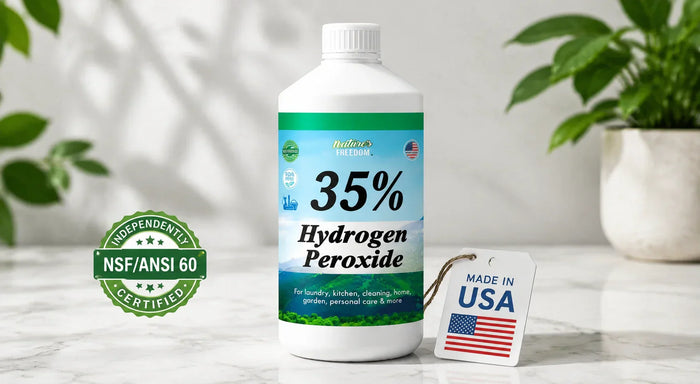
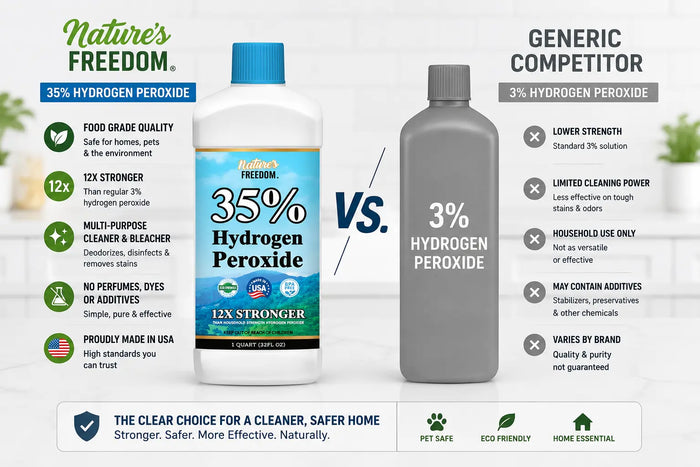
NSF-certified 35% H2O2 is residue-free, which matters specifically for shoe cleaning. Drugstore 3% hydrogen peroxide contains stabilizers such as acetanilide and phenol that leave trace residue on shoe fabric and rubber, attracting dirt over time. Nature’s Freedom 35% H2O2 contains no stabilizers, only pure H2O2 and water, independently verified to NSF/ANSI/CAN 60 and NSF/ANSI/CAN 50 standard.
One 32 fl oz bottle diluted to 3% produces more than ten spray bottles of cleaning solution.
What NSF certification means for shoe cleaning:
-
No stabilizer residue left on fabric or rubber after cleaning
-
Independently verified concentration, you know exactly what you are applying
-
Safe for food contact surfaces at correct dilution, which means safe for items your hands touch daily
-
Manufactured in the USA under NSF-audited conditions
-
Nature's Freedom 35% hydrogen peroxide is NSF Certified to NSF/ANSI/CAN 60 for drinking water treatment chemicals and NSF/ANSI/CAN 50 for pool, spa, hot tub, and other recreational water treatment chemical use.
Nature’s Freedom also produces a 45% concentrated vinegar, a powerful companion cleaner for descaling, weed control, and household surfaces.
Get Your Shoes Cleaner with Less Product
One bottle of Nature’s Freedom 35% hydrogen peroxide dilutes into a full season of shoe cleaning solution. NSF/ANSI/CAN 60 and NSF/ANSI/CAN 50 certified, stabilizer-free, and made in the USA. Shop concentrated hydrogen peroxide and put it to work across your shoes, surfaces, and laundry. Questions? Contact Nature’s Freedom.
Frequently Asked Questions About Cleaning Shoes with Hydrogen Peroxide
1. Does hydrogen peroxide actually clean shoes?
Yes. It breaks down organic stains, kills odor-causing bacteria, and reverses yellowing on white rubber and canvas through oxidation. Most effective on canvas, mesh, and rubber. Avoid on genuine leather and suede.
2. Will hydrogen peroxide bleach or damage colored shoes?
At 3% concentration, hydrogen peroxide is generally safe on white and light-colored canvas and mesh. On darker colors or synthetic leather, it can cause fading with extended contact time. Always spot-test a hidden area first. Avoid entirely on suede, nubuck, and genuine leather.
3. How long should hydrogen peroxide sit on shoes?
5 to 10 minutes for stain removal and disinfecting. 30 minutes for odor treatment before air drying. 3 to 4 hours in sunlight for the baking soda yellowing method. Extend contact time only on materials confirmed as compatible.
4. Is 35% hydrogen peroxide safe to use on shoes?
Only when diluted first. Mix 1 part 35% H2O2 with 10.7 parts water to reach 3% before applying to any shoe material. Wear nitrile gloves during preparation. Once diluted to 3%, it is safe for all compatible materials listed in the table above.
5. Can hydrogen peroxide remove yellow stains from white rubber soles?
Yes. Apply 3% H2O2 to yellowed soles, let sit for 10 minutes, then scrub with a soft brush. For severe yellowing, use the baking soda paste method with 3 to 4 hours of sunlight exposure. Results are typically visible after one to two treatments.
Key Takeaways
• Hydrogen peroxide breaks down organic stains, kills odor-causing bacteria, and reverses yellowing on white shoes through oxidation.
• Always dilute 35% H2O2 to 3% before use: 1 part H2O2 to 10.7 parts water. Wear nitrile gloves during preparation.
• Contact time: 5 to 10 minutes for stains, 30 minutes for odor, 3 to 4 hours for the baking soda yellowing method.
• Safe on canvas, mesh, and rubber. Avoid on genuine leather, suede, and nubuck, hydrogen peroxide will damage these materials.
• Nature's Freedom 35% H2O2 is NSF/ANSI/CAN 60 and NSF/ANSI/CAN 50 certified and stabilizer-free. One bottle yields more than ten spray bottles of 3% solution with no residue left on shoe fabric.
• Spot-test any uncertain material on a hidden area and wait 10 minutes before full application.