Outdoor Pet Odor FAQ: Top Questions Answered
Outdoor pet odor eliminator questions come up every day from pet owners dealing with smells that water and standard cleaners cannot fix. The answers are not complicated, but they require understanding what is actually causing the odor and why certain products work when others do not. This page covers 12 of the most frequently asked questions, organized by topic, with each answer grounded in how enzyme chemistry actually works, not marketing language.
TL;DR
This FAQ answers the most common questions pet owners have about outdoor pet odor eliminators: how they work, which surfaces they cover, how to apply them correctly, and why odors come back after rain. If you are dealing with persistent dog or cat urine odor in your yard, on artificial turf, or around your patio, this guide gives you direct answers based on how enzyme cleaners actually function.
The 12 questions in this guide
Outdoor pet odor, explained
What is an outdoor pet odor eliminator?
An outdoor pet odor eliminator is a cleaning product formulated to neutralize or eliminate pet urine and waste odors on exterior surfaces such as grass, artificial turf, concrete, patios, decks, and gravel. The most effective formulas use biological enzymes to break down the organic compounds in pet urine, including uric acid, urea, and ammonia, at a molecular level. Products that only mask odor with fragrance are not true odor eliminators.
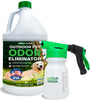
Nature's Freedom Outdoor Pet Urine Odor Remover is specifically formulated for outdoor surfaces and includes a hose-end sprayer for large-area coverage.
Why does pet urine smell worse outside than inside?
Outdoor surfaces concentrate and amplify pet urine odor for several reasons. Sunlight and heat cause ammonia compounds to volatilize faster, intensifying the smell on warm days. On porous surfaces like concrete and turf infill, uric acid crystals become embedded and cannot be removed by rinsing alone. In soil, urine compounds spread laterally and are reinforced by microbial activity in the ground. Rain reactivates dried crystals, releasing odor again.
Uric acid compounds in organic waste are particularly resistant to standard cleaning agents and require enzymatic action for effective degradation, which is the fundamental reason why enzyme cleaners outperform water and chemical deodorizers on outdoor surfaces.
Does water alone remove outdoor pet odor?
No. Water flushes surface debris and dilutes fresh urine, but it does not dissolve uric acid crystals or break down the ammonia-producing compounds responsible for persistent odor. In fact, rinsing with water can spread dried crystals to a wider area in soil or turf infill, extending the affected zone. Water is useful as a first step to remove solid waste and surface residue, but an enzyme cleaner is required to address the underlying odor compounds.
The chemistry behind the cleanup
What is the best outdoor pet odor eliminator?
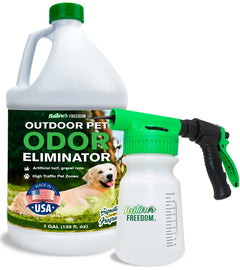
For outdoor use, the best pet odor eliminator combines a concentrated enzymatic formula with a hose-end sprayer for practical large-area coverage. Nature's Freedom Outdoor Pet Urine Odor Remover meets both criteria. The formula is tested for outdoor surface conditions including soil, turf infill, and porous concrete. The built-in hose-end sprayer makes treating an entire yard or dog run fast and even. The product is also pet-safe and plant-safe when used as directed.
Browse the full Pet Odor Eliminator collection for available sizes and outdoor cleaning options.
How does an enzyme cleaner remove pet odor?
Enzyme cleaners contain biological proteins, specifically proteases, urease, and lipases, that act as catalysts in the breakdown of organic compounds. When applied to a surface containing pet urine, these enzymes bind to uric acid crystals, urea molecules, and protein-based compounds and break them apart into odorless by-products: primarily carbon dioxide and water.
Most enzyme cleaners also contain beneficial bacteria that continue producing enzymes after application. This extends the cleaning action below the surface into soil or turf infill, reaching compounds that the initial application contacted but did not fully dissolve. The result is permanent odor elimination rather than temporary masking.
The EPA Safer Choice Program recognizes cleaning formulas that rely on biological rather than chemical action, a standard enzymatic cleaners are particularly well-suited to meet.
Safe around lawns, pets, and kids
Is outdoor pet odor eliminator safe for grass and plants?
A well-formulated outdoor enzyme cleaner is safe for natural grass, sod, and plants. Nature's Freedom Outdoor Pet Urine Odor Remover is confirmed plant-safe when used as directed. The enzymatic formula uses biological compounds that are compatible with soil ecosystems and do not leave chemical residues that harm root systems or surrounding vegetation.
Not all outdoor odor products are plant-safe. Bleach-based cleaners and high-pH chemical deodorizers can damage or kill grass and harm plant root systems. Always verify plant safety on the product label before applying any cleaner to areas with grass or landscaping.
Is outdoor pet odor eliminator safe for children and pets?
Nature's Freedom Outdoor Pet Urine Odor Remover is formulated to be pet-safe when used as directed. As a standard precaution, keep pets and children off the treated area until the product has dried completely. The ASPCA Animal Poison Control Center is the authoritative reference for verifying that any cleaning substance is safe in environments where animals are present.
Products containing bleach, strong acids, or synthetic fragrances are the most common sources of concern in outdoor pet cleaning. Enzymatic formulas avoid these ingredients by design.
How and how often to apply
How do I use a hose-end sprayer for pet odor removal?
A hose-end sprayer connects directly to a standard garden hose and dilutes the concentrated formula as water flows through. To use it effectively:
- Clear the area of solid waste and rinse loose debris before applying.
- Attach the hose-end sprayer to your garden hose and turn the water on to a moderate pressure.
- Apply the product in a slow, even pass across the affected area, overlapping slightly to ensure full coverage.
- Allow the formula to saturate through the surface; on grass or turf, this means soaking down to the root zone or infill layer.
- Leave the product undisturbed for a minimum of 10 to 15 minutes before rinsing.
- Rinse thoroughly with the hose after the dwell period is complete.
For severe or deeply embedded odors, a second application 24 to 48 hours after the first provides more complete coverage of residual uric acid crystals.
How often should I treat my yard for pet odor?
For households with one or two dogs using a yard regularly, an enzyme cleaning treatment every two to four weeks is a practical maintenance schedule. High-traffic zones such as designated toilet areas, dog runs, or gate areas may benefit from weekly treatment. Consistent outdoor routines, including designated areas and regular cleanup, reduce the surface area that requires regular treatment.
Between full treatments, rinsing high-use areas with water two to three times per week prevents uric acid from accumulating to a level that requires intensive remediation.
Where you can use it
Can I use outdoor enzyme cleaner on artificial turf?
Yes, and artificial turf is one of the most important use cases for outdoor enzyme cleaners. Pet urine on artificial turf settles into the infill layer below the fiber surface, where uric acid crystals accumulate and cannot be reached by rinsing alone. An enzyme cleaner with adequate concentration and saturation penetrates the infill and breaks down these crystals, eliminating the source of the odor rather than masking it.
Nature's Freedom Outdoor Pet Urine Odor Remover is compatible with both natural grass and artificial turf. The hose-end sprayer delivers the saturation depth needed to reach the infill layer in a single even pass.
What surfaces can outdoor pet odor eliminator be used on?
A well-formulated outdoor enzyme cleaner is compatible with a broad range of exterior surfaces:
- Natural grass and sod
- Artificial turf and synthetic grass
- Concrete and cement
- Pavers and stone patios
- Treated wood decks (check label for specific deck compatibility)
- Gravel and crushed stone
- Dog runs and kennel flooring
- Garden borders and soil areas
Always review the product label for any surface-specific restrictions. Nature's Freedom Outdoor Pet Urine Odor Remover is designed for the full range of common outdoor surfaces listed above.
For other concentrated cleaning needs across your home and outdoor areas, Nature's Freedom also offers hydrogen peroxide cleaners and the 35% Hydrogen Peroxide product for versatile household and surface cleaning applications.
Breaking the reactivation cycle
Why does outdoor pet odor come back after rain?
Rain introduces moisture to uric acid crystals in soil, turf infill, and porous surfaces. If those crystals have not been broken down by an enzyme cleaner, they reactivate and release ammonia-based odor again. This cycle repeats every time moisture or heat is applied to surfaces with untreated uric acid deposits.
The pattern of odor returning after rain is the most reliable indicator that the underlying compounds have not been addressed. Rinsing, fragrances, and chemical deodorizers do not dissolve uric acid crystals. Only enzyme cleaners with adequate concentration and dwell time accomplish this. After treating with an enzyme cleaner, the odor reactivation cycle stops because the source material no longer exists.
For step-by-step guidance on how to apply enzyme cleaner most effectively and prevent odors from returning, visit the Nature's Freedom blog for additional guides on outdoor odor control and concentrated natural cleaning.
Verified Sources
Key Takeaways
- Outdoor pet odor is caused by uric acid crystals and ammonia compounds that bind to porous surfaces and reactivate with moisture and heat.
- Water alone does not remove outdoor pet odor. Only enzyme cleaners with adequate concentration and dwell time dissolve uric acid at the molecular level.
- The best outdoor pet odor eliminator combines enzymatic chemistry with a hose-end sprayer for practical large-area coverage.
- Enzyme cleaners formulated for outdoor use are safe for grass, plants, pets, and children when used as directed.
- Odor returning after rain is the primary indicator that uric acid crystals have not been addressed. Enzymatic treatment breaks the reactivation cycle permanently.
- Preventive treatment every two to four weeks keeps outdoor odor from building to a level that requires intensive remediation.
Still have questions?
If your outdoor pet odor question was not covered above, the most direct next step is to try Nature's Freedom Outdoor Pet Urine Odor Remover on your specific surface. The concentrated enzymatic formula is designed for the full range of outdoor conditions, and the hose-end sprayer makes application practical at any scale, from a single patio spot to a full yard.
Explore the complete Pet Odor Eliminator lineup for available sizes and formats. For more guides on outdoor odor control, enzyme cleaners, and concentrated natural cleaning solutions, visit the Nature's Freedom blog.