Hydrogen Peroxide for Mold Removal: The Natural, Concentrated Solution
Mold on grout, tile, bathroom caulk, or basement walls resists most standard cleaners because surface-only treatment leaves the root structure intact. Bleach masks discoloration but does not penetrate porous materials deeply enough to destroy mold at the cellular level. Hydrogen peroxide works differently — it penetrates porous surfaces, releases active oxygen directly into the mold structure, and breaks it down from the inside without leaving toxic residue or harsh chemical fumes.
Nature's Freedom 35% food grade hydrogen peroxide is the professional-grade concentrate for effective mold and mildew treatment at home. Diluted to the correct working strength, it outperforms store-bought sprays and avoids the respiratory risks and surface damage that come with repeated chlorine bleach use.
Direct Answer
Hydrogen peroxide kills mold through oxidation — it penetrates porous surfaces, releases oxygen radicals directly into the mold structure, and breaks it down from the root, including spores and hyphae that allow regrowth. It leaves no chemical residue and produces no harmful fumes. Whether treating bathroom grout, basement concrete, or washing machine seals, dilute Nature's Freedom 35% food grade H₂O₂ to 3% for light mold or 6% for heavy growth, apply with a minimum 10-minute dwell time, scrub, and rinse. Nature's Freedom 35% food grade hydrogen peroxide is NSF Certified to NSF/ANSI/CAN 60 for drinking water treatment chemicals and NSF/ANSI/CAN 50 for pool, spa, hot tub, and other recreational water treatment chemical use.
This page covers the correct dilution ratios for every surface type, a step-by-step treatment process, and the safety guidance that applies to every mold removal application.
Why Hydrogen Peroxide Works for Mold Removal
Hydrogen peroxide kills mold through oxidation. When applied to a mold-affected surface, it releases oxygen radicals that penetrate and break down the cellular structure of mold and mildew — including the spores and hyphae that allow it to regrow. The reaction produces only water and oxygen as byproducts, leaving no chemical residue on the treated surface.
Research published in PubMed (NIH) confirms hydrogen peroxide as an effective antifungal agent against a broad range of mold species, including Aspergillus, Cladosporium, and Penicillium — among the most common household molds. Unlike bleach, which contains chlorine compounds that can irritate airways and degrade grout and caulk over time, hydrogen peroxide breaks down completely into water and oxygen after the reaction is complete.
Penetrates the Surface
Active oxygen soaks into porous grout, caulk, and concrete — reaching the root structure bleach cannot touch.
Releases Oxygen Radicals
Oxidation attacks the mold's cellular walls, spores, and hyphae directly — destroying it from the inside.
Breaks Down to Water + Oxygen
No chlorine residue, no chloramine byproducts, no lingering fumes. Just clean, treated surface.
Independently Verified Purity
Nature's Freedom 35% food grade hydrogen peroxide is NSF Certified to NSF/ANSI/CAN 60 for drinking water treatment chemicals and NSF/ANSI/CAN 50 for pool, spa, hot tub, and other recreational water treatment chemical use. That third-party certification provides independent purity verification that generic or stabilized alternatives do not carry — confirming concentration and purity on every batch.
Hydrogen Peroxide vs. Bleach for Mold
Both kill surface mold — but only one penetrates porous materials to destroy the root structure, and only one breaks down cleanly afterward. Here is how Nature's Freedom 35% food grade hydrogen peroxide compares to chlorine bleach across the factors that matter for mold.
| Factor | Hydrogen PeroxideNature's Freedom 35% | Chlorine Bleach |
|---|---|---|
| NSF/ANSI/CAN 60 + 50 Certification | ✓ NSF Certified to NSF/ANSI/CAN 60 (drinking water) and NSF/ANSI/CAN 50 (pool, spa & recreational water) treatment chemicals | ✗ No NSF/ANSI/CAN 60 or 50 certification |
| Penetrates porous surfaces | ✓ Yes — reaches mold root structure | ✗ Surface only on porous materials |
| Fumes and odor | ✓ None at working concentration | ✗ Strong chlorine fumes; ventilation required |
| Residue after use | ✓ None — breaks down to water and oxygen | ✗ Chlorine residue remains on surface |
| Safe on grout and caulk | ✓ Yes — does not degrade material | ✗ Degrades caulk and grout with repeated use |
| Safe on colored surfaces | ✓ Yes at 3%; spot test at 6%+ | ✗ Bleaches and discolors many surfaces |
| Kills mold spores | ✓ Yes — antifungal at 3–6% | Kills surface spores; may miss root growth |
| Safe after drying | ✓ Yes — no residual chemicals | ✗ Chlorine residue; keep children away until dry |
Ready to treat mold without bleach?
Nature's Freedom 35% food grade hydrogen peroxide — NSF certified, made in the USA, COA with every order. One bottle dilutes into gallons of working solution.
Hydrogen Peroxide Mold Removal: Concentration Guide
The correct concentration depends on the severity of mold growth and the surface type. Start at 3% for light surface mold and increase to 6% for heavy or deeply embedded growth. Do not exceed 6% on painted or delicate surfaces without spot testing first. All ratios below are calculated from 35% food grade concentrate.
| Mold Type / Surface | Target | Mix from 35% | Application Notes |
|---|---|---|---|
| Light surface mold — tile & sinks | 3% | 1 : 11 | Spray on, 10 min dwell, scrub, rinse. |
| Grout lines — bathroom & kitchen | 3–6% | 1:11 to 1:5 | Apply with a brush directly into grout; 15–20 min dwell. |
| Caulk & silicone seals | 3% | 1 : 11 | Spray and leave; do not scrub caulk aggressively. |
| Hard non-porous walls & surfaces | 3–6% | 1:11 to 1:5 | Spray on, 10–15 min dwell, wipe, allow to air dry. |
| Heavy mold — basement concrete | 6% | 1 : 5 | Apply generously; allow 20 min dwell; scrub and rinse. |
| Washing machine drum seals | 3% | 1 : 11 | Apply to gasket, leave 10 min, wipe clean. |
| HVAC drip pans & coil surfaces | 3% | 1 : 11 | Spray on coils and drip pans; 5–10 min dwell; rinse off. |
For tile, sinks, caulk, washing machine seals, and HVAC drip pans — everyday surface mold and mildew.
-
1Measure 458 ml (15.5 fl oz) water into your spray bottle
-
2Add 42 ml (1.4 fl oz) of 35% H₂O₂ — concentrate into water
-
3Spray to saturate, dwell 10 minutes, scrub, then rinse
For heavy mold on grout lines, basement concrete, and deeply embedded growth. Spot test colored surfaces first.
-
1Measure 415 ml (14 fl oz) water into your spray bottle
-
2Add 85 ml (2.9 fl oz) of 35% H₂O₂ — concentrate into water
-
3Apply generously, dwell 15–20 minutes, scrub, rinse
How to Remove Mold with Hydrogen Peroxide
Follow these steps for every mold treatment application. The process is the same whether you are treating bathroom grout, basement walls, or kitchen tile.
-
1
Put On Gloves and Eye Protection
Wear nitrile or chemical-resistant gloves and eye protection when mixing and applying hydrogen peroxide. The diluted 3–6% working solution is far safer than bleach, but direct skin and eye contact should still be avoided.
⚠ PPE first — before you mix -
2
Prepare the Diluted Solution
Add 1 part 35% H₂O₂ to 11 parts water for a 3% solution, or 1 part to 5 parts water for a 6% solution. Always add the concentrate to the water, not the reverse. Pour into a clean spray bottle.
📊 See the concentration guide above for the right strength per surface -
3
Ventilate the Area
Open windows and doors before applying the solution. Hydrogen peroxide produces no harmful fumes at working concentrations, but good ventilation speeds drying and improves results.
-
4
Spray the Affected Surface Generously
Apply enough solution to fully saturate the mold-affected area. Do not wipe immediately. The dwell time is critical — the solution needs time to penetrate and oxidize the mold structure.
-
5
Allow Full Dwell Time
Leave the solution in contact for a minimum of 10 minutes for light mold. For heavy mold in grout or on concrete, extend the dwell time to 15–20 minutes. Do not let the surface dry out during this period — reapply if needed.
⏱ Dwell time is the single most important step — do not rinse early -
6
Scrub Thoroughly
Use a stiff-bristle brush on grout and hard surfaces. A softer brush or cloth is appropriate for caulk and painted surfaces. Scrubbing dislodges the broken-down mold structure from the surface.
-
7
Rinse and Dry Completely
Rinse with clean water and dry the surface as completely as possible. Mold regrows where moisture remains. Eliminate the moisture source after treatment — improve ventilation, fix leaks, or use a dehumidifier to prevent recurrence.
💡 Treat the moisture source, not just the mold
Get the concentrate the pros use
Shop Nature's Freedom 35% food grade hydrogen peroxide in the hydrogen peroxide collection — 32 fl oz and 1 gallon, with COA and SDS on every order.
Is Hydrogen Peroxide Safe for Mold Removal?
Yes. At 3–6% concentration, hydrogen peroxide certified to NSF/ANSI/CAN 60 and NSF/ANSI/CAN 50 is significantly safer for both the user and the treated surface than chlorine bleach. It produces no chlorine fumes, no chloramine byproducts, and no residual chemical contamination after the reaction is complete.
The CDC mold resources recommend treating small mold-affected areas (under 10 square feet) yourself using appropriate cleaning agents and PPE. Hydrogen peroxide meets that guidance as an effective, documented antifungal agent. For mold coverage exceeding 10 square feet, or for mold that recurs persistently despite treatment, the CDC recommends professional remediation assessment.
✅ Appropriate For
- ✓Surface mold on hard, non-porous materials
- ✓Tile, grout, and bathroom caulk
- ✓Sealed concrete and basement walls
- ✓Metal and glass surfaces
- ✓Washing machine seals & HVAC drip pans
⚠️ Call a Professional Instead
- ✗Mold growth inside walls, in insulation, or behind drywall
- ✗Mold coverage exceeding 10 square feet in a single area
- ✗Mold resulting from sewage or contaminated water
- ✗Any black mold (Stachybotrys) or persistent respiratory symptoms
For structural or extensive mold problems, consult the EPA mold cleanup guidance before beginning any remediation work.
Handling Rules — Every Time
-
🧤Always dilute the 35% concentrate before use, and always add concentrate to water — never the reverse. Wear nitrile gloves and eye protection when measuring.
-
❌Never mix with bleach. Combining hydrogen peroxide with chlorine bleach is dangerous. Treat one or the other — never both together.
-
🍷Do not combine directly with vinegar. The mixture produces peracetic acid, corrosive at higher concentrations. Use them sequentially with a rinse in between (see FAQ).
-
🔥Store away from heat, light, and flammables. Keep concentrate in its original vented-cap bottle in a cool, dark place out of reach of children.
Nature's Freedom 35% Food Grade Hydrogen Peroxide
The professional-grade concentrate behind every dilution on this page. Made in the USA. NSF Certified. COA and SDS with every order. Ships to all 50 US states. One bottle of 35% concentrate dilutes into many gallons of working solution — far more cost-effective than store-bought 3% sprays.
Choose Your Size
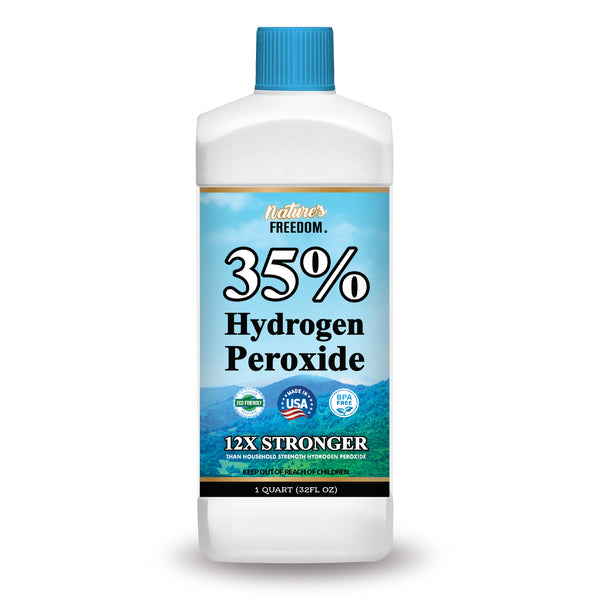
- ✓Makes ~3 gallons of 3% mold spray
- ✓Ideal for bathrooms & routine treatment
- ✓NSF Certified · COA + SDS included
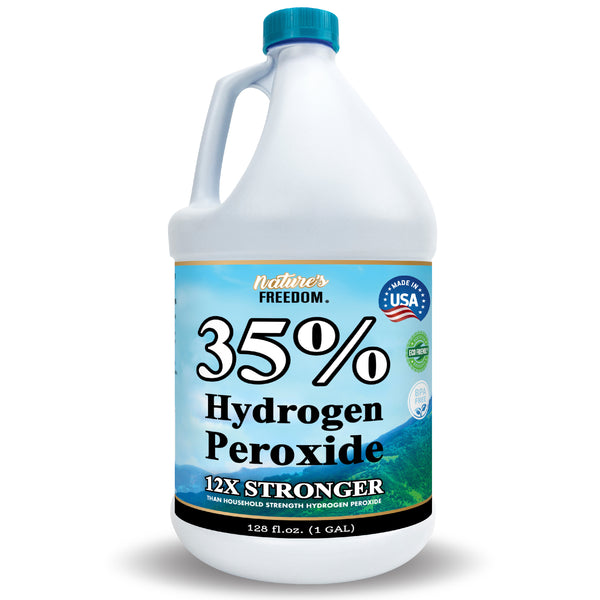
- ✓Makes ~12 gallons of 3% mold spray
- ✓Best for basements & whole-home use
- ✓Lowest cost per ounce · Free shipping
30-Day Money-Back
Not satisfied? Full refund within 30 days.
NSF Certified
Third-party verified purity on every batch.
COA + SDS
Documentation in every single order.
Free Shipping $49+
Ships to all 50 US states.
Frequently Asked Questions
Does hydrogen peroxide kill mold or just bleach it?+
It kills it. Hydrogen peroxide works through oxidation — it releases oxygen radicals that penetrate and destroy the cellular structure of mold, including the hyphae (root-like structures) and spores that allow mold to regrow. Chlorine bleach whitens the surface appearance of mold without fully penetrating porous materials, which is why mold often returns quickly after bleach treatment on grout and caulk.
How long do I leave hydrogen peroxide on mold?+
A minimum of 10 minutes for light surface mold at 3%. For heavier mold on grout, concrete, or deeply stained surfaces, extend the dwell time to 15–20 minutes. Keep the surface saturated throughout. If the solution dries before the dwell time is complete, reapply and restart the timer. Do not rinse early.
What concentration should I use for black mold?+
For surface black mold on hard, non-porous materials, use a 6% concentration (1 part 35% H₂O₂ to 5 parts water). Apply, allow 15–20 minutes dwell time, scrub thoroughly, and rinse. Black mold (Stachybotrys chartarum) is more commonly found in structural or hidden locations where professional remediation is required. If you suspect black mold beyond visible surface growth, consult the EPA mold cleanup guidance before treating independently.
Will mold come back after hydrogen peroxide treatment?+
Mold will return if the moisture source is not eliminated. Hydrogen peroxide kills the mold present at the time of treatment, but it does not create a residual barrier that prevents regrowth. After treating, address the underlying cause — improve ventilation, fix water leaks, reduce humidity with a dehumidifier, and ensure surfaces dry completely after exposure to moisture.
Can I use this alongside your vinegar product for mold?+
Do not mix hydrogen peroxide and vinegar directly together in the same solution. The combination produces peracetic acid, which is corrosive at higher concentrations. You can use them sequentially: apply the vinegar first, allow it to dwell and act on the mold, rinse thoroughly, then apply hydrogen peroxide as a follow-up treatment. Browse Nature's Freedom 45% concentrated vinegar in the concentrated vinegar collection.
Is Nature's Freedom hydrogen peroxide NSF certified?+
Yes. Nature's Freedom 35% food grade hydrogen peroxide is NSF Certified to NSF/ANSI/CAN 60 for drinking water treatment chemicals and NSF/ANSI/CAN 50 for pool, spa, hot tub, and other recreational water treatment chemical use. This certification is independently verified by a third party and confirms purity and concentration on every batch. The COA and Safety Data Sheet (SDS) are included with every order.
Key Takeaways
- NSF Certified to NSF/ANSI/CAN 60 + 50 — independently verified purity on every batch; no bleach-based mold treatment carries equivalent third-party documentation
- Hydrogen peroxide kills mold through oxidation — it penetrates porous surfaces and destroys mold structure and spores, unlike bleach which primarily whitens the surface
- Use 3% for light mold and 6% for heavy or embedded growth — dilute 35% H₂O₂ at 1:11 for 3% or 1:5 for 6%
- Dwell time is critical — leave the solution on for a minimum of 10 minutes; extend to 15–20 minutes for grout, concrete, and heavy growth
- Treat the moisture source, not just the mold — hydrogen peroxide kills existing mold but does not prevent regrowth; fix leaks, improve ventilation, and reduce humidity
Made in the USA · COA and SDS with every order · Ships to all 50 US states · Browse the full hydrogen peroxide collection · 45% concentrated vinegar