
Hydrogen Peroxide for Pools:
The Natural, Concentrated Solution
Sanitize your pool without chlorine. Hydrogen peroxide controls bacteria, algae, and organic waste through oxidation — no chloramines, no fumes, no bleaching of swimwear or liners. Nature's Freedom food grade H₂O₂ is NSF Certified to NSF/ANSI/CAN 60 and NSF/ANSI/CAN 50, the independent third-party standard for pool chemical purity. Available as concentrated 35% or ready-to-use 12% pool shock.
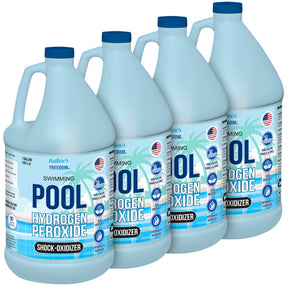
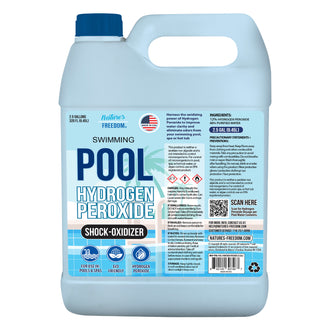
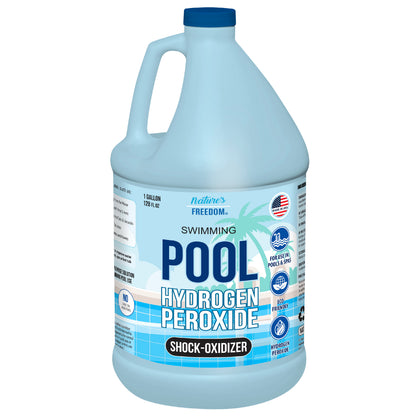
Hydrogen peroxide for pools is a non-chlorine sanitizing system that works through oxidation, maintaining 30-50 ppm H₂O₂ in pool water to control bacteria, algae, and organic waste. It produces only water and oxygen as byproducts — no chloramines, no fumes, no bleaching of swimwear or liners. Nature's Freedom 35% food grade hydrogen peroxide is NSF Certified to NSF/ANSI/CAN 60 for drinking water treatment chemicals and NSF/ANSI/CAN 50 for pool, spa, hot tub, and other recreational water treatment chemical use, the independent third-party standard for pool chemical purity. It is the professional-grade starting point for any chlorine-free pool system.
Why Hydrogen Peroxide for Pools Works
This page covers why hydrogen peroxide works for pool treatment, the correct dosing framework, how to switch from chlorine, and the safety rules that apply when maintaining an H₂O₂ pool.
Hydrogen peroxide (H₂O₂) sanitizes pool water through oxidation. It releases active oxygen that breaks down bacteria, algae, and organic waste on contact. The reaction produces only water and oxygen as byproducts — no chlorine smell, no chloramines, no skin drying, and no bleaching of swimwear or pool liners.
Research published in PubMed (NIH) confirms that hydrogen peroxide demonstrates broad-spectrum antimicrobial effectiveness across the pathogens relevant to recreational water, including bacteria, viruses, and algae. For pool owners looking for a documented, effective alternative to chlorine, the evidence base is solid.
Key Advantages Over Chlorine
Nature's Freedom hydrogen peroxide is NSF Certified to NSF/ANSI/CAN 60 for drinking water treatment chemicals and NSF/ANSI/CAN 50 for pool, spa, hot tub, and other recreational water treatment chemical use — independently verified for pool chemical purity. No chlorine-based pool sanitizer carries equivalent third-party certification documentation.
| Feature | H₂O₂ — Nature's Freedom | Chlorine Treatment |
|---|---|---|
| Eye and skin irritation | ✓ None at working PPM | ✗ Causes irritation from chloramines |
| Chemical smell | ✓ Odorless after treatment | ✗ Persistent chlorine smell |
| Swimwear fabric damage | ✓ No bleaching effect | ✗ Degrades elastic and color over time |
| Byproducts produced | ✓ Water + oxygen only | ✗ Chloramines, trihalomethanes |
| Algae control | ✓ Effective at 30-100 PPM | ✓ Effective |
| Works indoors | ✓ No ventilation required | ✗ Fumes require ventilation |
| Safe for vinyl liners | ✓ Fully compatible | ✓ Compatible at correct levels |
| Safe for fiberglass | ✓ No surface degradation | ✓ Compatible |
| pH impact | ✓ Minimal at working levels | ✗ Significant — requires ongoing adjustment |
| NSF certified | ✓ NSF/ANSI/CAN 60 + 50 | ✗ No equivalent third-party cert |
Key Advantages Over Chlorine
NSF Certified — Third-Party Verified
NSF Certified to NSF/ANSI/CAN 60 for drinking water treatment chemicals and NSF/ANSI/CAN 50 for pool, spa, hot tub, and other recreational water treatment chemical use. Independently verified for pool chemical purity — no chlorine-based sanitizer carries equivalent documentation.
No Chloramines
Chlorine reacts with organic matter to produce chloramines — the compounds responsible for eye irritation, strong smell, and respiratory discomfort. Hydrogen peroxide produces no chloramine byproducts.
No Bleaching
Hydrogen peroxide at pool treatment concentrations does not bleach swimwear, hair, or pool liners the way chlorine shock does.
No Fumes
Chlorine off-gasses in warm pool water, producing fumes that irritate lungs and skin. Hydrogen peroxide is odorless at pool treatment concentrations.
Safer for Sensitive Skin
Pool owners with eczema, sensitive skin, or respiratory conditions consistently report significantly better tolerance with H₂O₂-treated pools.
Environmentally Friendlier
The EPA List N recognizes hydrogen peroxide as an effective antimicrobial agent. It decomposes to water and oxygen, leaving no persistent chemical residue.
Ready to switch? Shop Nature's Freedom 35% food grade hydrogen peroxide, or choose the ready-to-use 12% Pool & Spa shock.
How Hydrogen Peroxide Pool Treatment Works
Hydrogen peroxide works as a standalone pool sanitizer when maintained at the correct concentration in the water. The target range for a residential pool is 30-50 ppm (parts per million). Below 30 ppm, the sanitizing effect becomes unreliable. Above 100 ppm, the water becomes irritating to eyes and skin.
The Critical Rule: Never Mix with Chlorine
This is the most important technical point for anyone switching from chlorine to hydrogen peroxide. The two sanitizers neutralize each other on contact. Adding hydrogen peroxide to a chlorinated pool does not produce a sanitizing effect — it simply destroys both chemicals simultaneously, leaving the pool unprotected.
Before introducing hydrogen peroxide to an existing chlorinated pool, the chlorine level must be reduced to zero. This typically takes 7-14 days of regular use without adding chlorine, or can be accelerated using a sodium thiosulfate dechlorinator. Test chlorine levels at zero before adding any H₂O₂.
Maintenance Frequency
Hydrogen peroxide degrades faster than chlorine, particularly in warm water and direct sunlight. UV light is the primary driver of H₂O₂ breakdown in outdoor pools. Test H₂O₂ levels every 2-3 days and top up when the reading drops below 30 ppm. Indoor pools and spas require less frequent testing but the same maintenance discipline.
Works in Every Water Environment
How to Switch Your Pool from Chlorine to Hydrogen Peroxide
-
1
Stop adding chlorine
Cease all chlorine additions — tablets, liquid, or granular — and allow existing chlorine to deplete naturally through regular pool use and sunlight. This typically takes 7-14 days.
-
2
Test chlorine levels to zero
Before adding any hydrogen peroxide, confirm chlorine reads zero on a test strip or kit. Residual chlorine will neutralize the H₂O₂ on contact.
⚠ Critical — chlorine must read zero before adding any H₂O₂ -
3
Clean the pool thoroughly
Brush walls and floor, vacuum debris, clean filters, and backwash as needed. Starting with a clean pool reduces the organic load that H₂O₂ must work against.
-
4
Calculate your initial dose
Use the pool calculator to determine the exact volume of 35% H₂O₂ needed to reach 50 ppm in your pool.
-
5
Add H₂O₂ to the pool with the pump running
Pour the measured dose around the perimeter of the pool with the circulation pump running at full speed. This ensures even distribution throughout the water.
-
6
Test after 24 hours
Check H₂O₂ levels and confirm the reading is in the 30-50 ppm maintenance range before swimming.
-
7
Maintain the level
Test every 2-3 days and top up when the reading drops below 30 ppm. Use the pool calculator for each top-up dose based on current level and pool volume.
📈 UV light accelerates breakdown — outdoor pools need testing every 2-3 days
Safe Handling Reminder
Concentrated hydrogen peroxide is a strong oxidizer. Wear chemical-resistant gloves and eye protection when pouring concentrate. Never mix with chlorine — the two neutralize each other and chlorine must read zero before adding H₂O₂. Store in the original vented-cap bottle away from heat, sunlight, and flammable materials. Ships as UN2014 with full DOT compliance documentation; SDS included with every order.
Hydrogen Peroxide Pool Treatment: Concentration Guide
The correct dose depends on your pool volume and current H₂O₂ level. Use the hydrogen peroxide pool calculator for a precise volume-based calculation. The table below gives the general application framework.
| Application | Target H₂O₂ | Testing Frequency | Initial Dose | Notes |
|---|---|---|---|---|
| Residential pool — initial dose | 50 ppm | Test after 24 hours | Use pool calculator | Add with pump running at full speed around pool perimeter. |
| Residential pool — maintenance | 30-50 ppm | Every 2-3 days | Top up when below 30 ppm | Use pool calculator for each top-up dose. |
| Hot tub / spa | 50-100 ppm | Every 2-3 days | Use pool calculator | Higher temp accelerates breakdown; test more frequently. |
| Algae treatment — shock dose | 100-200 ppm | Test after 24 hours | Use pool calculator for exact dose | Avoid pool use until level drops below 100 ppm. |
| Pool filter cleaning | 3% solution | Per filter cycle | — | Browse the pool and spa filter cleaner collection. |
Is Hydrogen Peroxide Safe for Swimming Pools?
Yes. At the correct maintenance concentration of 30-50 ppm, NSF certified hydrogen peroxide is safe for swimmers. At this level it is less irritating to eyes and skin than chlorine. The water is safe to swim in once the H₂O₂ level is within the maintenance range.
When to Stay Out of the Pool
Do not swim when H₂O₂ levels exceed 100 ppm. Above this threshold, the solution becomes irritating to eyes, skin, and mucous membranes. After a shock treatment at 100-200 ppm, wait until the level returns to below 100 ppm. This typically takes 24-48 hours depending on sunlight and temperature.
Per CDC NIOSH chemical safety data, concentrations above 8% (80,000 ppm) are classified as hazardous. Pool treatment concentrations of 30-100 ppm are well below any hazard threshold when swimmers are present.
Pool H₂O₂ Dosing Calculator
Chlorine vs. Hydrogen Peroxide
Tap each option to see how a typical swim day actually feels — the difference is in what you don't get with hydrogen peroxide.
See the Difference
Switch between sanitizers to compare the swimmer experience
Ready to Switch Your Pool?
12% H₂O₂ non-chlorine shock — on sale now, save 14%. NSF Certified (NSF/ANSI/CAN 60 + 50), made in the USA, ships to all 50 states.
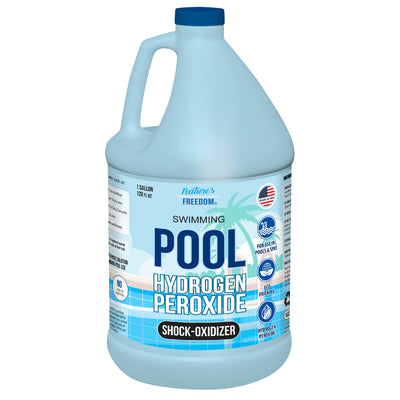
12% Hydrogen Peroxide — Pool & Spa Grade
All three sizes are the same NSF Certified 12% formula — NSF/ANSI/CAN 60 + 50. Choose the volume that fits your pool and usage frequency, or step up to 35% food grade concentrate to dilute your own.
 Sale — Save 14%
 Sale — Save 14%
 Best Value
Hydrogen Peroxide for Pools — FAQ
How much hydrogen peroxide do I add to my pool?+
The correct dose depends on your pool volume and current H₂O₂ level. To reach 50 ppm in a 10,000-gallon pool starting from zero, you need approximately 1.25 gallons of 35% hydrogen peroxide. For a precise calculation based on your specific pool volume and current reading, use the hydrogen peroxide pool calculator.
Can I use hydrogen peroxide with a saltwater pool?+
Not simultaneously. Saltwater pools use electrolysis to generate chlorine from salt, which means the water still contains chlorine. Adding hydrogen peroxide to a saltwater pool neutralizes both the generated chlorine and the H₂O₂. If you want to switch a saltwater pool to a hydrogen peroxide system, the salt chlorinator must be turned off and the chlorine level must reach zero before introducing H₂O₂.
How often do I need to test and top up?+
Outdoor pools in direct sunlight require testing every 2-3 days. UV light is the primary cause of H₂O₂ breakdown in outdoor water. Indoor pools and spas maintain levels more consistently but should still be tested every 3-4 days. Top up whenever the reading drops below 30 ppm.
Will hydrogen peroxide clear a green algae pool?+
Yes. A shock dose of 100-200 ppm will kill green algae and clear the water within 24-48 hours. Brush pool surfaces first to loosen algae from walls and floor. After treating, run the filter continuously and backwash when pressure rises. Do not allow swimmers until the H₂O₂ level drops below 100 ppm.
What size bottle do I need for a residential pool?+
For most residential pools of 10,000-20,000 gallons, a gallon size is the most practical for ongoing maintenance. Nature's Freedom offers a ready-to-use 12% Pool & Spa non-chlorine shock in 1, 2.5, and 4 gallon sizes, and a 35% food grade gallon concentrate for those who prefer to dilute. Larger sizes reduce the cost per dose. For the full range, browse the pool and spa filter cleaner collection.
Is Nature's Freedom hydrogen peroxide NSF certified for pool use?+
Yes. Nature's Freedom food grade hydrogen peroxide is NSF Certified to NSF/ANSI/CAN 60 for drinking water treatment chemicals and NSF/ANSI/CAN 50 for pool, spa, hot tub, and other recreational water treatment chemical use. NSF certification is independently verified by a third party and confirms purity and concentration on every batch. No chlorine-based pool sanitizer carries equivalent third-party documentation. The COA and SDS are included with every order.
Key Takeaways
- NSF Certified to NSF/ANSI/CAN 60 for drinking water treatment chemicals and NSF/ANSI/CAN 50 for pool, spa, hot tub, and other recreational water treatment chemical use — independently verified purity standard; no chlorine-based pool sanitizer carries equivalent third-party documentation
- Hydrogen peroxide sanitizes pools at 30-50 ppm through oxidation, producing only water and oxygen as byproducts — no chloramines, no fumes, no bleaching of swimwear or liners
- Never mix hydrogen peroxide with chlorine — they neutralize each other on contact; chlorine must read zero before adding H₂O₂ to any pool
- Test every 2-3 days for outdoor pools — UV light accelerates H₂O₂ breakdown; top up whenever the reading drops below 30 ppm
- A shock dose of 100-200 ppm clears algae within 24-48 hours; avoid swimming until the level returns below 100 ppm
- Use the pool calculator for every dose — the correct volume depends on your specific pool size and current H₂O₂ reading
- Shop Nature's Freedom food grade hydrogen peroxide in the hydrogen peroxide collection — available in 32 fl oz and 1 gallon with COA and SDS on every order
Made in the USA. NSF Certified to NSF/ANSI/CAN 60 for drinking water treatment chemicals and NSF/ANSI/CAN 50 for pool, spa, hot tub, and other recreational water treatment chemical use. COA and SDS with every order. Ships to all 50 US states. Also browse pool filter cleaners.